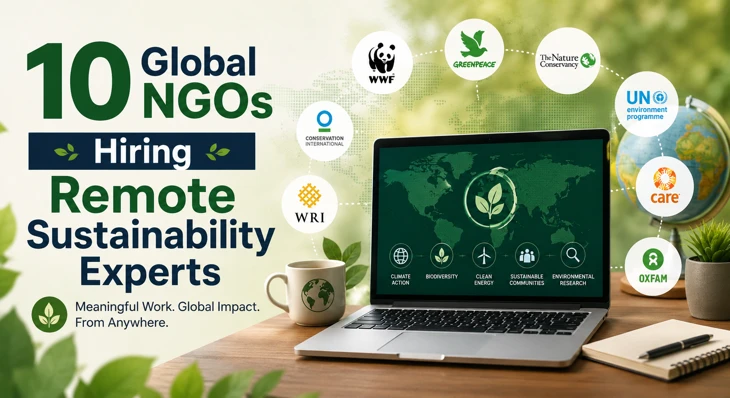
10 Global NGOs Hiring Remote Sustainability Experts
Introduction
Sustainability has stopped being a background discussion. It’s now part of how governments, businesses, and communities make real decisions every day. Whether it’s cutting emissions, protecting forests, or building cleaner cities, the demand for people who understand environmental systems is rising fast.
What’s changed even more in recent years is
how this work happens. You don’t always need to be in the field or sitting inside a headquarters anymore. A growing number of NGOs hiring remote sustainability experts are now building global teams that work across time zones, cultures, and continents.
That shift has quietly opened a new kind of career path—one where someone in one country can help shape climate policy in another, or support conservation projects happening thousands of miles away. It’s practical, it’s flexible, and for many professionals, it feels more meaningful than traditional roles.
If you’ve been exploring remote sustainability jobs, ESG remote jobs, or even work-from-home sustainability roles, you’re already looking in the right direction. The opportunities are real, and they’re expanding every year.
In this article, we’ll walk through 10 global NGOs where sustainability work is often done remotely, what kinds of roles exist, and how professionals typically fit into these organizations.
Why Remote Sustainability Work Is Expanding So Quickly
A few years ago, most sustainability roles were tied to fieldwork, travel, or office-based research. That model is still important, but it’s no longer the only way things operate.
One big reason is data. Environmental work today relies heavily on digital tools—satellite imagery, carbon tracking platforms, climate databases, and modeling software. Much of this can be analyzed from anywhere, which naturally supports sustainable remote careers.
Another reason is scale. NGOs are dealing with global problems that can’t be solved locally. Climate change doesn’t respect borders, so hiring talent shouldn’t either. That’s why organizations are increasingly open to remote sustainability professionals who bring niche skills, even if they’re halfway across the world.
And finally, there’s flexibility. Remote work allows NGOs to allocate more of their budget directly into programs rather than overhead costs. That means more funding for conservation, education, and climate resilience projects.
10 Global NGOs Where Remote Sustainability Roles Are Common
Instead of thinking of these as just employers, it’s better to see them as mission-driven ecosystems. Each one focuses on a slightly different piece of the sustainability puzzle.
World Wildlife Fund (WWF)
WWF is one of those organizations almost everyone recognizes. Their work focuses on protecting biodiversity, ecosystems, and endangered species across the globe.
Remote contributors often support research-heavy tasks. For example, someone might analyze changes in forest cover using satellite data or help assess the environmental impact of conservation programs. It’s not always fieldwork—much of it is strategic and data-driven.
Greenpeace International
Greenpeace takes a more activist approach to environmental change. Their campaigns often push governments and corporations toward cleaner energy and better environmental policies.
Remote professionals here may spend their time digging into climate policy reports, preparing communication materials, or supporting global campaigns with research-backed insights. It’s a mix of analysis and storytelling.
Conservation International
This organization focuses on the idea that protecting nature also protects human well-being. Their projects often sit at the intersection of science, policy, and local community needs.
Remote sustainability experts might work on ecosystem modeling, environmental risk analysis, or GIS mapping. A lot of the work feeds directly into field decisions, even if it’s done from a laptop.
The Nature Conservancy
The Nature Conservancy works on large-scale environmental restoration—forests, oceans, wetlands, and freshwater systems.
Remote roles can include carbon accounting, land-use analysis, and sustainability planning. A typical project might involve reviewing environmental data to guide investment decisions for conservation areas.
UN Environment Program (UNEP) Partners
The UNEP network includes several partner organizations that frequently collaborate on global sustainability programs.
Remote professionals often support policy development, climate adaptation planning, and sustainable urban development projects. These roles usually involve working across multiple countries and coordinating with different institutions.
World Resources Institute (WRI)
WRI is heavily research-oriented and known for producing influential climate reports and data tools used worldwide.
Remote experts here often work with large datasets—tracking emissions trends, analyzing energy systems, or studying urban sustainability. It’s one of the more technical environments in the sustainability space.
Climate Group
The Climate Group focuses on accelerating climate action through partnerships with businesses and governments.
Remote sustainability professionals may help design net-zero strategies, analyze clean energy transitions, or support corporate sustainability programs. Collaboration is a big part of the job.
CARE International
CARE is best known for humanitarian work, but sustainability is deeply embedded in many of its programs.
Remote roles often focus on agriculture resilience, water systems, and livelihood development in climate-affected regions. The emphasis is usually on long-term community impact.
Oxfam International
Oxfam works on inequality and poverty, with sustainability playing a major role in its global advocacy efforts.
Remote professionals may be involved in climate justice research, ethical supply chain analysis, or policy recommendations. The work often connects environmental issues with social outcomes.
Rainforest Alliance
Rainforest Alliance is widely known for its certification programs in sustainable agriculture and forestry.
Remote roles here often involve reviewing supply chain practices, supporting certification systems, and ensuring environmental compliance across global producers.
Skills That Matter More Than Titles
One thing that becomes clear in this space is that job titles vary, but skill sets overlap.
Technical ability is important—things like data analysis, ESG reporting frameworks, carbon accounting, and sometimes GIS tools. But equally important is how you think through problems.
Most NGOs value people who can interpret complex environmental data and turn it into something useful for decision-making. That could mean a report, a strategy, or even a recommendation for field teams.
Communication also matters more than people expect. Remote sustainability work is collaborative, often across cultures and time zones, so clarity becomes essential.
How People Usually Break Into Remote NGO Sustainability Careers
There isn’t one fixed path into this field, which is actually good news.
Some professionals start with degrees in environmental science. Others come from data analytics, policy research, or even engineering backgrounds. What connects them is a demonstrated interest in sustainability and some practical exposure—projects, internships, or freelance research.
A strong portfolio helps a lot. Instead of only listing skills, showing actual work—like a climate report, a small research project, or a data analysis case study—can make a real difference.
Networking also plays a role, especially in NGO spaces. Many opportunities are shared through professional communities, webinars, or sustainability forums rather than traditional job boards alone.
A Simple Example of What Remote Sustainability Work Looks Like
Picture this: a sustainability analyst working remotely for a conservation NGO wakes up and starts their day reviewing satellite data showing forest changes in a protected region.
Later, they join a virtual call with field researchers on another continent to discuss what the data might mean on the ground. By the afternoon, they’re preparing a short report to guide funding decisions for conservation projects.
No two days look exactly the same, but the impact is very real.
FAQs
Can remote sustainability jobs be done without a science background?
Yes. Many NGOs hire people with backgrounds in business, engineering, policy, and data if they have relevant skills or experience.
Are these roles usually full-time or contract-based?
Both exist. Some are long-term positions, while others are project-based consulting roles.
Do remote NGO jobs pay well?
Compensation varies widely depending on experience, region, and role type, but international NGOs generally follow structured pay systems.
What is the best entry point for beginners?
Internships, fellowships, and research assistant roles are often the easiest way in.
Is remote sustainability work stable as a career?
Yes, demand is growing steadily as more organizations shift toward climate-focused programs and global collaboration models.
Conclusion
Remote sustainability work is no longer a niche idea—it’s becoming a core part of how global environmental efforts are organized. NGOs hiring remote sustainability experts are building teams that reflect the scale of the challenges they’re trying to solve.
For professionals, this opens a path that blends flexibility with purpose. Whether you’re just starting out or shifting careers, there’s real opportunity in this space if you build the right mix of skills and experience.
The direction is clear: sustainability work is becoming more global, more digital, and more collaborative. And remote roles are right at the center of that shift.