📚 Table of Contents
- Electric Mobility and the Changing Face of Global Employment
- New Wave of Opportunities in EV Manufacturing Jobs
- Battery Technology Jobs Driving the Core of the Industry
- Charging Infrastructure Jobs Expanding Across Cities
- Software, AI, and the Smart Mobility Revolution
- Renewable Energy and Its Link to Electric Mobility Jobs
- Recycling and the Rise of Circular Economy Careers
- Indirect Job Creation That Often Goes Unnoticed
- Skills That Are Becoming More Valuable Than Ever
- Real-World Impact Across Different Countries
- Challenges That Still Need Attention
- The Future of Electric Mobility Jobs
- Conclusion
- FAQs
- 1. How does electric mobility help in job creation?
- 2. Which jobs are growing fastest in the EV industry?
- 3. Is electric mobility a stable career option?
- 4. What skills are needed for electric mobility jobs?
- 5. Does electric mobility replace traditional automotive jobs?
- 6. Why is electric mobility important for the future job market?
The Role of Electric Mobility in Job Creation Worldwide
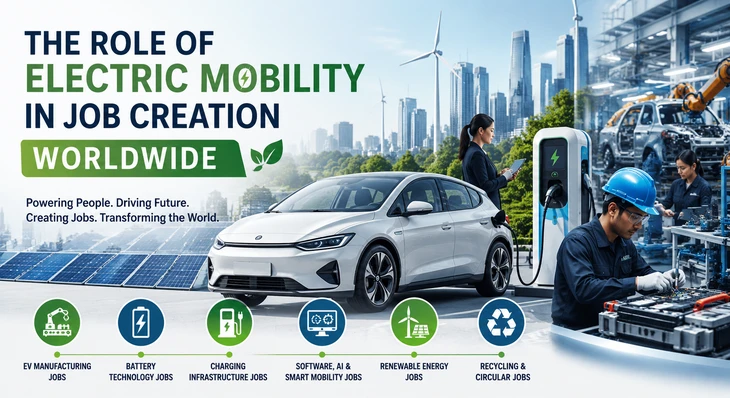
Electric mobility is no longer a distant idea sitting in future projections or policy papers. It is happening right now on real streets, in real factories, and in real workplaces. From the way people commute to how goods are delivered across cities, everything is slowly shifting toward electric-powered transport. And with that shift, something equally important is unfolding in the background—millions of new jobs are being created worldwide. What makes this transformation especially interesting is that it is not limited to one industry. Electric mobility is touching manufacturing, software, energy, infrastructure, and even finance. It is quietly reshaping the global job market in ways many people are only beginning to notice.Electric Mobility and the Changing Face of Global Employment
When people hear the term electric mobility, they usually think of electric cars or scooters. But the reality is much bigger. It includes everything that supports electric transportation—vehicles, batteries, charging stations, software systems, and energy networks. As countries push for cleaner air and lower emissions, electric vehicles are becoming more common on roads. But behind every EV on the road, there is a long chain of workers making it possible. Engineers design them, technicians build them, software developers program them, and energy experts power them. This entire ecosystem is driving a steady rise in electric mobility job creation worldwide, and demand is not slowing anytime soon.New Wave of Opportunities in EV Manufacturing Jobs
Walk into a modern vehicle factory today, and you will notice something very different from a decade ago. The noise, the machines, and even the skill requirements have changed. Electric vehicle manufacturing jobs are growing rapidly as companies shift from petrol and diesel engines to electric systems. This shift is not just a simple upgrade—it is a complete redesign of how vehicles are built. Workers are now involved in battery installation, electric motor assembly, wiring systems, testing units, and automated production lines. In many factories, robots handle repetitive tasks, while humans focus on precision work and system monitoring. Countries such as India, China, Germany, and the United States are investing heavily in EV manufacturing plants. These facilities are not just factories—they are job ecosystems that support thousands of families and local economies.Battery Technology Jobs Driving the Core of the Industry
If electric mobility had a heartbeat, it would be the battery. Everything depends on how efficiently energy is stored, transferred, and reused. This is why battery technology jobs are becoming one of the most in-demand areas in the world. Scientists and engineers are working to improve battery life, reduce charging time, and make storage safer and more affordable. There is also a growing focus on sustainability. Old batteries cannot just be discarded, so recycling and material recovery have become major employment areas. Workers in these roles help extract valuable materials such as lithium and cobalt for reuse in new batteries. Gigafactories—large-scale battery production plants—are emerging across continents. These facilities require chemical engineers, machine operators, safety supervisors, logistics planners, and quality control specialists. Each role contributes to a rapidly expanding job market.Charging Infrastructure Jobs Expanding Across Cities
Electric vehicles cannot run without charging stations, and this simple fact is creating a massive wave of employment opportunities. Charging infrastructure jobs include everything from site planning and electrical installation to software maintenance and network management. Engineers design charging networks, technicians install them, and digital teams ensure they run smoothly. You can now see charging stations appearing in malls, parking lots, highways, office buildings, and even residential societies. Each installation is a small project on its own, involving multiple workers and service providers. What makes this sector particularly interesting is its steady growth. Every new EV on the road increases the need for more charging points, which directly increases job demand.Software, AI, and the Smart Mobility Revolution
Electric mobility is not just mechanical—it is highly digital. Modern EVs are packed with sensors, smart systems, and connected features. This is where software and AI jobs in electric mobility come into play. Developers are building systems that manage battery performance, predict maintenance needs, and even support semi-autonomous driving. Data analysts study driving patterns to improve efficiency. Cybersecurity experts protect vehicles from digital threats. AI specialists work on smarter navigation and energy optimization systems. In many ways, electric vehicles today are closer to computers on wheels than traditional machines. And that shift is opening doors for tech professionals who may never have worked in the automotive industry before.Renewable Energy and Its Link to Electric Mobility Jobs
Electric mobility and renewable energy are deeply connected. As more electric vehicles hit the roads, demand for clean electricity increases. This connection is creating new opportunities in solar power plants, wind farms, and smart grid systems. Engineers and technicians working in renewable energy indirectly support electric mobility by ensuring that EVs are powered by clean sources. In some regions, EV charging stations are now directly powered by solar panels. This integration is creating hybrid job roles that combine energy management with mobility infrastructure.Recycling and the Rise of Circular Economy Careers
One of the less talked-about but highly important parts of electric mobility is recycling. As more batteries reach the end of their life cycle, there is a growing need to recover and reuse valuable materials. This has led to the rise of circular economy jobs focused on sustainability. Workers in this field handle battery dismantling, material recovery, waste treatment, and environmental compliance. These roles are essential not just for industry efficiency but also for reducing environmental impact. It is a reminder that electric mobility is not only about innovation but also about responsibility.Indirect Job Creation That Often Goes Unnoticed
Not all jobs in electric mobility are obvious. Many are created in supporting industries that benefit from the EV boom. Logistics companies are shifting to electric delivery fleets, creating demand for fleet managers and maintenance staff. Insurance companies are designing new EV-specific policies. Banks are offering loans and leasing options tailored to electric vehicles. Even small businesses are benefiting. Local workshops, charging service providers, and mobile repair units are all part of this expanding ecosystem.Skills That Are Becoming More Valuable Than Ever
The electric mobility sector is changing what it means to be “skilled” in the modern workforce. Some of the most valuable skills today include:- Electrical and mechanical system knowledge
- Software development and programming
- Battery science and energy systems understanding
- Data interpretation and AI tools
- Problem-solving and technical adaptability