📚 Table of Contents
- A New Wave of Energy Companies Changing How Careers Work
- Why Solar Startups Are Becoming Global Career Gateways
- Work That Spans Across Countries
- Remote Work Is Not an Exception Anymore
- Investment Is Fueling Expansion
- Career Paths You Actually See Inside Solar Startups
- Engineering and System Design Work
- Project Coordination and Execution Roles
- Technology, Data, and Software Roles
- Business and Growth Roles
- Skills That Make a Real Difference in This Industry
- Technical Understanding
- Digital Skills
- Human Skills That Often Get Overlooked
- A Simple Real-World Scenario
- Challenges That Come With the Opportunity
- Where This Industry Is Headed
- FAQs
- What kind of jobs can I find in solar startups?
- Do I need an engineering background to work in this field?
- Are solar startup jobs remote-friendly?
- Is solar energy a stable career option for the long term?
- Which regions offer the most opportunities?
- Conclusion
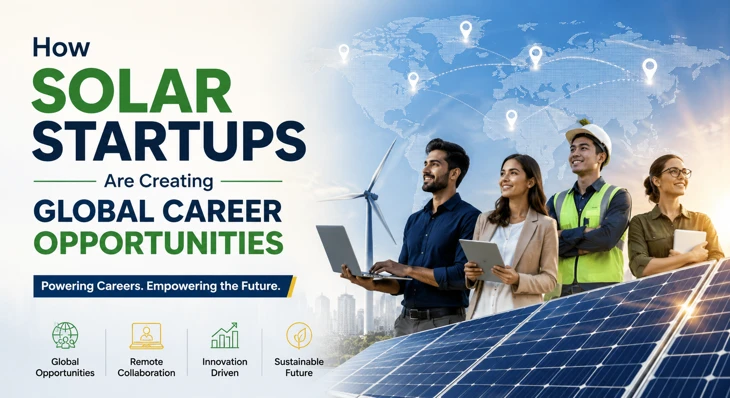
How Solar Startups Are Creating Global Career Opportunities
Something interesting is happening in the world of work. A few years ago, most people saw solar energy as an environmental topic. Today, it is a full-fledged career engine quietly reshaping how and where people build their professional lives. Solar startups, in particular, are driving this shift in a very real way. They are small enough to move fast, but ambitious enough to think globally. And that combination is opening doors for engineers, designers, marketers, analysts, and even people switching careers entirely. What makes this even more fascinating is that these opportunities are no longer tied to a single country or office. A project might begin in India, be designed in Germany, monitored from the United States, and maintained by teams spread across multiple continents. Work has become distributed, and solar startups are one of the strongest examples of this new reality. Let’s break down how this industry is quietly building global career opportunities—and why it is becoming one of the most promising paths for the future of work.A New Wave of Energy Companies Changing How Careers Work
If you look closely, solar energy didn’t suddenly become popular. It has been building momentum for years. Panel costs have dropped, governments have increased incentives, and climate concerns have pushed companies to act faster than ever before. But the real acceleration is coming from startups. Unlike traditional energy companies that navigate layers of approval and lengthy planning cycles, solar startups operate with urgency. They test ideas quickly, adopt new technology faster, and are far more willing to experiment with business models. Some focus on rooftop installations for homes. Others build software that tracks energy usage in real time. A few are even working on AI-driven systems that predict solar output based on weather conditions. This variety is exactly what is creating such a wide range of job opportunities.Why Solar Startups Are Becoming Global Career Gateways
One of the most important shifts in today’s job market is that location matters less than it used to. Solar startups are a perfect example of this change.Work That Spans Across Countries
It is common now for a single solar project to involve multiple regions working together. An engineering team in one country might design the system. Another team overseas could manufacture components. Meanwhile, a completely different group handles installation and maintenance. This structure naturally creates global exposure for employees. You are no longer limited to local opportunities—you become part of an international workflow without needing to relocate.Remote Work Is Not an Exception Anymore
In many solar startups, remote work is simply how things operate. Data analysts track energy performance from home. Software developers build monitoring platforms across different time zones. Marketing teams run global campaigns without ever sitting in the same office. This shift has made the industry especially attractive to professionals seeking flexibility alongside meaningful work.Investment Is Fueling Expansion
Clean energy is one of the most heavily funded sectors right now. Governments are pushing for the adoption of renewables, and private investors are actively backing solar innovation. This steady flow of capital allows startups to expand quickly, hire globally, and explore new markets at a pace that traditional industries struggle to match.Career Paths You Actually See Inside Solar Startups
One of the biggest misconceptions about solar energy is that it is only about installing panels. In reality, the industry is much broader and more dynamic.Engineering and System Design Work
Engineers still play a central role, but their work today is far more advanced than before. They design systems that are not just functional but optimized for efficiency, cost, and long-term performance. They work with software tools, simulation platforms, and increasingly, AI-based design systems. Typical roles include solar system designers, electrical engineers, and renewable energy consultants.Project Coordination and Execution Roles
Behind every solar installation is a detailed coordination effort that keeps everything moving smoothly. Project managers handle timelines, budgets, vendor coordination, and on-ground execution. Their role is part technical, part operational, and heavily focused on communication. It is the kind of job where no two days feel exactly the same.Technology, Data, and Software Roles
This is where things get especially interesting. Modern solar startups rely heavily on data to understand how systems are performing in real time. Software teams build dashboards that show energy output, detect faults, and even suggest optimizations. Data analysts and engineers working in this space are often dealing with live energy systems, IoT devices, and predictive analytics models. For people with a tech background, this is one of the fastest-growing areas in the industry.Business and Growth Roles
Of course, innovation alone is not enough. Solar startups also need people who can take their solutions to market. Business development professionals work on partnerships, expansion strategies, and client relationships across regions. Marketing teams help explain complex energy solutions in simple, relatable ways so that businesses and homeowners can clearly understand their value.Skills That Make a Real Difference in This Industry
What stands out in solar startups is that they do not only hire based on traditional degrees. They care about adaptability and the ability to learn quickly.Technical Understanding
A strong grasp of energy systems helps, especially in roles connected to engineering or data. But even non-engineering roles benefit from a basic understanding of how solar systems function.Digital Skills
Tools like data visualization platforms, coding languages such as Python, and IoT systems are becoming increasingly common in day-to-day work.Human Skills That Often Get Overlooked
Communication matters more than people expect. Solar projects involve multiple teams across time zones, so clarity is essential. Problem-solving, patience, and the ability to work across cultures are just as valuable as technical knowledge.A Simple Real-World Scenario
Imagine a solar startup working on a smart energy system for residential buildings. The design team creates the hardware blueprint in one country. A software team in another region builds an app that tracks energy usage in real time. Meanwhile, a separate operations team ensures installations are completed in different cities. When everything comes together, a homeowner can simply open an app and see how much energy their roof is producing at any moment. Behind that simple experience is a globally distributed workforce solving complex problems together.Challenges That Come With the Opportunity
Of course, no industry is without its challenges. The solar sector moves quickly, so professionals must continually update their skills. New technologies often emerge, and staying relevant requires continuous learning. There is also strong competition. As more startups enter the space, companies are constantly trying to innovate faster and operate more efficiently. And because solar energy is regulated differently across countries, professionals working on global projects often need to understand multiple sets of rules and compliance standards.Where This Industry Is Headed
Looking ahead, solar startups are likely to become even more influential in the global job market. We are already seeing signs of what is coming next:- More companies are shifting to fully remote or hybrid global teams
- Increased use of AI in energy prediction and optimization
- Greater collaboration between countries on renewable energy projects
- Rising demand for professionals who understand both technology and sustainability