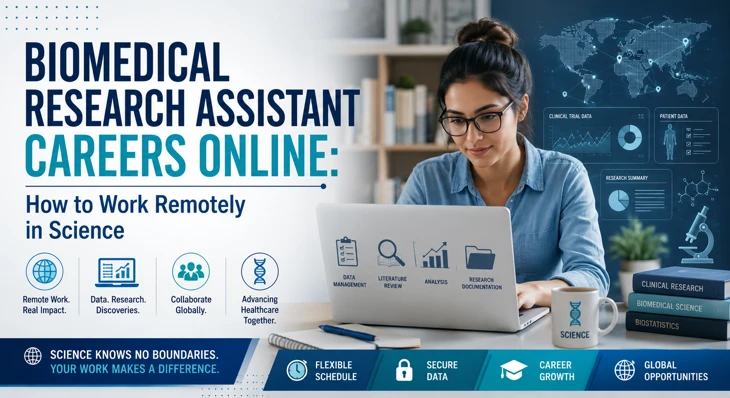
Biomedical Research Assistant Careers Online: How to Work Remotely in Science
Introduction
Science work used to feel like something that only happened inside labs—white coats, machines humming, long hours at benches, and strict routines. But that picture has quietly changed over the last few years. A large part of biomedical research today happens through screens, shared databases, and virtual collaboration tools.
That shift has created a very real space for biomedical research assistant careers online. People who once thought they needed constant lab access are now finding meaningful roles they can do from home or in hybrid setups.
At its core, a biomedical research assistant supports scientific and healthcare research work. The role is less about running physical experiments every day and more about managing information—cleaning data, reviewing studies, organizing research findings, and helping teams stay accurate and on track.
What makes this path interesting is how flexible it has become. You don’t always need to be inside a lab to contribute to real medical progress. If you enjoy science but also value flexibility and structured digital work, this career direction fits surprisingly well.
How an Online Biomedical Research Assistant's Work Really Feels
Most people imagine research as something very hands-on. In reality, a big portion of modern biomedical work is already digital.
Think about clinical trials, patient records, published studies, and research reports. All of that information needs to be organized, checked, compared, and understood. That’s where remote biomedical research assistant roles come in.
Instead of standing beside lab equipment, you might be sitting with datasets, reading through scientific journals, or updating research records in secure systems used by hospitals and universities.
A typical day might include reviewing new study findings, fixing inconsistencies in data sheets, or helping a research team prepare summaries for publication. It’s structured work, but not repetitive in a boring way—there’s always something new to understand.
Skills That Actually Matter in This Field
People often assume this career is only for highly technical scientists, but that’s not completely true. The skills needed are a mix of science understanding and practical digital ability.
A basic background in life sciences helps a lot. Whether it’s biology, biotechnology, microbiology, or healthcare studies, having familiarity with scientific language makes everything easier to follow.
Then comes data handling. You don’t need to be a programmer, but you should be comfortable working with spreadsheets, structured data, and research platforms. A lot of the job revolves around accuracy rather than speed.
Attention to detail quietly becomes one of the most valuable traits in this role. Small errors in research documentation can affect larger conclusions, so careful work matters more than anything else.
Communication also plays a bigger role than people expect. Even though the job is remote, you’re constantly interacting with teams—sharing updates, clarifying data points, or summarizing findings through messages and calls.
And of course, digital tools are part of everyday work. Platforms such as Excel, PubMed, SPSS, and various research management systems are commonly used in online biomedical research assistant careers.
What Remote Biomedical Research Work Looks Like Day to Day
Working remotely in science doesn’t mean working alone. Most of the time, you’re connected to a larger research team that may be spread across different cities or even countries.
Everything happens through shared systems. Research data is stored on secure platforms, updates are tracked in real time, and communication occurs via video calls or collaboration tools.
Instead of physically handling experiments, your focus is usually on what happens after data is collected. You might check if datasets match study requirements, review patient trial entries, or compare findings with previous research papers.
There’s also a strong documentation side. Research teams rely on assistants to keep everything organized—because in science, if information is messy, conclusions become unreliable.
So while the work is digital, it still feels connected to real-world outcomes, especially in healthcare and clinical studies.
This career wouldn’t exist without technology. Everything is built around tools that make scientific collaboration possible from anywhere.
For research reading and understanding, platforms like PubMed and Google Scholar are used almost daily. They help professionals stay up to date with the latest studies.
For managing and analyzing data, tools such as Excel, SPSS, R, and sometimes Python are used, depending on the project's complexity.
Clinical research teams often rely on specialized systems such as REDCap or Medidata, where patient data and trial information are securely stored and managed.
And then there’s the communication side—Zoom calls, Slack messages, shared Google Docs, and Notion pages keep everything moving smoothly across teams.
Without these tools, remote biomedical research assistant careers simply wouldn’t function the way they do today.
Where These Jobs Are Actually Found
Finding remote biomedical research assistant roles is not always straightforward, but opportunities do exist if you know where to look.
Many positions are posted directly on university websites or research institute portals. These are often hidden gems because they don’t always appear on general job boards.
Pharmaceutical companies and healthcare research organizations also hire remote assistants for data-heavy or documentation-focused work.
Platforms like LinkedIn and Indeed can help, especially when using specific search terms such as "remote biomedical research assistant," "virtual clinical research support," or "online research coordinator."
Networking quietly plays a big role here. Sometimes a conversation with a researcher or academic professional opens doors that job boards don’t show.
Career Growth and What to Expect Over Time
This field doesn’t stay at one level. With experience, the responsibilities naturally grow.
Early roles usually focus on supporting tasks like data entry, research updates, and basic documentation.
Over time, people often move into more analytical or coordination-focused positions where they manage larger parts of research projects.
Eventually, some professionals grow into clinical trial coordination, research leadership, or regulatory roles that shape how studies are conducted.
What’s interesting is that remote work doesn’t limit growth. In many cases, it expands opportunities because you’re not restricted to local organizations.
Challenges You Might Notice Along the Way
Like any career, this one has its own difficulties.
One of the biggest is the limited exposure to hands-on lab work. Since most tasks are digital, practical lab experience can be less frequent.
Accuracy pressure is another factor. Working with research data means every detail matters, and mistakes can affect larger scientific outcomes.
Communication across time zones can sometimes slow things down, especially in global teams.
And because science keeps evolving, there’s always a need to stay up to date with new tools, methods, and research standards.
The Direction This Career Is Moving Toward
Biomedical research is becoming more digital every year. Artificial intelligence, automation tools, and cloud-based systems are changing how research is done and managed.
This shift is making remote roles more common, not less. Tasks that once required physical presence are now being handled through secure online systems.
In the coming years, biomedical research assistant careers online are expected to grow even more, especially in clinical research and data-driven healthcare studies.
It’s becoming a global space where location matters less and skills matter more.
FAQs
Can biomedical research assistants really work remotely?
Yes, many parts of the job, like data review, documentation, and literature research, can be done online using digital systems.
What background is needed for this career?
A degree in life sciences, biotechnology, or healthcare-related fields is usually preferred.
Do beginners have opportunities in this field?
Yes, entry-level roles and internships are available, especially for candidates with basic research experience.
Start with Excel, PubMed, and basic research platforms. Advanced tools come with experience.
Is this field growing?
Yes, remote biomedical research roles are expanding as healthcare systems become more digital.
Conclusion
Online biomedical research assistant careers are changing how people enter the world of science. What used to be limited to lab environments is now open to remote professionals who can handle research, data, and documentation work from anywhere.
It’s a career that blends science with digital work in a very practical way. With the right mix of curiosity, consistency, and basic technical skills, this path can open doors to meaningful work in global healthcare research.