📚 Table of Contents
- Introduction: Farming Is Quietly Transforming on the Ground
- What Green Technology in Agriculture Really Means
- Why Farmers Are Slowly Shifting Toward Green Tech
- Rising day-to-day farming costs
- Weather that no longer follows patterns
- Growing demand for cleaner food
- How Green Technology Is Actually Used in Fields Today
- Solar-powered irrigation is becoming more common
- Precision farming using basic data tools
- Drones helping farmers see the bigger picture
- Organic farming is making a quiet comeback
- Drip irrigation solves water stress
- Real Benefits Farmers Are Experiencing
- Lower recurring costs
- More stable crop output
- Improved soil quality over time
- Better pricing in markets
- Reduced dependency on external inputs
- Challenges That Still Exist
- High upfront investment
- Lack of awareness in rural areas
- Learning and adaptation curve
- Infrastructure gaps
- Support Systems Helping Farmers Transition
- Government support programs
- Training initiatives
- Agri-tech startups
- A Real-Life Shift Seen in Many Villages
- What the Future of Farming Is Moving Toward
- FAQs
- 1. What does green technology in agriculture mean?
- 2. How does green technology help farmers earn sustainable income?
- 3. Can small farmers use green farming methods?
- 4. What are the most widely used green farming tools?
- 5. Is precision farming difficult to learn?
- 6. Does green farming improve soil health in the long run?
- Conclusion: A Practical Shift Toward Smarter Farming
How Farmers Are Adopting Green Tech for Sustainable Income
Introduction: Farming Is Quietly Transforming on the Ground
If you look at farming today compared to even a decade ago, the difference is hard to miss. Not in the way the fields look—but in the way decisions are being made. Farmers are slowly moving away from relying on instinct and experience alone. Instead, they are blending traditional knowledge with practical, low-cost technology that makes everyday farming a little more predictable and a lot more efficient. This shift toward green technology in agriculture is not happening overnight. It is gradual, sometimes experimental, and often driven by necessity rather than choice. Rising costs, changing weather, and shrinking profit margins have pushed farmers to rethink how they work the land. What is emerging from this change is something very important: sustainable income. Not just higher yield in one season, but a more stable, long-term way of earning from farming without exhausting the soil or increasing debt.What Green Technology in Agriculture Really Means
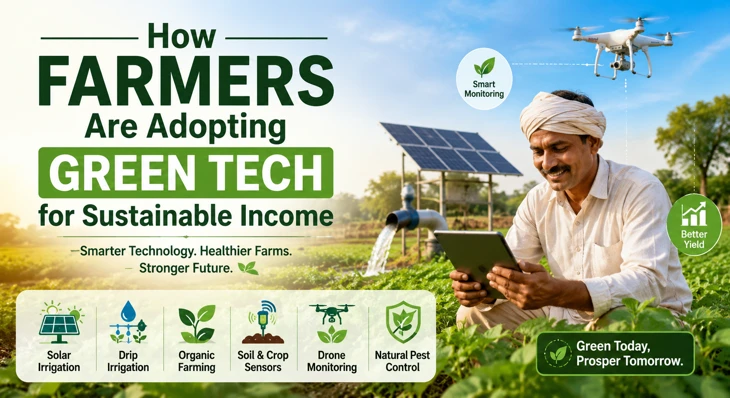
Green technology in agriculture is not a single invention or tool. It is a collection of practical methods that help farmers grow crops in a cleaner, smarter, and more resource-efficient way. At its core, it is about doing more with less—less water, less fuel, fewer chemicals, and less waste. In real farming conditions, this often looks simple rather than high-tech. A solar pump replacing a diesel engine. A drip pipe replaces flood irrigation. A mobile app replacing guesswork. Some widely used approaches include:- Solar-powered irrigation systems that reduce fuel dependency
- Drip irrigation systems that deliver water directly to roots
- Organic farming methods using compost and natural inputs
- Sensors that track soil moisture and crop conditions
- Drones that help monitor fields from above
- Smarter pest control using biological alternatives
Why Farmers Are Slowly Shifting Toward Green Tech
Farmers rarely adopt new practices just because they are modern. The shift usually begins when old methods stop working as effectively as they used to.Rising day-to-day farming costs
One of the biggest pressures is cost. Diesel, fertilizers, and labor are all more expensive than they were a few years ago. For many farmers, profit margins have become extremely thin. Green technology helps reduce recurring expenses. Once installed, systems like solar pumps or drip irrigation start saving money season after season.Weather that no longer follows patterns
Rainfall used to be predictable in many regions. That is no longer the case. Some seasons bring drought, others bring sudden heavy rain that damages crops. Farmers are now turning to technology that helps them adapt instead of react. Better water management and crop monitoring tools make a real difference here.Growing demand for cleaner food
Consumers are becoming more aware of how food is grown. Produce grown with fewer chemicals is not just healthier—it often sells at better prices in urban markets. This demand is encouraging farmers to explore organic farming and more sustainable practices.How Green Technology Is Actually Used in Fields Today
The interesting part is that this transformation is not limited to large commercial farms. Even small farmers are slowly adopting simple, practical tools that fit their budget and needs.Solar-powered irrigation is becoming more common
In many rural areas, solar pumps are replacing diesel-powered irrigation systems. The change may sound simple, but its impact is significant. Instead of worrying about fuel availability or rising diesel prices, farmers now rely on sunlight—something freely available in most regions. Over time, this reduces irrigation costs and provides more control over watering schedules. Some farmers even report that they can irrigate their fields more consistently during dry spells, which directly improves crop health.Precision farming using basic data tools
Precision farming sounds advanced, but in practice, it often starts small. A soil sensor is placed in a field. A mobile app suggesting irrigation timing. A simple weather update before planning fertilizer use. These small inputs help farmers avoid waste and make better decisions. Instead of applying water or fertilizer on a fixed schedule, they adjust based on actual need. That alone improves efficiency and reduces cost.Drones helping farmers see the bigger picture
Drones are becoming more accessible than before. While not every farmer uses them, their adoption is growing in many regions. They help farmers quickly check large fields, identify crop stress, and detect pest issues early. What once required walking across acres of land can now be done in minutes from above. This saves time and helps catch problems before they spread.Organic farming is making a quiet comeback
There is also a visible return to organic farming practices. Many farmers are reducing chemical use and returning to natural inputs. This includes compost, animal manure, and bio-fertilizers. The change is not only about health concerns. Over time, farmers notice that soil treated naturally often becomes more productive and less dependent on expensive inputs. It is a slower process, but one that supports long-term land health.Drip irrigation solves water stress
Water scarcity is one of the biggest challenges in agriculture today. Drip irrigation has become one of the most practical solutions. Instead of flooding entire fields, water is delivered slowly and directly to plant roots. This method reduces waste, improves efficiency, and helps crops grow more consistently, especially in dry regions. For many farmers, this single change has significantly improved water management.Real Benefits Farmers Are Experiencing
The shift toward green technology in agriculture is not just theoretical. Farmers are seeing real, measurable improvements in their daily lives.Lower recurring costs
Reduced fuel usage, smarter water management, and fewer chemical inputs all contribute to lower expenses over time.More stable crop output
Better planning and controlled inputs lead to healthier crops and fewer unexpected losses.Improved soil quality over time
Natural farming practices and reduced chemical use help maintain soil fertility.Better pricing in markets
Crops grown with sustainable methods often attract better buyers, especially in cities where demand for cleaner food is rising.Reduced dependency on external inputs
Farmers become less dependent on fertilizers, fuel supply chains, and unpredictable market price changes.Challenges That Still Exist
Even though the benefits are clear, the transition is not always smooth.High upfront investment
Tools like solar pumps, drip systems, or drones require initial spending, which can be difficult for small farmers.Lack of awareness in rural areas
Many farmers are still not fully aware of available green farming solutions or how to use them effectively.Learning and adaptation curve
New tools require basic training, and not everyone has easy access to it.Infrastructure gaps
Internet access, electricity reliability, and technical support are still inconsistent in some regions.Support Systems Helping Farmers Transition
Fortunately, farmers are not navigating this change alone.Government support programs
Subsidies and schemes are helping reduce the cost of solar pumps, drip irrigation systems, and organic farming tools.Training initiatives
Agricultural institutions and NGOs are actively conducting training programs in rural areas.Agri-tech startups
New companies are building affordable, farmer-friendly tools designed specifically for small and medium farms.A Real-Life Shift Seen in Many Villages
In several farming communities, small but meaningful changes are becoming visible. For example, a farmer who replaced diesel irrigation with a solar pump noticed a clear drop in monthly expenses. Over time, the savings were reinvested into improving soil quality through organic inputs. The result was not instant success, but gradual improvement—better soil, healthier crops, and more consistent income. Stories like this are becoming more common as more farmers experiment with green practices.What the Future of Farming Is Moving Toward
Farming is slowly entering a phase where technology and tradition work side by side. In the coming years, we are likely to see:- Wider use of AI-based crop planning tools
- More affordable solar and renewable energy systems
- Growth of precision farming even among small farmers
- Expansion of organic and sustainable food markets