📚 Table of Contents
- Introduction
- The Changing Reality of Remote Finance Work
- AI Tools That Are Quietly Reshaping Finance Work
- Accounting and Bookkeeping Systems
- Financial Forecasting and Analytics
- Fraud Detection and Monitoring Systems
- Financial Planning Tools
- How AI Is Reshaping Everyday Finance Roles
- Accountants Moving Toward Advisory Work
- Financial Analysts Becoming Insight Interpreters
- Auditors Working Faster with AI Assistance
- Financial Advisors Focusing on Relationships
- Benefits of Driving AI Adoption in Remote Finance Careers
- The Other Side: Challenges That Still Exist
- Skills That Matter More in an AI-Driven Finance World
- Real Examples from Remote Finance Work
- What the Future of Remote Finance Careers Looks Like
- FAQs
- 1. How is AI changing remote finance careers?
- 2. Will AI replace finance professionals?
- 3. What are examples of AI tools used in finance?
- 4. Do you need technical skills to work in AI-based finance roles?
- 5. What careers are growing due to AI in finance?
- Conclusion
How AI Tools Are Changing Remote Careers in Finance
Introduction
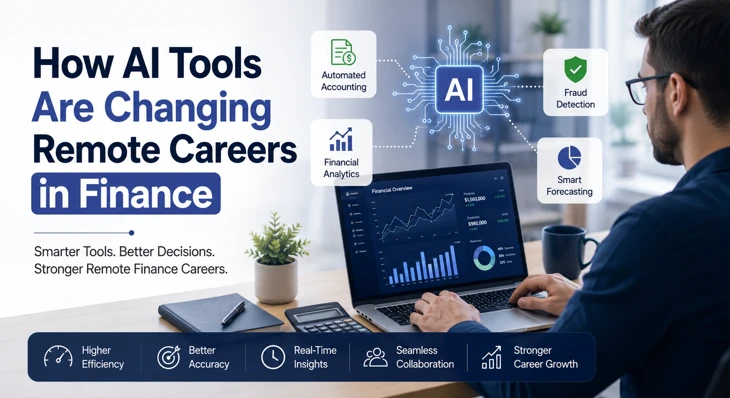
Remote finance work has changed a lot in the last few years, but what’s happening now with artificial intelligence feels like a bigger shift altogether. Tasks that once took entire afternoons—like sorting transactions, preparing reports, or checking for errors—are now handled in a fraction of the time with AI-powered systems. For professionals working from home or across global teams, this is not just about speed. It is about how work itself is being reshaped. AI tools are quietly becoming part of everyday workflows in accounting, analysis, auditing, and financial planning. And the interesting part is that this shift is not removing jobs—it is changing what those jobs look like. Today, roles in finance are becoming less about repetitive work and more about judgment, interpretation, and decision-making. That’s why searches for AI tools in remote finance jobs and AI-powered remote finance careers have become so common. People are trying to understand where they fit in this changing environment.The Changing Reality of Remote Finance Work
A few years ago, remote finance work mainly meant working on spreadsheets, emailing reports, and coordinating with teams through long back-and-forth messages. Now, AI systems are doing much of the heavy lifting behind the scenes. What’s really changing is the type of thinking required. Instead of manually building reports, professionals are now reviewing AI-generated insights and asking better questions based on that data. It feels less mechanical and more strategic. This shift is also why terms like remote financial analysis using artificial intelligence are becoming part of everyday job descriptions. Companies want people who can work with data tools, not just produce data manually.AI Tools That Are Quietly Reshaping Finance Work
AI has entered almost every corner of finance, but not in a loud or obvious way. It usually shows up as “helpful automation” inside tools people already use.Accounting and Bookkeeping Systems
Modern accounting platforms now do far more than record numbers. They can categorize expenses automatically, match transactions, and even flag missing entries without human intervention. For someone managing clients remotely, this changes everything. Instead of spending hours on repetitive entries, they can focus on reviewing exceptions and advising clients. This is one reason remote accounting jobs using AI tools have become more scalable and flexible than traditional setups.Financial Forecasting and Analytics
Forecasting used to be based on manual calculations and historical spreadsheets. Now, AI models scan patterns in real time and suggest possible outcomes. A financial analyst working remotely can now open a dashboard and instantly see risk trends, revenue forecasts, and market shifts without having to build everything from scratch. This is a major reason AI in financial analysis remote work is growing so quickly across industries.Fraud Detection and Monitoring Systems
Fraud detection is another area where AI quietly plays a major role. Instead of waiting for issues to surface, systems now continuously monitor transactions and immediately flag unusual behavior. For remote teams, this reduces pressure and improves response time. It also allows smaller teams to handle larger volumes of data without missing critical signals.Financial Planning Tools
Advisory work has also evolved. AI tools can now generate investment suggestions based on client behavior, risk appetite, and market conditions. For financial advisors working remotely, this means more time can be spent on client conversations rather than on manual calculations or portfolio adjustments.How AI Is Reshaping Everyday Finance Roles
The biggest change in finance careers is not the tools themselves—it is how roles are being redefined around them.Accountants Moving Toward Advisory Work
Accountants are no longer stuck in data entry cycles. Much of that work is automated now. Instead, they are reviewing outputs, ensuring compliance, and offering financial guidance to clients. The job feels more consultative than ever before.Financial Analysts Becoming Insight Interpreters
Analysts today are not spending hours manually building reports. Instead, they are interpreting dashboards, validating AI suggestions, and explaining what the numbers actually mean for a business. The skill has shifted from building data models to understanding what those models are saying.Auditors Working Faster with AI Assistance
Auditing used to involve long hours of sampling and checking records. Now, AI tools scan entire datasets and highlight inconsistencies instantly. Remote auditors can focus on investigating issues rather than manually searching for them.Financial Advisors Focusing on Relationships
Advisors now rely on AI for portfolio suggestions and risk analysis. Their real value lies in understanding client needs and building trust, not just running calculations.Benefits of Driving AI Adoption in Remote Finance Careers
There is a reason why AI-powered remote finance careers are growing so quickly. The benefits are practical and easy to see in day-to-day work.- Work gets done faster without sacrificing quality
- Fewer manual errors in reporting and calculations
- Real-time insights instead of delayed reports
- Easier collaboration across remote teams
- More capacity to take on multiple clients or projects
The Other Side: Challenges That Still Exist
Even though AI brings efficiency, it also introduces new concerns that professionals cannot ignore. One major issue is over-dependence. When systems automate too much, it becomes easy to trust outputs without questioning them. That can lead to blind spots if something goes wrong. Data security is another concern. Since most tools run on cloud platforms, protecting sensitive financial information is critical. There is also a learning curve. Not everyone in finance is immediately comfortable with AI-driven platforms. Those who avoid learning these tools risk falling behind as the industry moves forward.Skills That Matter More in an AI-Driven Finance World
The skills required in finance are shifting, but they are not becoming harder—they are becoming more focused. Professionals now need to be comfortable working with AI tools while still understanding core financial principles. Key skills include:- Working with AI-based financial platforms
- Interpreting data rather than just collecting it
- Understanding financial modeling supported by automation
- Awareness of cybersecurity basics
- Strong analytical thinking and decision-making