📚 Table of Contents
- Introduction
- The Changing Shape of Global Work
- What’s Driving This Global Shift in Work
- Artificial Intelligence Changing Everyday Tasks
- Remote Work Becoming the Default, Not the Exception
- Hiring Without Borders
- Everything Turning Digital
- Competing in Global Markets Feels Different Now
- Skills That Actually Matter in the Future Workforce
- Digital Skills Are Now the Base Layer
- Communication That Works Across Borders
- Thinking Beyond Instructions
- Learning Without Stopping
- AI Is Changing Careers, But Not in the Way People Think
- Remote Work and the Reality of Global Opportunity
- Personal Brand Has Become a Career Asset
- Simple Ways Professionals Build It
- Staying Relevant in a Competitive Global Workforce
- Challenges That Come With Global Work
- FAQs
- 1. What does the future of work actually look like?
- 2. How do professionals compete globally today?
- 3. Which skills matter most right now?
- 4. Is AI reducing job opportunities?
- 5. Why is remote work such a big deal?
- Conclusion
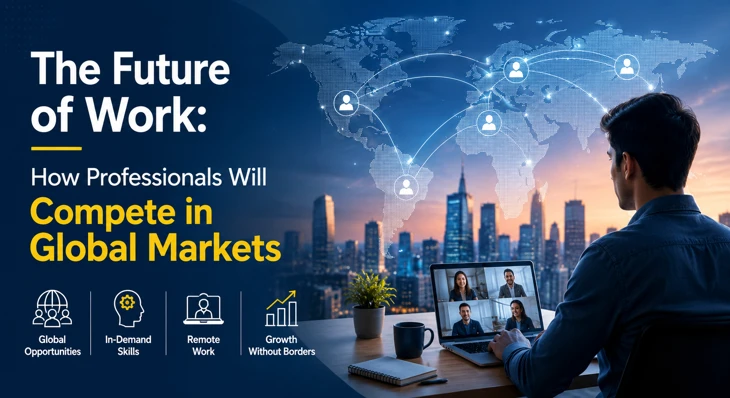
The Future of Work: How Professionals Will Compete in Global Markets
Introduction
Work doesn’t feel the same anymore—and honestly, it probably never will again. The idea of staying in one office, in one city, doing one kind of job for decades is quietly fading into the background. In its place is something far more flexible, unpredictable, and global. Think about this for a moment. A freelance writer in Bhopal collaborates daily with a startup in London. A developer in Pune fixes bugs for a company based in San Francisco while sipping chai at home. A designer in a small town builds brand identities for clients they’ve never met in person. This is not some future concept. It’s already normal. The real shift is simple but powerful: geography is no longer the gatekeeper. Skills are. And that changes everything about how professionals compete in global markets.The Changing Shape of Global Work
Work has quietly slipped out of its old boundaries. Earlier, your opportunities mostly depended on what existed within commuting distance. Today, your “workplace” is the internet itself. Companies have realized something important: the best talent doesn’t always sit nearby. So they’ve opened their doors wider—sometimes across continents. Remote work didn’t just make life more comfortable; it rewired hiring itself. Teams now operate across time zones, jumping between Slack messages, Zoom calls, and shared documents instead of sitting in the same room. Alongside this, freelancing and contract-based work have become normal career paths—not backup options. People are building entire careers project by project. But here’s the catch: once borders disappear, competition expands. You’re no longer compared to people around you—you’re compared to people everywhere. That’s where the pressure and opportunity begin to blend.What’s Driving This Global Shift in Work
This transformation isn’t happening randomly. A few strong forces are pushing it forward faster than ever.Artificial Intelligence Changing Everyday Tasks
AI is now quietly sitting inside most workflows. It writes, organizes, summarizes, analyzes, and sometimes even decides. But instead of removing work, it is reshaping it. The repetitive stuff is slowly fading out, while thinking-heavy work is becoming more valuable. Someone who knows how to use AI tools well today can often complete what used to take half a day in one hour. That efficiency is becoming a serious advantage in global markets.Remote Work Becoming the Default, Not the Exception
Work is no longer tied to office buildings. In fact, for many roles, the idea of “going to work” has almost disappeared. What matters now is output. Did you deliver? Did you communicate clearly? Did you solve the problem? This also means one quiet truth: discipline now matters as much as skill.Hiring Without Borders
Companies are no longer asking, “Where are you from?” as their first filter. They’re asking, “Can you do the work well?” That sounds fair—and it is—, but it also raises the bar. Because now, every role has global competition.Everything Turning Digital
From hospitals using digital records to banks moving online to schools shifting platforms—everything is becoming tech-driven. Even non-technical roles now require comfort with tools, dashboards, and digital systems.Competing in Global Markets Feels Different Now
There’s a misconception that competing globally is about having the “best degree” or working for a big company first. It’s not. In reality, global competition is much more direct. People judge your ability based on what you can show, not just what you claim. A strong portfolio often speaks louder than a long resume. A well-written LinkedIn post can bring more visibility than a formal application. And something else is changing too—visibility matters more than ever. If people can’t see your work, they assume you don’t exist in that space. Professionals who understand this early start building presence intentionally, not accidentally.Skills That Actually Matter in the Future Workforce
Let’s be honest—skills lists on the internet often feel the same. But in real work, only a few truly separate people.Digital Skills Are Now the Base Layer
You don’t need to be a coder, but you do need to understand digital tools. Whether it’s analytics dashboards, content platforms, automation tools, or AI assistants—digital comfort is now basic survival.Communication That Works Across Borders
Talking to someone across the world is not just about language. It’s about clarity, timing, and understanding differences. A simple message like “Let’s fix this” can mean different things in different cultures. Professionals who learn to communicate clearly without confusion stand out immediately.Thinking Beyond Instructions
Global work rarely comes with step-by-step guidance. You’re expected to figure things out. That means noticing patterns, asking better questions, and solving problems without waiting for direction.Learning Without Stopping
One skill that quietly beats everything else is this: the ability to learn fast. Tools change. Platforms change. Even entire industries change. People who stay flexible don’t struggle as much when things shift.AI Is Changing Careers, But Not in the Way People Think
There’s a lot of fear around AI replacing jobs. But what’s actually happening is more subtle. AI is not replacing thinking—it’s replacing repetition. Tasks like writing basic reports, sorting data, or answering common queries are becoming automated. But that doesn’t remove the need for humans. It actually increases the need for people who can guide, edit, and make decisions. New roles are quietly emerging too—like managing AI workflows, refining prompts, or designing automation systems that make businesses faster. In many workplaces, AI is less like a replacement and more like a very fast assistant who doesn’t get tired.Remote Work and the Reality of Global Opportunity
Remote work sounds simple: work from anywhere. But in practice, it comes with its own discipline. When your client is in another time zone, you don’t just “log off and forget.” You plan better. You respond clearly. You manage expectations carefully. There’s also a subtle shift happening: trust matters more than supervision. Nobody is watching your desk. People are watching your results. Those who handle this responsibility well often grow faster than those in traditional setups.Personal Brand Has Become a Career Asset
Like it or not, your professional presence now travels faster than your applications. Before someone hires you, they might already have an impression of you from your online presence. That impression is your personal brand. It is built slowly through consistency—not overnight.Simple Ways Professionals Build It
- Sharing real work instead of polished claims
- Writing small insights from daily experience
- Keeping profiles clean and updated
- Being active in professional communities