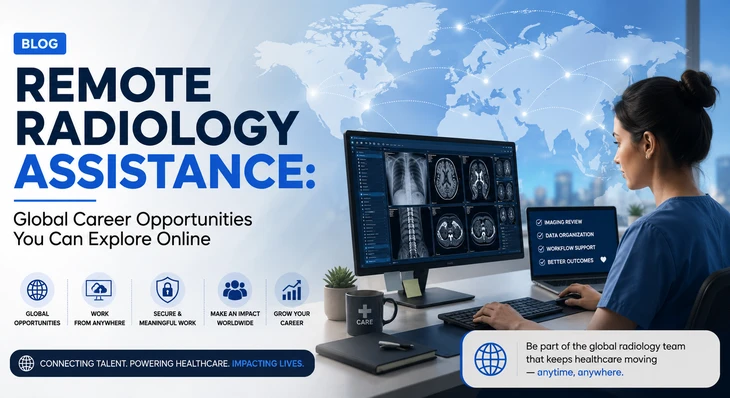
Remote Radiology Assistance: Global Career Opportunities You Can Explore Online
Introduction
Not long ago, radiology work was something you could only imagine inside hospitals—bright imaging rooms, bulky machines, and specialists working side by side. That picture is still real, of course, but it is no longer the only version of reality.
Today, a growing share of radiology support occurs quietly in remote settings. Professionals log in from different parts of the world, review imaging files, organize data, and help radiologists make faster decisions. It feels less like a traditional hospital job and more like a connected digital workflow that never really sleeps.
This shift is not just about technology. It is about how healthcare is adapting to pressure—more patients, faster diagnostics, and fewer specialists available in many regions. Remote radiology assistance sits right at the center of this change.
For people working in medical imaging, healthcare support, or even those transitioning into healthcare tech roles, this space is opening up meaningful work that feels both flexible and future-oriented.
Let’s explore what this actually looks like in real life and why so many professionals are paying attention to it.
What Remote Radiology Assistance Really Means
If you strip away the technical terms, remote radiology assistance is fairly simple to understand.
It is the process of helping radiologists manage medical imaging work without being physically present in a hospital.
Instead of standing next to imaging machines, professionals work through secure platforms where X-rays, CT scans, and MRI files are uploaded, reviewed, and organized. Think of it as the behind-the-scenes structure that keeps diagnostic workflows moving smoothly.
A typical day might include things like sorting imaging files, checking whether scans are complete, labeling data correctly, or preparing reports that a radiologist will later finalize. Nothing happens in isolation—everything feeds into a larger diagnostic process.
And while the work feels technical, it is also surprisingly structured. Small details matter. A mislabeled scan or missing file can slow down an entire case.
A Simple Real-World Picture
To make it easier to imagine, consider this scenario.
A hospital in Germany receives hundreds of imaging scans overnight. Rather than overwhelming the local team, the files are securely shared with remote assistants across different time zones, including professionals in countries such as India and the Philippines.
By the time doctors in Germany start their morning, most of the imaging data has already been organized, checked, and prepared for review.
No delays. No backlog building up. Just a smooth pipeline of information.
That is the quiet strength of remote radiology assistance—it keeps healthcare moving even while the world sleeps.
Why This Career Path Is Expanding So Quickly
There is no single reason behind the rise of remote radiology roles. It is a combination of real pressures across healthcare systems worldwide.
Hospitals Are Overloaded
Medical imaging demand has increased steadily over the years. More scans mean more workload for radiologists. Remote support helps distribute that load so reports don’t get delayed.
Not Enough Radiology Experts
Many regions simply do not have enough trained radiologists. Remote assistance helps fill that gap without requiring physical relocation.
Digital Systems Changed Everything
Cloud storage, PACS systems, and secure medical platforms have made it possible to handle sensitive imaging data safely from anywhere.
Healthcare Systems Want Efficiency
Hospitals are always trying to reduce turnaround time and operational costs. Remote workflows help achieve both without lowering quality.
Career Options You Can Explore
One interesting thing about this field is that it is not limited to a single job title. Different roles exist depending on experience and technical depth.
Radiology Workflow Support Roles
These professionals focus on keeping imaging data organized and accessible. It is a detail-heavy role where accuracy matters more than speed.
Teleradiology Support Assistants
These are often entry points into the field. Work revolves around preparing imaging files so radiologists can focus purely on diagnosis.
Imaging Data Handling Specialists
Think of this role as the backbone of the organization. Large volumes of scans are managed, sorted, and stored properly for long-term use.
Reporting Assistance Roles
Some professionals help structure preliminary notes or templates based on radiologist inputs. The final medical interpretation always remains with certified experts.
PACS System Support
These roles focus on the systems that store and transmit imaging data. It is a mix of healthcare understanding and technical system management.
Skills That Actually Matter in This Field
This is not a career where memorizing theory alone is enough. The real work happens in consistency, focus, and digital comfort.
You need a clear understanding of the basics of medical imaging—what different scans show and how they are used in diagnosis. But equally important is your ability to stay organized while handling large volumes of data.
Software familiarity also plays a big role. PACS systems, imaging viewers, and secure cloud tools are part of everyday work.
And then there is attention to detail. It sounds simple, but in this field, small mistakes can affect real medical decisions.
Communication also matters more than people expect, especially when teams are spread across countries and time zones.
How the Work Flows Day to Day
Many people assume remote healthcare work is unpredictable. In reality, it is quite structured.
Imaging files come in batches. They are checked, sorted, and labeled. Any missing information is flagged. Once everything is clean and organized, radiologists take over for final diagnosis.
The process feels almost like a relay—each person handles a specific part before passing it forward.
What makes it interesting is the scale. One team might support multiple hospitals at the same time, each operating in a different time zone. That is why this system works so efficiently around the clock.
Benefits That Go Beyond Just Employment
People often view remote radiology assistance as just another job category, but it tends to offer a different kind of work experience.
There is flexibility in how and where you work. Many roles are remote or hybrid, which changes daily life quite a bit.
You also get exposure to international healthcare systems. That experience alone can shape your career direction in unexpected ways.
Over time, professionals move into more specialized roles—sometimes in healthcare IT, sometimes in data management, and sometimes in coordination or leadership positions.
And yes, compensation tends to be competitive, especially for those who build strong technical and system knowledge.
Challenges You Should Be Aware Of
It is not a casual field. There is responsibility involved, even in support roles.
Patient data is sensitive, so privacy and security are always serious matters. There is no room for carelessness.
Accuracy is another non-negotiable part of the job. A small oversight can delay or complicate a diagnosis.
And then there is the constant learning curve. Tools evolve, systems update, and workflows change. Staying current is part of the role, not an optional extra.
How People Usually Start in This Field
Most professionals enter through medical imaging backgrounds—radiology technology, healthcare assistance, or clinical training.
From there, the next step is learning the tools used in the industry. PACS and DICOM systems are commonly mentioned as forming the backbone of imaging workflows.
Some people gain experience through hospitals first. Others start in support roles and grow into more specialized positions over time.
What matters most is not how quickly you start, but how consistently you build your understanding of imaging workflows and digital systems.
Where This Career Is Heading
Healthcare is becoming more connected and more digital every year.
Artificial intelligence is already helping with image detection and analysis, but it is not replacing human judgment. Instead, it is supporting it.
Remote collaboration is also becoming the default in many healthcare systems. That means more global teams, more distributed workflows, and more demand for professionals who understand both healthcare and digital systems.
In many ways, this field is still taking shape.
FAQs
Is remote radiology assistance a technical job or a healthcare job?
It is a mix of both. You work with healthcare data using technical systems, so you need an understanding of both sides.
Can someone without a medical degree enter this field?
Yes, some entry-level roles focus more on imaging support and system management than on clinical diagnosis.
Do these jobs always require hospital experience?
Not always, but prior exposure to medical environments can be helpful.
Is remote radiology work stressful?
It can be detail-intensive, especially during busy workflows, but it is generally structured and process-driven.
What is the biggest advantage of this career path?
The ability to work globally while contributing to real healthcare outcomes is one of the most valued aspects.
Conclusion
Remote radiology assistance is quietly becoming one of the most important support systems in modern healthcare. It connects professionals across borders, speeds up diagnosis, and helps hospitals manage increasing workloads more efficiently.
For anyone looking at healthcare from a modern perspective, this field offers something meaningful—work that blends technology, responsibility, and global collaboration. It is not just a job trend. It is part of how healthcare is evolving for the long term.