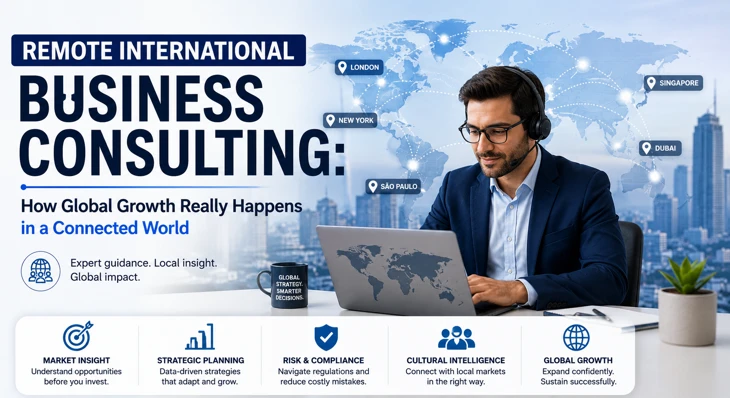
Remote International Business Consulting: How Global Growth Really Happens in a Connected World
A few years ago, expanding a business internationally felt like something only large corporations could afford. You needed offices in different countries, long travel schedules, and teams scattered across time zones. Today, things look very different.
Businesses now scale across borders without ever leaving their home base. Meetings happen online. Strategies are built in shared documents. Decisions are made in real time across continents.
And sitting quietly at the center of this shift is
remote international business consulting—a modern way of guiding companies through global expansion without physical boundaries.
It’s not just about advice anymore. It’s about helping businesses actually enter new markets with clarity, speed, and fewer costly mistakes.
What Remote International Business Consulting Really Feels Like in Practice
Forget the formal definition for a moment. In real life, remote international business consulting is more like having a global partner who understands markets you’ve never worked in.
One day, a company might be planning to enter Southeast Asia. Next, they’re trying to understand pricing in Europe. Instead of guessing, they lean on someone who already knows how those regions behave.
This kind of consulting usually covers things like:
- Figuring out whether a market is actually worth entering
- Understanding what customers in that region expect
- Breaking down competitors who already dominate the space
- Helping adjust products so they fit local demand
- Guiding compliance so nothing goes wrong legally
It’s practical, grounded work. Less theory, more real-world direction.
Why This Model Is Becoming the Default Choice for Global Expansion
If you look closely, the shift toward remote consulting didn’t happen overnight. It crept in slowly as businesses realized something important—global expansion doesn’t require physical presence as much as it requires accurate insight.
Spending Less Without Slowing Down Growth
Opening offices abroad used to be the first step. Now it’s often the last.
Remote international business consulting allows companies to test markets before investing heavily. That alone changes how decisions are made. Instead of committing millions upfront, businesses can explore first, expand later.
Getting Answers Faster Than Traditional Models Allow
In global business, timing matters more than most people realize. A delayed entry can mean losing an entire market opportunity.
Remote consultants shorten that cycle. Instead of waiting weeks for reports or travel schedules, companies get direct insights almost instantly.
Learning From People Who Already Know the Market
Every country has its own rhythm. What feels like a strong strategy in one place might fall flat somewhere else.
Experienced consultants bring that lived understanding. They’ve seen what works and what doesn't, which saves companies from expensive trial and error.
The Work That Actually Happens Behind the Scenes
Most people think consulting is just presentations and strategy decks. But remote international consulting is far more layered than that.
Market Research That Actually Reflects Reality
Good research is not just about collecting numbers. It’s about understanding what those numbers mean in context.
For example, a product might show strong demand in one region, but purchasing behavior could still be inconsistent. A consultant helps interpret that gap.
They look at:
- Local buying habits
- Seasonal demand shifts
- Price sensitivity
- Cultural influence on purchasing decisions
This is where decisions become sharper and more reliable.
Strategy That Adapts Instead of Staying Fixed
Global expansion rarely follows a straight line. What works in one country might need adjustment in another.
Remote consultants help shape flexible strategies—ones that evolve as new information comes in instead of staying rigid.
That might mean changing entry models midway or repositioning a product based on early feedback.
Compliance Without the Confusion
Legal frameworks across countries can feel overwhelming. Taxes, import rules, licensing requirements—it’s a lot to handle.
A remote international business consultant simplifies this by breaking it down into steps that make sense for the business, rather than overwhelming them with legal complexity.
Cultural Understanding That Shapes Real Outcomes
This part is often underestimated.
A message that works in one country might feel completely off in another. Even product colors, packaging style, or tone of communication can change customer response.
Consultants help businesses avoid those silent mistakes that don’t show up in spreadsheets but show up in sales.
A Real Scenario That Shows How It Plays Out
Let’s take a simple example.
A mid-sized electronics brand in India wants to expand into Europe. They have a strong product, good domestic sales, and growing demand.
Instead of jumping straight into setting up operations abroad, they work with a remote international business consulting expert.
Here’s what actually happens over the next few months:
First, the consultant studies demand across different European countries. Not all markets behave the same—Germany might value durability, while Spain may focus more on pricing.
Then, pricing structures are adjusted. Not reduced blindly, but aligned with purchasing behavior in each region.
Next comes distribution planning. Instead of shipping everywhere, they focus on specific entry points where logistics are easier.
Marketing is also adjusted. The tone becomes more localized, less generic.
Slowly, the brand enters two markets—not with a big splash, but with controlled, steady growth.
And that’s the key difference. It’s not rushed. It’s structured.
Skills That Make Remote Consultants Effective in Real Situations
This work isn’t about one skill. It’s a mix of several abilities working together.
Thinking Beyond Surface-Level Data
Numbers alone don’t tell the full story. A strong consultant reads between the lines and connects patterns that aren’t obvious at first glance.
Clear Communication Without Overcomplication
Since everything happens remotely, clarity becomes essential. If something is unclear, it slows everything down.
Good consultants keep things simple and direct.
Understanding People Across Cultures
Markets are shaped by people, and people behave differently everywhere.
Recognizing those differences helps shape better strategies.
Handling Uncertainty Without Panic
Global expansion rarely goes exactly as planned. Adjustments are constant.
The ability to stay calm and recalibrate quickly is a major advantage.
Comfort With Digital Systems
From analytics dashboards to collaboration tools, everything runs through technology. Comfort with these systems keeps workflows smooth.
Challenges That Come With Remote Global Consulting
It’s not a perfect system, and it’s important to understand where things can get tricky.
Time zones can stretch communication cycles. Something simple might take longer just because teams are asleep in different parts of the world.
Miscommunication can happen more easily when people are not in the same room. Tone doesn’t always translate well through messages.
Security of information is another concern. Sensitive business data needs careful handling and proper systems.
And sometimes, not being physically present in a market means missing small but important details that only show up on the ground.
Still, businesses continue to use this model because the advantages outweigh the limitations when it is done properly.
How Businesses Get Better Results From Remote Consulting
Companies that achieve strong results usually don’t treat consulting as a one-time input. They treat it as a working relationship.
They define clear goals from the beginning instead of vague expectations. They stay involved rather than passively waiting for reports. They ask questions, challenge assumptions, and stay flexible when the market shifts.
Most importantly, they stay open to changing direction when data suggests something different.
That willingness often makes the biggest difference between success and stagnation.
Where This Is All Heading
The future of remote international business consulting is not slowing down—it’s expanding.
Artificial intelligence will play a bigger role in analyzing global markets faster than humans alone ever could.
Companies will rely more on distributed teams instead of centralized offices.
Consultants will become more specialized, focusing deeply on specific industries or regions rather than general global advice.
And many businesses will adopt hybrid models, mixing remote strategy with occasional on-ground visits for deeper understanding.
The direction is clear: global business is becoming more flexible, more connected, and more digital.
FAQs
What is remote international business consulting in simple terms?
It is a way to help businesses expand into global markets by using online communication instead of in-person consulting.
Who benefits the most from it?
Startups, growing companies, and established businesses planning international expansion benefit the most.
Is it effective for entering new countries?
Yes, especially when combined with proper research, planning, and experienced guidance.
Which industries use it the most?
Technology, e-commerce, manufacturing, and service-based industries use it widely.
What makes it different from traditional consulting?
The biggest difference is flexibility. Everything is done remotely, making it faster and more scalable.
Conclusion
Global expansion is no longer about how big a company is—it’s about how well it understands new markets and adapts to them.
Remote international business consulting has become a practical way to achieve that. It removes unnecessary barriers, speeds up decision-making, and helps businesses move with more confidence into unfamiliar regions.
For companies aiming to grow beyond borders, this approach isn’t just convenient anymore. It’s becoming the standard way to think about global growth.