📚 Table of Contents
- Introduction
- What Remote Risk Management Consulting Really Means
- Why Remote Risk Management Consulting Is Growing So Fast
- Businesses are now digital-first
- Teams are spread across the world
- Cyber threats are getting smarter
- It saves time and cost
- Key Skills Needed in Remote Risk Management Consulting
- Strong risk identification skills
- Understanding compliance and regulations
- Awareness of cybersecurity fundamentals
- Data reading and interpretation
- Clear and simple communication
- Comfort with digital tools
- Salary Trends in Remote Risk Management Consulting
- Entry-level stage
- Mid-level stage
- Senior-level professionals
- What affects salary growth
- Global Demand for Remote Risk Consultants
- North America
- Europe
- Asia-Pacific
- Middle East and Africa
- Tools That Make Remote Risk Consulting Possible
- A Real-World Scenario
- Career Paths in Remote Risk Management Consulting
- Future of Remote Risk Management Consulting
- FAQs
- What does a remote risk management consultant do daily?
- Is remote risk management consulting a stable career?
- Do I need technical skills for this role?
- Can freshers enter this field remotely?
- Which industries hire risk consultants the most?
- What makes this career future-proof?
- Conclusion
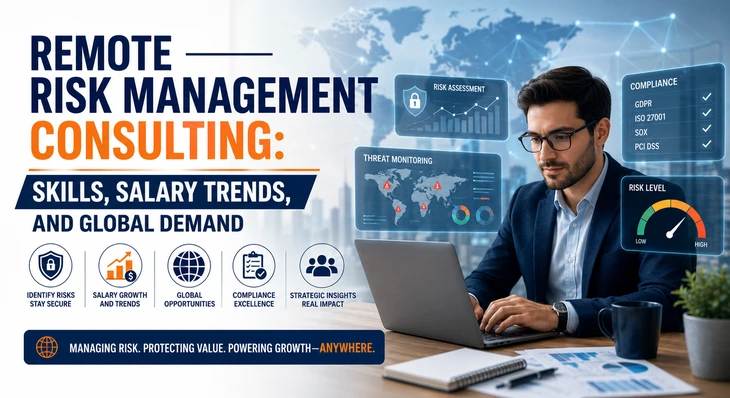
Remote Risk Management Consulting: Skills, Salary Trends, and Global Demand
Introduction
Risk today doesn’t sit still. It moves with businesses—across countries, systems, and digital platforms. A decade ago, risk management usually meant onsite audits, long meetings, and heavy paperwork. Now, things look very different. Remote risk management consulting has quietly become one of the most important support systems for modern businesses. Professionals in this space help companies spot problems early, reduce exposure, and stay compliant—all without ever setting foot in a physical office. What’s driving this shift? Simple. Businesses are going global, teams are distributed, and most operations now run in the cloud. That mix creates opportunity, but it also creates risk. And that’s exactly where remote risk consultants step in. From banking systems that handle millions of transactions daily to startups scaling across borders, organizations rely on remote experts to keep operations stable and secure. In this guide, we’ll break down what the role actually looks like, the must-have skills, realistic salary trends, and why global demand for remote risk management consulting keeps rising year after year.What Remote Risk Management Consulting Really Means
At its core, remote risk management consulting is about identifying what could go wrong in a business—and figuring out how to prevent it before it happens. The only real difference today is location. Instead of being physically present, consultants work through dashboards, cloud platforms, reports, and virtual meetings. Think of it like this: a business is running at full speed, often in multiple countries at once. A remote risk consultant acts like a safety radar, constantly scanning for issues such as:- Cybersecurity threats and data breaches
- Financial inconsistencies or fraud patterns
- Compliance gaps in different regions
- Operational bottlenecks
- Supply chain interruptions
Why Remote Risk Management Consulting Is Growing So Fast
This field didn’t grow overnight. It evolved alongside digital transformation, remote work culture, and rising global complexity.Businesses are now digital-first
Most companies don’t just “use” technology anymore—they are built on it. From cloud storage to SaaS platforms, everything runs digitally. Naturally, this creates new types of risks that require constant monitoring.Teams are spread across the world
It’s common now for a company to have teams in India, the US, and Europe working on the same project. While this improves efficiency, it also complicates risk tracking. Remote consultants help bring structure to that complexity.Cyber threats are getting smarter
Cybersecurity isn’t just an IT issue anymore—it’s a business survival issue. Attacks are more frequent, more targeted, and more expensive. Companies need experts who can spot vulnerabilities early and respond quickly.It saves time and cost
Hiring full-time in-house risk teams in every region is expensive. Remote consulting offers a flexible, scalable alternative without compromising expertise. Put simply, businesses want agility—and remote risk consultants provide exactly that.Key Skills Needed in Remote Risk Management Consulting
This is not a role you can step into casually. It requires a balanced mix of technical thinking, business understanding, and communication clarity.Strong risk identification skills
The ability to notice small warning signs before they become big problems is the heart of this profession. It’s part logic, part experience, and part intuition built over time.Understanding compliance and regulations
Whether it’s GDPR in Europe or financial compliance rules in banking systems, consultants must understand how regulations differ across regions and industries.Awareness of cybersecurity fundamentals
You don’t need to be a hacker—but you do need to understand how breaches happen, how data leaks occur, and how systems get compromised.Data reading and interpretation
Most decisions are driven by data. A good consultant knows how to read patterns, question anomalies, and turn raw numbers into meaningful insights.Clear and simple communication
This is often underestimated. You might uncover complex risks, but if you can’t explain them clearly, they lose value. Strong remote consultants know how to simplify without losing accuracy.Comfort with digital tools
From risk dashboards to cloud-based reporting systems, digital tools are part of everyday work. The more comfortable you are with them, the smoother your workflow becomes.Salary Trends in Remote Risk Management Consulting
Let’s talk numbers—but realistically.Entry-level stage
At the beginning, professionals usually assist with data reviews, documentation, and basic analysis tasks. Even at this stage, compensation is competitive compared to many traditional roles.Mid-level stage
With a few years of experience, consultants start handling independent projects. This is where salary growth becomes noticeable, especially if you can manage client communication and deliver insights confidently.Senior-level professionals
At senior levels, things change significantly. Experienced consultants—especially those specializing in cybersecurity risk, financial systems, or regulatory compliance—often command high salaries or consultancy fees. Many also move into independent consulting, working with multiple clients across different countries.What affects salary growth
A few key factors make a big difference:- Industry (finance, healthcare, IT, etc.)
- Certifications like FRM, CISA, CRM
- Complexity of risk environments
- Global client exposure
- Ability to work independently
Global Demand for Remote Risk Consultants
One of the most interesting things about this career is how universal the demand is.North America
Companies in the US and Canada operate under strict regulations and high cybersecurity expectations. That creates steady demand for experienced consultants.Europe
With strict data protection laws like GDPR, businesses need constant compliance support. Risk consultants play a major role in keeping operations legally sound.Asia-Pacific
Fast-growing digital economies like India, Singapore, and Australia are scaling rapidly, creating strong opportunities for remote consulting roles.Middle East and Africa
These regions are investing heavily in infrastructure, finance, and technology—each of which requires structured risk planning. The takeaway? This is not a region-specific career. It’s truly global.Tools That Make Remote Risk Consulting Possible
Without technology, remote risk consulting wouldn’t work. Professionals rely on:- Cloud-based risk management systems
- Data analytics dashboards
- Cybersecurity monitoring tools
- Compliance tracking software
- Collaboration platforms like virtual meeting tools and shared workspaces
A Real-World Scenario
Let’s make this more practical. A global e-commerce company is preparing to expand into three new countries. Everything looks promising—but each market has distinct tax laws, customer-behavior risks, and cybersecurity concerns. A remote risk management consultant is brought in to:- Review legal and compliance requirements in each country
- Identify potential fraud risks in payment systems
- Evaluate supply chain reliability
- Suggest improvements before launch
Career Paths in Remote Risk Management Consulting
This field offers flexibility in how you grow your career. Common roles include:- Risk Analyst
- Compliance Consultant
- Cyber Risk Advisor
- Financial Risk Specialist
- Operational Risk Manager
Future of Remote Risk Management Consulting
If there’s one thing clear about this field, it’s that it’s not slowing down. In fact, it’s evolving quickly. We’re already seeing:- AI-driven risk detection systems are becoming more common
- Automation handling routine compliance checks
- Remote-first consulting firms expanding globally
- Higher demand for cybersecurity-focused specialists