📚 Table of Contents
- How Remote Pricing Analysis Really Works in Today’s Market
- Why Retail and FMCG Are Driving Demand for Pricing Analysts
- Everything is moving faster
- FMCG markets are highly competitive
- Data is now the decision-maker
- Remote work is now normal
- What a Remote Pricing Analyst Actually Does Day-to-Day
- Studying pricing trends
- Adjusting pricing models
- Running scenario analysis
- Coordinating with teams
- Tracking performance
- Skills That Actually Matter in Remote Pricing Analysis Jobs
- Strong analytical mindset
- Excel and data tools proficiency
- Understanding of market behavior
- Communication skills
- Business awareness
- Where Remote Pricing Analysts Are Needed the Most
- Retail companies
- FMCG organizations
- E-commerce platforms
- Consulting firms
- Career Growth in Remote Pricing Analysis
- Entry-level stage
- Mid-level stage
- Senior stage
- A Simple Real-World Example from FMCG
- Tools That Make Remote Pricing Work Possible
- Data tools
- Visualization platforms
- Pricing software
- Challenges You Should Expect in This Career
- Too much data
- Fast-changing markets
- Communication gaps in remote setups
- High responsibility
- Future Scope of Remote Pricing Analysis
- How to Start Your Journey in This Field
- FAQs
- What is remote pricing analysis in simple terms?
- Is pricing analysis a good career in retail and FMCG?
- Do I need coding skills for pricing analyst remote jobs?
- Which industries hire remote pricing analysts the most?
- Can beginners enter this field easily?
- What is the future of pricing strategy careers?
- Conclusion
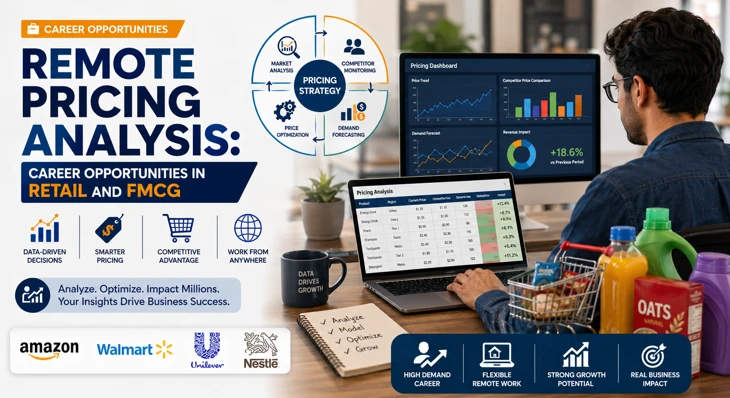
Remote Pricing Analysis: Career Opportunities in Retail and FMCG
Pricing today is no longer something decided in a boardroom based on instinct or past experience. It has become deeply analytical, fast-moving, and closely tied to real-time market behavior. One of the most in-demand roles shaping this shift is remote pricing analysis, especially across the retail and FMCG sectors. What makes this career path interesting is not just the technical side of it, but the fact that you can now work from anywhere while influencing how global products are priced and positioned. From everyday grocery items to high-demand online products, pricing analysts quietly shape decisions that directly impact sales, profit, and customer behavior.How Remote Pricing Analysis Really Works in Today’s Market
At its core, remote pricing analysis is about studying data to decide the most effective price for a product. But in practice, it’s much more dynamic than that. A pricing analyst working remotely looks at competitor pricing, customer demand patterns, seasonality, and internal cost structures. The goal is simple: find a price that keeps customers interested while ensuring healthy profit margins. In retail and FMCG environments, prices don’t stay still for long. They shift based on promotions, demand spikes, supply chain changes, and even regional buying behavior. Companies like entity["company","Amazon","global e-commerce and cloud computing company"] and entity["company","Walmart","multinational retail corporation"] have built entire pricing ecosystems powered by analytics teams who work continuously behind the scenes. What’s changed in recent years is that many of these roles no longer require a physical office. With cloud platforms and advanced dashboards, analysts can now work from home while still accessing everything they need in real time.Why Retail and FMCG Are Driving Demand for Pricing Analysts
The growth of remote pricing analyst roles isn’t random. It’s directly tied to how the retail and FMCG industries operate today.Everything is moving faster
Online shopping has changed customer expectations. People compare prices instantly, switch brands quickly, and expect constant value. This forces companies to adjust pricing strategies more frequently than ever before.FMCG markets are highly competitive
Brands like entity["company","Unilever","British multinational consumer goods company"] and entity["company","Nestlé","Swiss multinational food and beverage company"] operate in environments where even a small pricing change can shift market share.Data is now the decision-maker
Instead of guessing, companies now rely on dashboards, predictive models, and AI-driven insights. This shift has made pricing analysis a core function rather than a support role.Remote work is now normal
Since most pricing work happens on spreadsheets, databases, and analytics tools, physical presence is no longer necessary. That flexibility has opened opportunities globally.What a Remote Pricing Analyst Actually Does Day-to-Day
The job sounds technical, but once you break it down, it becomes more structured and logical. A typical day might include:Studying pricing trends
Looking at competitor websites, market reports, and internal sales data to understand where the business stands.Adjusting pricing models
Updating pricing formulas based on new data inputs such as cost changes, demand fluctuations, or promotional campaigns.Running scenario analysis
Testing what happens if prices go up, down, or remain stable. This helps companies avoid risky decisions.Coordinating with teams
Even remotely, pricing analysts regularly interact with marketing, sales, and product teams to ensure pricing aligns with business goals.Tracking performance
After changes are made, they measure how those adjustments impact revenue, conversion rates, and customer behavior. It’s not just number crunching. It’s decision support that directly influences business outcomes.Skills That Actually Matter in Remote Pricing Analysis Jobs
You don’t need to be a math genius, but you do need structured thinking and comfort with data.Strong analytical mindset
You should be able to look at raw data and identify patterns without getting overwhelmed.Excel and data tools proficiency
Excel is still widely used, but SQL, Power BI, and Tableau are becoming standard expectations.Understanding of market behavior
Knowing how customers react to pricing changes is more valuable than memorizing formulas.Communication skills
Insights are useless if you cannot explain them clearly to non-technical teams.Business awareness
You need to understand how pricing affects profit margins, demand, and brand positioning.Where Remote Pricing Analysts Are Needed the Most
This career is not limited to one type of company. It spans multiple industries.Retail companies
Retailers constantly adjust prices based on demand, competition, and inventory levels.FMCG organizations
These companies deal with large-scale product distribution where even small pricing decisions can have a massive financial impact.E-commerce platforms
Companies like entity["company","Amazon","global e-commerce and cloud computing company"] use automated pricing systems supported by human analysts.Consulting firms
Many consultants provide pricing strategies for multiple clients across industries, often relying on remote analysts for data insights.Career Growth in Remote Pricing Analysis
One of the most appealing aspects of this field is how structured the growth path is. You typically start small, working on data support or junior analyst tasks. Over time, you move into deeper decision-making roles.Entry-level stage
At this stage, you focus on collecting data, cleaning reports, and supporting senior analysts.Mid-level stage
Here, you begin building pricing models and contributing to real pricing decisions.Senior stage
Senior analysts and managers lead pricing strategy, oversee teams, and influence major business decisions. Eventually, professionals move into roles like revenue optimization lead or pricing strategy consultant.A Simple Real-World Example from FMCG
Imagine a beverage company launching a new energy drink. The pricing team studies:- Competitor prices in different regions
- Customer purchasing power
- Production and distribution costs
- Seasonal demand patterns