📚 Table of Contents
- Understanding Trade Compliance Consulting in a Global Economy
- Why Remote Trade Compliance Careers Are Growing Rapidly
- Essential Skills Needed for a Remote Trade Compliance Consultant
- 1. Knowledge of Import-Export Regulations
- 2. Understanding of Global Trade Laws
- 3. Analytical and Problem-Solving Skills
- 4. Communication and Advisory Skills
- 5. Digital and Compliance Tools Proficiency
- How to Start a Remote Career in Trade Compliance Consulting
- Build a Strong Educational Foundation
- Gain Practical Experience
- Specialize in a Niche Area
- Develop a Remote-Friendly Skill Set
- Build Your Professional Brand
- Common Career Paths in Trade Compliance Consulting
- Full-Time Remote Consultant
- Freelance Trade Compliance Consultant
- Independent Compliance Advisor
- Hybrid Corporate Consultant
- Tools and Technologies That Support Remote Compliance Work
- Challenges in Remote Trade Compliance Consulting (And How to Overcome Them)
- Staying Updated with Constant Regulatory Changes
- Managing Cross-Border Communication
- Handling Complex Compliance Cases Remotely
- Real-Life Example: A Remote Consultant’s Impact
- Future Scope of Trade Compliance Consulting Careers
- FAQs
- 1. What does a trade compliance consultant do remotely?
- 2. Do I need certification to become a trade compliance consultant?
- 3. Can beginners start a career in remote trade compliance consulting?
- 4. Is trade compliance consulting a good remote career option?
- 5. What industries hire trade compliance consultants?
- Conclusion
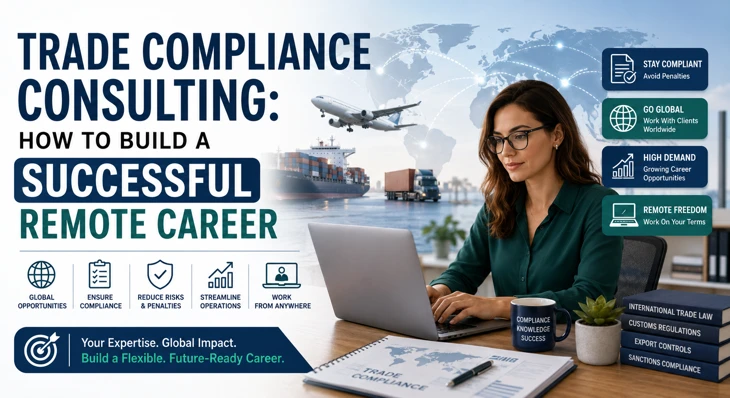
Trade Compliance Consulting: How to Build a Successful Remote Career
In today’s globally connected economy, businesses are expanding across borders faster than ever. With that growth comes a complex web of import-export regulations, customs requirements, and international trade laws. This is where trade compliance consulting becomes not just relevant—but essential. And for professionals seeking flexibility, it also opens the door to a rewarding remote career path. This guide explores how to build a successful remote career in trade compliance consulting, the skills you need, how to get started, and how to position yourself as a trusted expert in this high-demand field.Understanding Trade Compliance Consulting in a Global Economy
Trade compliance consulting focuses on helping businesses ensure that their international trade activities comply with legal and regulatory requirements. These include customs regulations, export control laws, sanctions compliance, and documentation accuracy. Companies engaged in global trade rely on consultants to reduce risks, avoid penalties, and streamline operations. As supply chains become more interconnected, the demand for professionals with deep knowledge of international trade compliance continues to rise. A remote trade compliance consultant can work with clients across different countries without being physically present, making this one of the most flexible and scalable career options in the compliance industry.Why Remote Trade Compliance Careers Are Growing Rapidly
The shift toward remote work has transformed traditional consulting roles. Trade compliance is no exception. Organizations now prefer hiring remote compliance professionals for several reasons:- Access to global talent without geographical limitations
- Reduced operational costs compared to in-house teams
- Faster response times across time zones
- Increased flexibility in managing complex trade operations
Essential Skills Needed for a Remote Trade Compliance Consultant
To succeed in this field, you need a strong blend of technical knowledge, analytical thinking, and communication skills.1. Knowledge of Import-Export Regulations
A deep understanding of customs regulations, tariff classifications, and trade agreements is fundamental. You should be familiar with frameworks such as HS codes, export licensing, and documentation requirements.2. Understanding of Global Trade Laws
Trade laws vary from country to country. A successful consultant stays up to date on international trade policies, sanctions lists, and regulatory changes that affect cross-border commerce.3. Analytical and Problem-Solving Skills
You will often need to identify compliance gaps, analyze supply chain risks, and recommend corrective actions. Strong analytical thinking helps in making accurate, risk-free decisions.4. Communication and Advisory Skills
Since you’ll be working remotely, clear communication becomes even more important. You must be able to explain complex compliance requirements to clients and stakeholders in simple terms.5. Digital and Compliance Tools Proficiency
Familiarity with compliance software, ERP systems, and digital documentation tools is essential for efficient remote work.How to Start a Remote Career in Trade Compliance Consulting
Breaking into this field requires a combination of education, experience, and strategic positioning.Build a Strong Educational Foundation
A background in international business, law, finance, or supply chain management is highly beneficial. Many professionals also pursue certifications in customs compliance or trade regulations to strengthen their expertise.Gain Practical Experience
Before going fully remote, work in roles related to import-export operations, logistics, or compliance departments. Hands-on experience with documentation and regulatory processes is invaluable.Specialize in a Niche Area
Instead of trying to cover everything, focus on a specific niche such as export control compliance, customs valuation, or sanctions compliance. Specialization increases your credibility and market value.Develop a Remote-Friendly Skill Set
Learn how to manage clients digitally, use cloud-based tools, and collaborate across time zones. Strong remote work discipline is essential for success.Build Your Professional Brand
Create a strong online presence showcasing your expertise in trade compliance consulting services. Share insights, write articles, and engage in professional networks to build credibility.Common Career Paths in Trade Compliance Consulting
There are multiple ways to structure your career in this field, depending on your goals and experience level.Full-Time Remote Consultant
You can work with a consulting firm or multinational company as a remote compliance specialist. This provides stability and structured growth.Freelance Trade Compliance Consultant
Freelancing allows you to work independently with multiple clients. This path offers flexibility and higher earning potential but requires strong self-management.Independent Compliance Advisor
Experienced professionals often transition into advisory roles, offering strategic guidance to companies on global trade compliance frameworks.Hybrid Corporate Consultant
Some professionals combine remote consulting with periodic onsite audits or training sessions for clients.Tools and Technologies That Support Remote Compliance Work
Technology plays a major role in enabling remote trade compliance careers. Some commonly used tools include:- Trade compliance management systems
- Cloud-based document storage platforms
- ERP systems integrated with supply chain modules
- Customs declaration software
- Communication tools for virtual collaboration
Challenges in Remote Trade Compliance Consulting (And How to Overcome Them)
While the career is rewarding, it also comes with challenges that require proactive solutions.Staying Updated with Constant Regulatory Changes
Trade laws frequently change. To overcome this, subscribe to regulatory updates, attend webinars, and join industry forums.Managing Cross-Border Communication
Time zone differences and cultural variations can create communication gaps. Clear documentation and structured communication help reduce misunderstandings.Handling Complex Compliance Cases Remotely
Some cases require deep investigation and collaboration with multiple stakeholders. Using digital collaboration tools and maintaining detailed records helps streamline the process.Real-Life Example: A Remote Consultant’s Impact
Consider a consultant working with a mid-sized e-commerce company expanding into Europe. The company struggled with customs delays and incorrect tariff classifications. A remote trade compliance consultant stepped in, reviewed their documentation processes, corrected classification errors, and implemented a digital compliance tracking system. Within months, the company reduced shipment delays significantly and avoided potential penalties—demonstrating the tangible value of expert compliance guidance.Future Scope of Trade Compliance Consulting Careers
The future of this field is highly promising. With increasing globalization and stricter trade regulations, demand for skilled professionals continues to grow. Key trends shaping the future include:- Automation of customs and compliance processes
- AI-driven risk assessment tools
- Expansion of cross-border e-commerce
- Increased focus on sustainability and ethical sourcing compliance