📚 Table of Contents
- What Remote Venture Capital Analysis Really Involves
- Why Global VC Careers Are Expanding So Rapidly
- Skills That Shape a Strong Remote VC Career
- Financial Thinking That Goes Beyond Numbers
- Understanding Startup Ecosystems
- Research That Turns into Insight
- Clear and Structured Communication
- How to Enter Remote Venture Capital Analysis, Roles
- Build a Strong Foundation in Business Thinking
- Learn How Startups Are Evaluated
- Gain Real Exposure Through Projects
- Build Relationships in the Ecosystem
- Tools That Power Remote Venture Capital Analysis
- Real Challenges in Remote VC Work
- Limited Physical Interaction
- Too Much Information
- Time Zone Gaps
- Increasing Competition
- Career Growth in Global VC Careers
- A Realistic Example of a Remote VC Journey
- The Future of Remote Venture Capital Analysis
- FAQs
- What is remote venture capital analysis?
- Can beginners enter global VC careers?
- What skills matter most in VC roles?
- Are remote VC jobs difficult to get?
- What tools are used in VC analysis?
- Conclusion
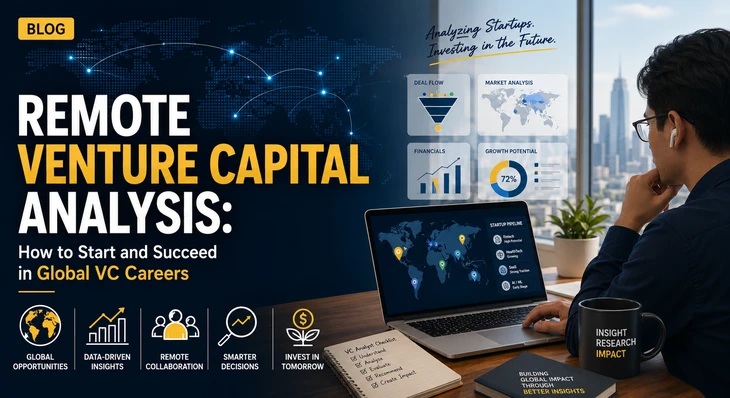
Remote Venture Capital Analysis: How to Start and Succeed in Global VC Careers
The venture capital world is no longer confined to glass towers in major financial hubs. It is evolving into something far more open, distributed, and global. Today, professionals can build meaningful careers in remote venture capital analysis, working with startups across continents while collaborating entirely online. This shift has changed who gets access to venture capital careers. You no longer need to live in Silicon Valley or London to participate in deal flow, evaluate startups, or support investment decisions. With the right skills and mindset, you can contribute to global VC careers from almost anywhere in the world. What makes this space especially interesting is how fast it moves. New industries emerge quickly, startup ecosystems evolve in different regions, and investors rely heavily on data-driven insights rather than physical presence. Remote VC professionals sit right at the center of this transformation.What Remote Venture Capital Analysis Really Involves
At its core, remote venture capital analysis is about evaluating startups and investment opportunities without being physically present in an office or local market. Everything happens through digital collaboration tools, research platforms, and virtual communication. Professionals working in this space typically:- Study startup business models and growth potential
- Review financial performance and projections
- Analyze markets, competitors, and customer behavior
- Support investment teams with structured research
- Identify emerging sectors and global trends
Why Global VC Careers Are Expanding So Rapidly
The rise of global VC careers is not accidental. Several real shifts in the industry are driving this change: One major factor is the globalization of startups. Founders are now building companies in every region, not just traditional tech hubs. Investors need analysts who understand these diverse markets. Another factor is technology. Tools for communication, data analysis, and collaboration have enabled teams to work together across time zones without friction. Cost efficiency also plays a role. VC firms are increasingly open to hiring talent remotely because it allows them to access specialized skills without geographic limitations. Finally, decision-making itself has become more data-focused. Investment choices are increasingly based on structured analysis rather than location-based intuition.Skills That Shape a Strong Remote VC Career
Succeeding in remote venture capital analysis requires a combination of financial understanding, research ability, and strong communication skills.Financial Thinking That Goes Beyond Numbers
You don’t need to be a Wall Street expert, but you must understand how startups create and lose value. That includes:- Revenue models and monetization strategies
- Cash flow and burn rate
- Unit economics and scalability
- Basic valuation thinking
Understanding Startup Ecosystems
Every market behaves differently. A consumer app that works in India may not perform the same way in Europe. A strong VC analyst understands these differences and factors them into decision-making. This includes awareness of:- Regional demand patterns
- Regulatory environments
- Industry maturity levels
- Cultural buying behavior
Research That Turns into Insight
Raw data is everywhere. The real skill lies in turning information into insight. Remote VC analysts spend a lot of time studying reports, startup databases, and founder materials to identify meaningful signals.Clear and Structured Communication
Since most work happens online, clarity is everything. Investment memos, summaries, and research notes must be easy to read and logically structured so decision-makers can act quickly.How to Enter Remote Venture Capital Analysis, Roles
Starting a career in VC is less about shortcuts and more about consistent skill-building and exposure to real startup environments.Build a Strong Foundation in Business Thinking
Most professionals in this field come from backgrounds like finance, economics, consulting, or data analytics. However, career switchers from engineering or operations also enter VC by developing analytical thinking and startup knowledge.Learn How Startups Are Evaluated
Understanding how investors think is essential. This includes studying:- Market sizing methods (TAM, SAM, SOM)
- Competitive positioning
- Product-market fit signals
- Growth trajectory indicators
Gain Real Exposure Through Projects
Experience matters more than titles in early VC careers. You can build credibility by:- Assisting early-stage funds with research
- Supporting startup accelerators
- Writing investment breakdowns
- Working on freelance market research projects
Build Relationships in the Ecosystem
VC is still a relationship-driven industry. Many opportunities come through networks rather than job boards. Engaging with founders, analysts, and investors on platforms like LinkedIn or virtual startup communities can significantly increase visibility.Tools That Power Remote Venture Capital Analysis
Remote VC professionals rely heavily on digital tools to stay organized and efficient. Some commonly used platforms include:- Startup databases for company research and tracking
- Spreadsheet tools for financial modeling and comparisons
- Collaboration tools for team communication
- Note-taking systems for organizing deal flow insights
- Data platforms that track market and funding trends
Real Challenges in Remote VC Work
While remote venture capital careers are exciting, they also come with challenges that require adaptability.Limited Physical Interaction
Building trust with founders and investors can take longer when everything happens online. Strong communication becomes essential.Too Much Information
With global access to startups, analysts often face overwhelming amounts of data. Filtering what truly matters is a skill in itself.Time Zone Gaps
Working across continents means meetings and decisions often happen at odd hours. Flexibility becomes part of the job.Increasing Competition
As remote opportunities grow, more professionals enter the space. Continuous learning becomes necessary to stay relevant.Career Growth in Global VC Careers
Once you establish yourself in global VC careers, several paths open up. You might move into investment roles where you help decide how capital is allocated. Some professionals become venture partners, supporting deal sourcing and strategy. Others transition into advisory roles, working closely with startups on growth and fundraising. A few eventually move into angel investing or start their own funds after gaining enough experience and network depth.A Realistic Example of a Remote VC Journey
Imagine an analyst working remotely for a European VC firm while based in Asia. Their focus is on emerging markets. They begin by researching fintech startups across Southeast Asia and Africa. Over time, they develop a deep understanding of how digital payments evolve in these regions. One of their research insights helps the firm invest early in a startup that later expands internationally. That single contribution builds credibility and opens the door to more decision-making responsibilities. This is how remote VC careers often grow—step by step, through consistent research and insight.The Future of Remote Venture Capital Analysis
The direction of venture capital is becoming increasingly borderless. Remote collaboration is no longer an experiment—it is becoming standard practice. In the coming years, we will likely see:- More distributed investment teams across continents
- AI-supported startup screening and deal sourcing
- Greater focus on emerging markets
- Flexible global hiring models in VC firms