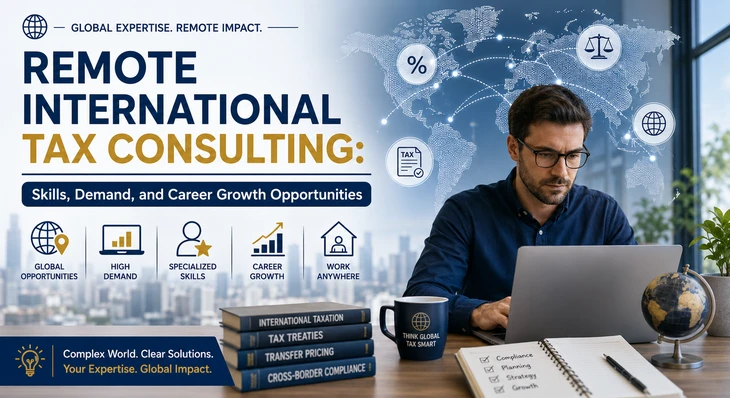
Remote International Tax Consulting: Skills, Demand, and Career Growth Opportunities
Introduction
There’s a quiet shift happening in the finance world that most people outside the industry barely notice.
A tax consultant in one country can now help a startup on the other side of the world without ever stepping into an office. A freelancer working from a small apartment can advise a multinational team spread across three continents. Ten years ago, this would have sounded unusual. Today, it’s just another Tuesday in global finance.
Remote international tax consulting sits right at the center of this change.
It blends law, finance, and cross-border strategy—but the real story is simpler: businesses are no longer local, so tax expertise can’t afford to be either.
For professionals in accounting or taxation, this shift isn’t just a trend. It’s a doorway into a career that feels more global, more flexible, and often more interesting than traditional office-based roles.
What This Work Actually Looks Like
At first glance, international tax consulting sounds rigid and technical. And yes, the rules matter. A lot. But daily work is often more dynamic than people expect.
One day might involve helping a SaaS company figure out how to expand into Europe without getting tangled in compliance issues. Another day could be about advising an individual who works remotely for clients in three different countries and is unsure where they owe taxes.
Nothing about it is one-size-fits-all.
The core idea is simple, though: money crosses borders, and every border has its own tax logic. A consultant’s job is to make those systems work together without creating unnecessary risk or cost.
Unlike domestic tax roles, there’s rarely a single “correct” answer. Instead, there are trade-offs between compliance, efficiency, and long-term business goals.
And that’s where experience starts to matter more than textbooks.
Why This Field Is Growing So Fast
If you zoom out, the rise in demand starts to make sense.
Businesses are expanding globally earlier than ever. A small tech startup might launch with users in five countries before it even hires its tenth employee. E-commerce sellers are reaching international customers from day one. And remote work has blurred the line between where someone lives and where they earn income.
All of that creates tax questions that didn’t really exist in the same way before.
At the same time, governments are tightening rules around cross-border income. Digital taxation is evolving quickly, and companies are expected to keep up or face penalties.
So businesses are stuck in a position where they need guidance—but not necessarily full-time, in-house experts in every country. That’s where remote consultants step in.
They bring specialized knowledge without requiring physical presence, which makes the model both efficient and scalable.
Skills That Actually Make a Difference
There’s a common misconception that international tax consulting is all about memorizing complex laws. In reality, the real skill is knowing how to connect pieces that don’t naturally fit together.
Yes, you need a solid understanding of tax systems, treaties, corporate structures, and compliance frameworks. But that’s just the foundation.
What separates a good consultant from a great one is how they think through uncertainty.
For example, a client might ask: “If we shift operations from Country A to Country B, what happens overall?”
The answer isn’t just a tax rate comparison. It involves understanding business intent, long-term expansion plans, and how different jurisdictions interact.
Communication also plays a bigger role than people expect. Clients often don’t struggle with the complexity itself—they struggle with understanding it. If you can’t translate technical detail into simple, practical guidance, your value drops immediately.
And then there’s the remote aspect. You’re constantly switching between time zones, tools, and communication styles. Some clients want detailed reports. Others want quick voice explanations. Flexibility becomes part of your skillset whether you plan for it or not.
Career Paths Don’t Follow One Pattern
There isn’t a single route into this field, which is part of what makes it interesting.
Some professionals start in traditional accounting firms and gradually move into international tax projects. Others begin in corporate finance roles and slowly specialize as they gain exposure to global operations.
And then there are those who step into freelance consulting after building enough experience to handle complex cases independently.
Roles vary depending on focus. Some people work deeply in transfer pricing. Others focus on expatriate taxation or corporate restructuring. A few specialize in fast-growing areas like digital nomad taxation or cross-border freelancing setups.
Industries hiring for this expertise are just as diverse—technology companies, consulting firms, global e-commerce brands, and even startups that suddenly find themselves dealing with international customers.
What’s changing most is flexibility. The traditional “office-first” model is no longer required for this type of work. Many professionals now operate fully remotely, managing clients across multiple countries from a single location.
How People Actually Enter This Field
Most careers in this space build slowly rather than starting with a big leap.
A typical starting point is a background in accounting, finance, or law. From there, professionals usually gain experience in domestic taxation before moving into international cases.
Certifications help, but what really matters early on is exposure. Even small projects involving cross-border transactions can make a big difference over time.
As people grow in the field, they start noticing patterns—how companies structure global operations, how tax treaties influence decisions, and how compliance risks appear in unexpected places.
Remote work skills have also become surprisingly important. It’s not just about doing the job, but doing it across distance—managing communication gaps, handling documentation digitally, and staying organized without in-person oversight.
Eventually, many professionals start building visibility online. A strong professional profile often leads to international opportunities that don’t come through traditional job applications.
Earnings and What Influences Them
Income in this field doesn’t follow a fixed pattern.
Early-stage professionals usually earn stable salaries in structured roles. As expertise grows, compensation increases significantly, especially for those handling complex multinational cases.
Senior consultants who work with global firms or high-value clients often earn at a premium because the stakes are higher and the decisions carry more weight.
Independent consultants have a different trajectory. Income can fluctuate, but the upside is often higher. A strong network of international clients can turn this into a highly rewarding path.
What really drives earnings isn’t just experience—it’s specialization. The more specific your expertise (for example, transfer pricing or digital taxation), the more valuable your input becomes.
Challenges People Don’t Talk About Enough
This career looks smooth from the outside, but it comes with real pressure points.
Tax laws change frequently, and sometimes unexpectedly. What worked last year might not apply today.
There’s also a constant need for accuracy. A small mistake in interpretation can lead to serious financial consequences for clients.
Working remotely adds another layer. You’re coordinating across time zones, often without immediate feedback. That requires discipline and strong organization.
And then there’s data security. You’re handling sensitive financial information, which means systems and habits need to be airtight.
Still, most professionals stay in this field because the work itself is intellectually engaging. It keeps evolving, and that keeps things interesting.
Where This Is All Heading
The future of international tax consulting is becoming more digital, but not less human.
Automation is already handling parts of compliance work, especially repetitive tasks. That doesn’t reduce demand for consultants—it shifts their focus toward higher-level thinking and strategy.
At the same time, remote work is expanding the number of people who need cross-border tax advice. Freelancers, remote employees, and digital entrepreneurs are all creating new types of tax situations.
The result is a field that’s becoming broader, not narrower.
Professionals who stay adaptable—who keep learning as rules and tools change—will likely find themselves in a strong position for years to come.
FAQs
What does a remote international tax consultant actually do?
They help individuals and businesses manage tax responsibilities across multiple countries while working remotely, focusing on compliance and strategic planning.
Is certification necessary for this career?
Not always, but qualifications like CA, CPA, or ACCA significantly improve credibility and career opportunities.
Can this work be done independently?
Yes. Many experienced professionals build independent consulting careers with global clients.
Is this a high-paying field?
It can be, especially for specialists handling complex international cases or working with large organizations.
What matters most for success?
A combination of technical tax knowledge, problem-solving ability, communication skills, and adaptability to remote work environments.
Conclusion
Remote international tax consulting reflects how global work has changed. It’s no longer tied to geography, and it’s no longer limited to traditional office structures.
It’s a field built on complexity—but also on opportunity. For those willing to keep learning and adapt to shifting global rules, it offers something rare: a career that grows alongside the world itself.