📚 Table of Contents
- Introduction: Finance Work Has Quietly Moved Beyond Office Walls
- Understanding Remote Equity Research in Simple Terms
- Why Global Firms Are Embracing Remote Equity Research
- Technology Removed Location Barriers
- Talent Became a Global Search
- Efficiency Became a Priority
- Professionals Wanted Better Balance
- Skills That Actually Matter in This Career Path
- Financial Understanding You Cannot Skip
- Thinking Like an Analyst
- Writing That Feels Clear, Not Complicated
- Tools You’ll Work With Daily
- Education and Background: What Firms Usually Look For
- How People Actually Break Into Remote Equity Research Roles
- Step 1: Learn the Core Skills Properly
- Step 2: Build Something You Can Show
- Step 3: Start Applying Strategically
- Step 4: Network in a Realistic Way
- A Realistic Picture of a Remote Analyst’s Day
- Challenges You Should Not Ignore
- Communication Takes More Effort
- You Must Be Self-Disciplined
- Market Pressure Is Constant
- It Can Feel Isolated at Times
- Salary Reality in Remote Equity Research Careers
- Where This Career Is Heading Next
- Practical Advice for Long-Term Growth
- FAQs: Remote Equity Research Careers
- 1. Is equity research really possible to do remotely?
- 2. Do I need a CFA to get into this field?
- 3. Can beginners apply for remote equity research jobs?
- 4. What industries do equity researchers focus on?
- 5. How stressful is this career?
- 6. Is remote equity research a stable career choice?
- Conclusion: A Career That Moves With the Market
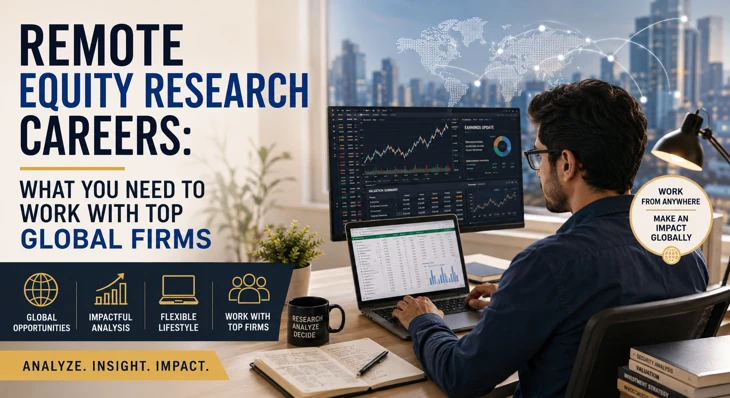
Remote Equity Research Careers: What You Need to Work With Top Global Firms
Introduction: Finance Work Has Quietly Moved Beyond Office Walls
There was a time when equity research almost automatically meant sitting in a high-rise office, surrounded by multiple screens, market tickers flashing in the background, and endless printed reports stacked on desks. That picture still exists—but it no longer defines the profession. Today, remote equity research careers are not just an alternative setup. For many professionals, they’ve become the preferred way of working. Analysts now break down company earnings, study sector trends, and build valuation models from home offices, co-working spaces, or even while traveling. What changed? A mix of better technology, global hiring shifts, and a growing acceptance that insight matters more than physical presence. Top global firms have started prioritizing output, clarity of thinking, and analytical accuracy over location. For anyone interested in investment research careers, this shift is more than a trend—it’s a real opportunity to enter a global finance ecosystem without relocating to expensive financial hubs.Understanding Remote Equity Research in Simple Terms
At its core, equity research is about understanding businesses deeply enough to judge whether they are worth investing in. Doing it remotely doesn’t change that responsibility—it just changes the environment in which it happens. A remote equity research analyst studies financial statements, tracks industry movements, and evaluates companies listed on stock exchanges. The end goal remains the same: help investors make informed decisions based on data-backed insights. In practice, the work often looks like this:- Reviewing quarterly earnings reports over morning coffee
- Updating financial models after new market data drops
- Joining virtual calls with global investment teams
- Writing detailed reports explaining whether a stock is undervalued or overhyped
Why Global Firms Are Embracing Remote Equity Research
If you look closely, this shift didn’t happen overnight. It built up slowly and then accelerated quickly.Technology Removed Location Barriers
Financial data used to be locked inside office terminals. Now it’s accessible through cloud platforms, advanced analytics tools, and real-time dashboards. Analysts no longer need to sit in a specific building to access information.Talent Became a Global Search
Investment firms realized something important: good analysts aren’t limited to one city or country. Strong financial thinkers can be found anywhere—from large metros to smaller towns. This opened the door for global investment firms to hire remote analysts and diversify their talent pool.Efficiency Became a Priority
Remote teams reduce overhead costs and increase flexibility. But more importantly, they allow firms to operate across time zones, which is critical in global markets that never truly sleep.Professionals Wanted Better Balance
On the other side, analysts themselves began valuing flexibility. Long commutes and rigid schedules no longer felt necessary for work that is largely analytical and digital.Skills That Actually Matter in This Career Path
Many people assume equity research is only about numbers. That’s only partly true. Numbers matter, but interpretation matters more.Financial Understanding You Cannot Skip
If you want to build a serious career in remote equity research jobs, you need comfort with:- Reading income statements, balance sheets, and cash flow statements
- Understanding valuation methods like DCF and comparable analysis
- Interpreting financial ratios in context, not isolation
Thinking Like an Analyst
A strong equity research professional doesn’t just report data—they question it. Why did revenue grow this quarter? Is it sustainable? Is the industry shifting? What risks are not obvious at first glance? That curiosity is often what separates average analysts from strong ones.Writing That Feels Clear, Not Complicated
Since you are not sitting next to your team, your writing becomes your voice. Reports must be structured, easy to understand, and logically flowing. In many ways, clarity in writing is as important as accuracy in analysis.Tools You’ll Work With Daily
Modern equity research relies heavily on digital tools such as:- Excel for modeling and forecasting
- Bloomberg or similar financial terminals for market data
- FactSet and Morningstar for research insights
- Python or SQL for data-heavy roles (in some firms)
Education and Background: What Firms Usually Look For
There is no single “perfect” path into equity research analyst remote roles, but certain backgrounds are common. Most professionals come from:- Finance or economics degrees
- Accounting or business studies
- MBA programs with a finance specialization
How People Actually Break Into Remote Equity Research Roles
Let’s be honest—this is not a field where people get hired just by sending resumes.Step 1: Learn the Core Skills Properly
Before applying anywhere, focus on building confidence in financial modeling. You should be able to take a company’s financial data and build a basic valuation without depending heavily on templates.Step 2: Build Something You Can Show
A portfolio makes a huge difference. It can include:- A stock analysis report on a listed company
- A valuation model built from scratch
- A sector comparison study (like banking or tech)
Step 3: Start Applying Strategically
Instead of applying everywhere, focus on firms that actively hire for remote equity research jobs or hybrid analyst roles. Many hedge funds, boutique research firms, and asset managers are more open than people expect.Step 4: Network in a Realistic Way
This doesn’t mean sending random messages. It means engaging with professionals, reading their work, and asking thoughtful questions when appropriate. Over time, visibility often turns into opportunity.A Realistic Picture of a Remote Analyst’s Day
Imagine an analyst based in India working for a European investment firm. Their morning starts early—not because of office pressure, but because European markets open while it’s still morning locally. They scan overnight news, update valuation models, and prepare notes for the team. By midday, they’re on a video call discussing a company’s earnings surprise. Later, they refine a report explaining whether the stock still fits the fund’s strategy. There’s structure, but also flexibility. Some days feel intense, especially during earnings season. Other days are quieter, focused on deep research rather than urgent updates. This rhythm is quite common in investment research careers today.Challenges You Should Not Ignore
Remote work sounds comfortable—and in many ways it is—, but it comes with its own pressure points.Communication Takes More Effort
You don’t have quick desk conversations anymore. Everything depends on writing, messaging, or scheduled calls.You Must Be Self-Disciplined
No one is physically watching your work, which means your consistency depends entirely on you.Market Pressure Is Constant
Equity research is deadline-driven. Earnings releases, market events, and sudden news cycles can disrupt plans instantly.It Can Feel Isolated at Times
Even with virtual meetings, the absence of in-person interaction can feel noticeable over time.Salary Reality in Remote Equity Research Careers
Compensation varies widely depending on experience and firm type. Early-career analysts usually start at competitive global pay levels, especially if they work for international firms. As experience builds, compensation grows significantly, often boosted by performance-based bonuses. Senior analysts or those working with top global funds can earn high incomes, sometimes with equity-linked incentives, depending on the firm structure. In many cases, remote roles match in-office compensation because performance expectations remain the same.Where This Career Is Heading Next
Remote equity research is not a temporary experiment. It is becoming part of how global finance operates. AI tools will likely handle more data processing in the future, but interpretation, judgment, and storytelling around financial insights will still depend on human analysts. Hybrid setups may become the most common structure, but fully remote roles will continue growing, especially in global investment environments.Practical Advice for Long-Term Growth
If you’re serious about building a future in this field, a few habits make a real difference:- Stay close to markets daily, even if just for 20–30 minutes
- Keep improving your modeling speed and accuracy
- Learn how global events affect different sectors
- Focus on writing clear, structured research notes
- Keep upgrading your understanding of industries, not just companies