Digital Twin Development: Remote Career Opportunities With Global Firms
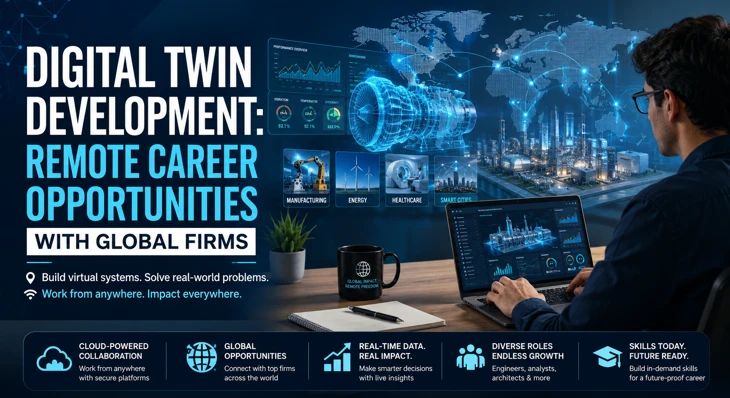
Digital twin development is no longer something reserved for high-end research labs or experimental engineering teams. It has slowly but steadily become part of everyday operations in industries that power the modern world. From manufacturing plants and energy grids to healthcare systems and smart cities, companies are now relying on virtual models that behave exactly like real-world systems.
And here’s what’s really changing the game: a growing number of professionals are working on these systems remotely. The rise of
remote digital twin jobs has created a completely new way of building a career in engineering and data-driven industries—one where location matters far less than skill.
What used to require on-site access to machines and physical infrastructure can now be done from a laptop, anywhere in the world. That shift has opened doors to
remote career opportunities with global firms, especially for people who can understand systems, data, and simulation tools.
Let’s explore how this field works, why companies are hiring globally, and what it actually takes to build a career in it.
What Digital Twin Development Really Means in Practice
At first glance, the term
digital twin development might sound overly technical, but the idea is surprisingly simple once you break it down.
Imagine a physical machine—say a wind turbine spinning in a remote field. Now imagine a live digital version of that same turbine sitting on a screen. Every change in speed, temperature, vibration, or output is reflected instantly in the virtual model.
That virtual version is the digital twin.
It is not just a 3D model. It is a living system that continuously updates using real-time data from sensors and connected devices. This allows engineers to see what is happening without being physically present near the equipment.
In real-world applications, this means:
A factory manager can understand why a machine is slowing down without having to walk to the shop floor.
An energy company can predict when a turbine might fail before it actually stops working.
A city planner can test traffic flow changes before changing a single road.
This is where the real value of digital twins begins—predicting problems before they happen and improving systems before they break.
Why Remote Digital Twin Careers Are Growing So Quickly
A few years ago, it would have been hard to imagine engineers working on industrial systems from home. But today, that is exactly what is happening.
One of the biggest reasons behind the rise of
remote digital twin development careers is the shift to cloud-based engineering environments. Instead of relying on physical machines or in-house labs, companies now run simulations on cloud platforms. That means work can happen from anywhere, as long as there is a secure connection and the right technical setup.
There is also a deeper shift happening in how companies think about talent. Global firms are no longer limiting themselves to local hiring pools. They are actively looking for people who can contribute specialized skills, no matter where they live.
Another important factor is time zones. Digital systems don’t stop working at 6 PM. Machines generate data all day, every day. With remote teams spread across different regions, companies can continuously monitor and improve their systems.
And of course, there is efficiency. Remote teams reduce infrastructure costs, speed up development cycles, and allow companies to scale faster without physical limitations.
Skills That Actually Matter in This Field
Working in digital twin development is not just about knowing one programming language or tool. It is about understanding how physical systems and digital systems connect.
Most professionals in this field gradually build a mix of technical and analytical abilities over time.
For example, programming plays a major role. Python is widely used because it connects well with data systems and automation. C++ and Java are often used when performance matters in simulations.
But coding alone is not enough.
You also need to understand how data behaves in real time. Digital twins generate constant streams of information. Being able to identify what is normal and what is unusual becomes an important skill.
Cloud platforms such as AWS, Azure, and Google Cloud also play a major role, as most digital twin systems are hosted online. Understanding how these environments work gives professionals a real advantage when applying for
remote digital twin jobs.
And then there is communication. Remote work sounds flexible, but it also demands clarity. Teams rely heavily on documentation, structured updates, and clear explanations of complex ideas.
In many cases, the ability to explain a technical problem simply is just as valuable as solving it.
The Kind of Roles Emerging in This Space
The digital twin ecosystem has created a wide range of career paths, many of which are now open to remote professionals working with global firms.
A digital twin engineer, for example, focuses on building and maintaining virtual models of physical systems. Their work sits at the core of the entire ecosystem.
An IoT systems architect designs how devices, sensors, and platforms connect with each other. Without this layer, real-time data would not flow properly.
Simulation analysts spend their time studying system behavior. They help organizations understand how changes in one area affect the entire system.
Data scientists in this field work with industrial data instead of traditional business data. Their insights help improve efficiency, safety, and performance.
Cloud integration engineers ensure that everything runs smoothly across digital platforms, especially when teams are distributed across different countries.
What makes these roles interesting is that they often overlap. A single project might involve engineers, analysts, and architects working together across time zones, each contributing a different layer of expertise.
Industries Where Digital Twin Development Is Already Mainstream
One of the most interesting things about this field is how widely it is being used.
In manufacturing, digital twins help track production lines and reduce unexpected breakdowns. A small improvement in efficiency can save large operational costs.
In healthcare, digital systems are used to model equipment behavior and even simulate hospital workflows. This helps improve patient care and resource planning.
The automotive and aerospace industries rely heavily on digital twins to test performance before physical production begins. It reduces risk and improves safety.
Smart cities use these systems to simulate traffic patterns, energy usage, and infrastructure planning. Instead of guessing how a city will behave, planners can test it virtually.
Even the energy sector depends on digital twin systems to monitor wind farms, power plants, and renewable energy systems in real time.
When you look at all these industries together, one thing becomes clear: digital twin development is not a niche skill anymore. It is becoming a core part of how modern systems are built and managed.
Building a Remote Career in Digital Twin Development
Most people entering this field do not start with perfect knowledge. They build it step by step.
It usually begins with learning the basics of programming and data handling. From there, many move into simulation tools and cloud platforms.
But what really makes a difference is practice.
Working on small projects—even simple simulations—helps build real understanding. It could be as basic as modeling a system response or analyzing sensor-like data patterns.
Over time, professionals start building portfolios that show what they can actually do, not just what they have studied.
This becomes especially important when applying for
remote career opportunities with global firms, where employers often look for proof of real-world capability rather than just theoretical knowledge.
Eventually, with the right mix of skills and experience, professionals begin applying to international companies that offer remote or hybrid roles in this field.
Challenges You Should Expect Along the Way
Like any advanced technical field, digital twin development comes with challenges that cannot be ignored.
The systems themselves are complex. They involve multiple layers of hardware, software, and data working together simultaneously.
Security is another major concern. Since industrial systems are involved, protecting sensitive data is always a priority.
Integration can also be difficult. Connecting different tools, platforms, and devices is not always straightforward and often requires on-the-go problem-solving.
And then there is the pace of change. Technology in this field evolves quickly, which means continuous learning is not optional—it is part of the job.
Where This Career Path Is Headed
If there is one thing that stands out about digital twin development, it is momentum.
As more industries move toward automation and predictive systems, digital twins are becoming a standard part of operations rather than an advanced option.
In the coming years, we are likely to see more AI-driven digital twins capable of making decisions on their own. Remote teams will become even more common as companies expand globally. New industries will adopt this technology as tools become easier to use.
For professionals, this means the field is not just growing—it is expanding in multiple directions at once.
Those who build strong foundational skills today are likely to find themselves in high-value roles in the near future, often working with international teams without ever needing to relocate.
Frequently Asked Questions (FAQs)
What is digital twin development in simple terms?
It is the process of creating a virtual version of a physical system that updates in real time using live data.
Can digital twin work be done remotely?
Yes, most modern systems are cloud-based, which makes remote collaboration very common.
What skills are important for this career?
Programming, data analysis, cloud computing, IoT understanding, and simulation knowledge are key.
Is this a good long-term career option?
Yes, it is growing rapidly across multiple industries and offers strong global demand.
Do I need a technical degree to enter this field?
A degree helps, but practical skills and real project experience can also lead to opportunities.
Conclusion
Digital twin development is quietly reshaping how industries operate and how professionals build their careers. What makes it especially powerful is its flexibility—work that once required physical presence can now be done remotely with the right tools and skills.
As companies continue adopting digital transformation strategies, the demand for skilled professionals in this space will only increase. For those willing to learn and adapt, this field offers something rare: a combination of technical depth, global exposure, and genuine remote career freedom.