📚 Table of Contents
- Introduction: Remote Work Didn’t Just Change Where We Work — It Changed How We Think
- The Remote Work Shift and Why Creativity Suddenly Matters More
- Communication now depends on creative thinking
- Routine tasks are fading — thinking work is rising
- Why Creative Skills Are Becoming a Real Career Advantage
- Clear communication wins in remote work
- Digital-first businesses depend on content
- Creativity improves problem-solving
- High-Demand Remote Careers Where Creativity Leads the Way
- Content and digital marketing roles
- UX and product design careers
- Video and visual storytelling
- Brand and creative strategy roles
- How Creativity Improves Performance in Remote Jobs
- You solve problems without waiting for instructions
- You manage your work better
- You communicate without confusion
- A Realistic Example of a Remote Creative Career
- Skills That Actually Matter in Creative Remote Careers
- Storytelling and content thinking
- Visual awareness
- Familiarity with digital tools
- Willingness to adapt
- The Future of Remote Work Is Quietly Becoming More Creative
- AI is not replacing creativity — it’s changing how we use it
- Global teams are becoming the norm
- Challenges That Come With Creative Remote Careers
- Time zone gaps
- Staying consistent without supervision
- Competition is global now
- How to Build a Strong Creative Remote Career
- Build real work samples
- Choose a focus area
- Stay active in online spaces
- Keep improving quietly
- FAQs
- Why are creative skills important in remote work?
- Which remote jobs need creative skills the most?
- Can beginners enter creative remote careers?
- Do creative skills improve productivity?
- Is AI reducing creative career opportunities?
- Conclusion: Creativity Is Quietly Defining the Future of Remote Work
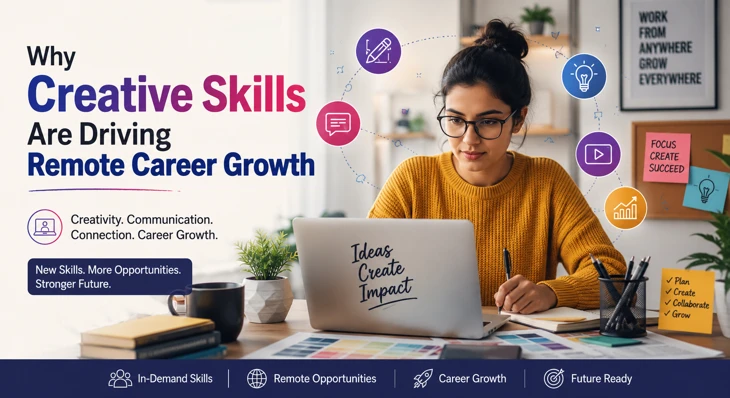
Why Creative Skills Are Driving Remote Career Growth
Introduction: Remote Work Didn’t Just Change Where We Work — It Changed How We Think
A few years ago, most people still connected “career growth” with office spaces, fixed timings, and face-to-face meetings. That picture has changed faster than anyone expected. Remote work didn’t just move jobs online — it reshaped the way skills are valued. And right in the middle of this shift, creative skills quietly began to become one of the strongest career drivers. Not because creativity is new, but because the way we work now demands it more than ever. When teams are spread across cities, countries, and time zones, communication can’t rely on quick desk conversations anymore. Ideas need to be written clearly, designed well, and expressed in ways that actually hold attention. That’s exactly where creative professionals naturally stand out. You’ll notice it across industries — marketing, design, tech, education, even finance teams are now leaning on people who can think visually, write clearly, and simplify complexity without losing meaning. Remote work didn’t replace creativity. It amplified its value.The Remote Work Shift and Why Creativity Suddenly Matters More
Remote work changed something fundamental: visibility. In an office, effort is often visible. You speak in meetings, walk over to desks, share ideas casually. In remote setups, none of that happens automatically. Everything depends on how well you communicate through screens. That shift alone changed hiring priorities.Communication now depends on creative thinking
In remote teams, communication isn’t just talking — it’s structuring ideas so they travel well across messages, emails, slides, and documents. That means:- A message has to be clear without explanation
- A presentation must tell a story, not just show data
- A piece of content should hold attention without in-person persuasion
Routine tasks are fading — thinking work is rising
Another big change is automation. Many repetitive tasks that once took hours are now handled by tools and AI. So what’s left? Work that requires judgment, imagination, and interpretation. In simple terms, creative thinking. That’s why roles like content strategist, UX designer, brand storyteller, and digital marketer are growing so quickly in remote setups.Why Creative Skills Are Becoming a Real Career Advantage
There’s a common misunderstanding that creative skills only matter for designers or writers. In reality, they influence almost every remote job today. Let’s break it down in a practical way.Clear communication wins in remote work
Think about how most remote teams function — Slack messages, Zoom calls, shared documents, project boards. Now imagine two people: One writes short, unclear updates that need follow-up questions. The other explains things in a structured, easy-to-understand way. Guess who becomes easier to work with? That’s the real power of creative communication.Digital-first businesses depend on content
Every brand today is essentially a content-driven business. Whether it’s a startup or a global company, they need:- Content that ranks on search engines
- Social media posts that grab attention
- Visual designs that build trust
- Videos that explain products quickly
Creativity improves problem-solving
Remote teams don’t always have instant solutions. You can’t just turn around and ask a colleague sitting next to you. So people who can think differently, test ideas, and come up with simple solutions tend to move faster in their careers.High-Demand Remote Careers Where Creativity Leads the Way
If you look at the fastest-growing remote jobs, you’ll notice a pattern — most of them rely heavily on creative thinking.Content and digital marketing roles
This is probably the most visible area where creativity is driving demand. Companies constantly need people who can understand audiences and turn ideas into content that performs. Common roles include:- SEO content writers who create search-friendly articles
- Copywriters who write persuasive brand messaging
- Content strategists who plan campaigns
- Email marketers who improve engagement
UX and product design careers
When someone uses an app or website, and it feels smooth and intuitive — that’s creative thinking in action. UX/UI professionals focus on:- Making digital products easy to use
- Designing user journeys that feel natural
- Improving visual flow and interaction
Video and visual storytelling
If you’ve spent even a few minutes online today, you’ve already consumed video content. That’s why video editors, motion designers, and content creators are in such high demand. They help brands:- Explain ideas quickly
- Build emotional connection
- Stay visible in crowded platforms
Brand and creative strategy roles
This is where creativity meets business thinking. These professionals shape how a brand looks, feels, and communicates across every platform. It’s not just design — it’s direction.How Creativity Improves Performance in Remote Jobs
Getting hired is one thing. Doing well in the job is another. Creative skills directly impact how smoothly you work in remote environments.You solve problems without waiting for instructions
Instead of getting stuck, creative professionals tend to explore alternatives. That independence is extremely valuable when teams are spread across time zones.You manage your work better
Remote work needs discipline. Creative thinkers often develop strong self-management habits because their work involves planning, experimenting, and refining.You communicate without confusion
Clear communication reduces back-and-forth messages, which saves time for everyone on the team.A Realistic Example of a Remote Creative Career
Picture a freelance content designer working with clients in different countries. Their day isn’t tied to an office. Instead, it looks like this: They research what audiences care about. They turn ideas into structured content. They collaborate with designers across time zones. They refine messaging based on feedback. No physical office. No fixed location. Just skills, communication, and consistency. That’s what a modern creative remote career looks like.Skills That Actually Matter in Creative Remote Careers
There’s no single path, but certain skills recur in successful careers.Storytelling and content thinking
Being able to turn ideas into stories people understand is a major advantage in any digital role.Visual awareness
Even if you’re not a designer, understanding layout, spacing, and presentation helps a lot in remote communication.Familiarity with digital tools
Most creative work today runs on tools like:- Figma for design collaboration
- Canva for quick visuals
- Adobe tools for advanced editing
- Google Workspace for teamwork