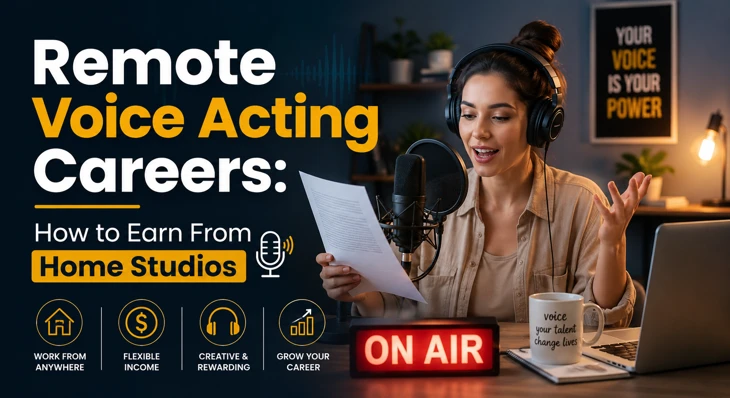
Remote Voice Acting Careers: How to Earn From Home Studios
Introduction: A Career That Starts Quietly, Not Loudly
Most people don’t stumble into remote voice acting careers with a big plan. It usually starts in a much smaller way—someone records a short clip, listens back, thinks “hmm… that doesn’t sound too bad,” and suddenly starts wondering if this could actually become something.
That’s often how it begins. Quiet. Simple. Almost accidental.
And in a strange way, that’s exactly why it works.
Because remote voice acting jobs today aren’t locked inside studios anymore. They’re coming from bedrooms, home corners, walk-in wardrobes turned into makeshift booths, and simple setups that cost less than a weekend outing.
If you’ve been searching phrases like how to become a remote voice actor, or trying to figure out how to earn from home studios, you’re already circling the right idea. It’s less about perfection and more about consistency showing up over time.
No dramatic entry required.
What Remote Voice Acting Actually Looks Like Day to Day
Let’s drop the polished version you usually see online.
Real remote voice acting work feels surprisingly ordinary.
A script lands in your inbox. You open it, read it once just to understand the tone. Maybe it’s a playful ad. Maybe it’s a calm narration. Maybe it’s something corporate and a bit formal.
You read it out loud. You stop. You try again. You adjust your tone without overthinking it. And eventually, you record a clean version and send it off.
That’s the cycle.
Nothing cinematic. Nothing overly technical.
And the interesting part is how wide the work actually spreads out:
Some days, it’s short social media ads that need energy in just a few seconds. Other days, it’s YouTube narration where pacing matters more than anything else. Sometimes it’s audiobooks you just sit with for hours. Then there are game characters, corporate training videos, and podcast intros that need a specific mood right away.
Different worlds. Same basic skill: making words sound alive.
And here’s something people don’t realize at first—clients rarely care where you are. They care about whether your voice fits what they imagined.
Why Remote Voice Acting Careers Keep Growing Without Making Noise
This isn’t a sudden trend. It’s been building in the background for years.
The biggest reason is simple: everything moved online.
Even small businesses now post videos. A local shop explains its offers through reels. Startups rely on explainer videos. Creators upload content daily. And almost all of that needs voice work.
At the same time, people changed how they consume content. Reading long explanations feels heavy now. Listening feels easier. More natural. More flexible.
You probably notice it in your own routine too—podcasts while doing chores, videos while scrolling, audiobooks while relaxing.
Then there’s the work culture shift. Hiring someone remotely for creative tasks doesn’t feel unusual anymore. In fact, it’s often preferred because it’s faster.
Put all that together, and remote voice acting careers quietly turn into a global freelance space without much noise or attention.
The Skills That Actually Matter (And the Ones People Overthink)
Let’s clear something up early.
You don’t need a “perfect voice.” That idea stops more people than anything else.
What actually matters is whether your voice feels natural and believable for the script in front of you.
Some people speak softly and work beautifully in narration. Others have energetic voices that suit commercials. Some are expressive. Some are subtle. There isn’t one correct type.
What helps more than anything is clarity. If people understand you without effort, you’re already in a strong position.
Then comes emotion. Not dramatic acting—just enough feeling that the script doesn’t sound flat.
And then there’s timing. Knowing when to pause, when to slow down, when to let a line breathe.
Technical skills matter too, but only at a basic level in the beginning. Enough to clean the background noise and make the audio presentable.
Everything else improves quietly with practice, not theory.
Setting Up a Home Studio (Without Turning It Into a Project)
Many beginners get stuck here. They think they need a perfect setup before they start.
That’s usually not true.
Most people begin with something very simple.
A basic USB microphone. A pair of headphones. A quiet corner of the room. That’s really it.
You don’t need soundproof walls or expensive gear to start exploring remote voice acting jobs.
Even the space you choose matters more than equipment. A small, quiet area with less echo often beats a fancy microphone in a noisy room.
Some people record in wardrobes because clothes absorb sound. Others use blankets or soft furniture around them. It’s not about looking professional—it’s about reducing distractions so your voice stays clean.
For software, most beginners start with something simple like Audacity. It feels basic, but it does the job. Later, people upgrade when they actually need more control.
The key is not building the perfect studio. It’s building a space where you can actually start.
How People Actually Get Their First Remote Voice Acting Work
Almost nobody starts with big clients or long-term contracts.
It usually begins small.
You create a short demo—not something overly produced, just samples of how you sound in different moods. A commercial tone. A calm narration. Maybe a slightly expressive character line.
Nothing fancy.
Then you put it out where clients are already looking.
Freelance platforms are the obvious starting point—places like Fiverr, Upwork, Voices.com, or ACX for audiobook work.
The first few jobs might feel small. Short scripts. Modest pay. But they do something important—they teach you how real projects work.
Timing. Instructions. Revisions. Communication.
At the same time, many people overlook another path: direct connections. YouTubers, indie developers, small brands—they often need voice work but don’t always post formal listings. A simple message sometimes leads to real work.
And somewhere along the way, something shifts. You stop thinking about “trying voice acting” and start doing it regularly.
That’s usually the turning point.
What Remote Voice Acting Actually Pays (Without the Hype)
Let’s be honest here—income varies a lot.
At the beginning, it’s usually small. Quick tasks, short recordings, basic narration. Not life-changing money, but enough to understand how the system works.
As you gain experience, things start to change slowly. Clients come back. Projects get longer. Rates improve naturally because your work becomes more reliable.
At a more stable stage, voice actors often work on audiobooks, brand campaigns, or ongoing corporate projects. That’s where things start feeling consistent.
It’s not a fast-money path. It’s a build-over-time kind of career.
And that’s actually what makes it sustainable.
Finding Your Own Direction Without Rushing It
One mistake beginners make is trying to do everything at once.
Commercial work, narration, character voices, corporate content—it can feel overwhelming if you don’t narrow it down a bit.
Over time, most people naturally lean toward what fits them.
Some enjoy the energy of ads. Some prefer storytelling in audiobooks. Some like structured corporate scripts. Others enjoy character work because it feels creative.
There’s no fixed path here. It’s more about noticing where your voice feels comfortable.
The Challenges Nobody Talks About Much
It’s not all smooth, and it shouldn’t be.
At first, it might feel like there are too many people already doing this. That feeling is common. But consistency is what separates people who stay in it from people who leave early.
Income can feel unstable at the start. That’s normal in most freelance careers, not just this one.
Technical things might feel confusing in the beginning, but they stop feeling complicated once you use them regularly.
And yes—hearing your own recorded voice for the first time can feel strange. Almost everyone goes through that moment.
It fades.
Small Habits That Quietly Build Real Progress
Progress in remote voice acting careers doesn’t usually come from big breakthroughs. It comes from small repetition.
Reading aloud a little every day helps more than expected. Listening to your own recordings builds awareness over time. You start noticing things you've never heard before.
You naturally begin adjusting tone, pacing, and clarity.
And when you communicate well with clients and deliver on time, trust builds without needing anything extra.
It’s slow, but steady.
Where This Career Is Headed
Even with AI voice tools becoming more common, human voice work hasn’t disappeared. If anything, it has become more focused.
Machines can read text. But they still struggle with emotion, subtle shifts in tone, and natural storytelling.
That’s where human voice actors still matter.
E-learning platforms, gaming, digital content, and virtual assistants—all of these continue to rely on real human expression in different ways.
The format might change, but the need doesn’t go away.
FAQs: Remote Voice Acting Careers
1. Can I really start from home with no experience?
Yes. Most people begin with zero experience and improve through small, real projects.
2. Do I need expensive equipment?
Not at all. A basic microphone and a quiet space are enough to start.
3. How do beginners actually find remote voice acting jobs?
Most start with freelance platforms or direct outreach to content creators.
4. Can this become a stable career?
Yes, but it grows gradually through consistent clients and regular work.
5. How long does it take to improve?
Many people notice meaningful improvement within a few months of practice.
Conclusion: A Simple Skill That Grows With Time
Remote voice acting careers don’t demand a perfect beginning. They just need a starting point.
You don’t need a studio. You don’t need perfect confidence. You don’t even need to feel ready.
You just need to begin with what you have.
The opportunities are already out there. Remote voice acting jobs are increasing across industries, quietly but steadily.
And if you’re exploring how to earn from home studios, this is one of those paths where progress builds slowly—but stays with you for a long time.
Your voice doesn’t need to change. It just needs to be used.