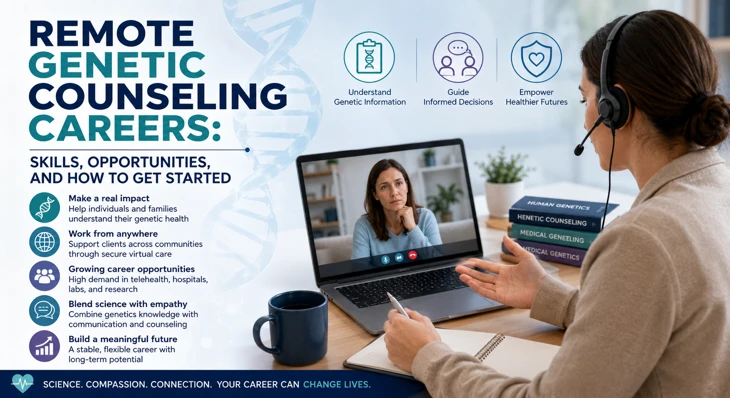
Remote Genetic Counseling Careers: Skills, Opportunities, and How to Get Started
There’s a quiet shift happening in healthcare that most people don’t notice until they personally need it. Someone gets a genetic test result—sometimes expected, sometimes completely surprising—and suddenly they’re looking at numbers, terms, and risk indicators that don’t feel human anymore.
That’s usually the moment remote genetic counseling careers become relevant.
Not in theory. In real life.
Because while genetic testing has become easier to access than ever, understanding what those results mean is still complicated. And that gap between “having information” and “knowing what to do with it” is exactly where genetic counselors step in.
Increasingly, they’re doing this work remotely. Not in hospital rooms or clinic offices, but through video calls and secure digital systems. The environment has changed, but the conversations haven’t lost their weight—they’re still personal, sometimes emotional, and often life-shaping.
What Remote Genetic Counseling Careers Actually Look Like
At the center of remote genetic counseling careers is a simple responsibility: helping people understand genetic information in a way that feels clear enough to act on.
But the real work rarely starts with science.
It often starts with uncertainty.
A person joins a call after receiving a report they don’t fully understand. They may not even know what questions to ask yet. So the counselor begins by slowing things down—listening first, then building context.
From there, the session moves naturally:
- Understanding why the test was taken in the first place
- Walking through family history in a conversational, non-clinical way
- Translating technical genetic findings into everyday language
- Talking through risk without creating unnecessary fear
- Helping the person decide what steps actually matter next
Even though everything happens online, the interaction often feels surprisingly grounded. People are in their own space, speaking more freely than they sometimes do in clinical settings.
Why This Career Path Is Growing Right Now
Remote genetic counseling careers didn’t appear overnight. They grew as healthcare itself began to change shape.
One of the biggest changes has been the normalization of telehealth. A few years ago, online consultations felt like a backup option. Now they’re often the default.
Genetic testing also became more accessible to the general public. It’s no longer limited to specialists or research environments. People receive results from hospitals, screening programs, and even home testing kits.
But access created a new problem: interpretation.
A report might show a “higher risk” for something, but what does that actually mean in everyday life? Should someone be worried? Should they take action immediately? Or is it something to monitor over time?
This uncertainty is exactly why remote genetic counseling careers are expanding.
There’s also a practical shortage. Many regions simply don’t have enough trained genetic counselors. Remote work allows specialists to support far more people without being limited by geography.
At the same time, healthcare is shifting toward personalization. Treatment decisions increasingly depend on individual genetic profiles. That increases the need for professionals who can explain complex findings in a way patients can actually use.
Skills That Make a Real Difference in This Work
On a resume, this profession looks technical. In reality, it’s a balance of scientific knowledge and human understanding.
Genetics is the foundation—you need to understand inheritance patterns, risk probabilities, and how genetic conditions are identified. But that alone doesn’t define success in this role.
What matters just as much is how that knowledge is shared.
Most sessions don’t feel like formal medical appointments. They feel like conversations where someone is trying to make sense of something personal and unfamiliar.
That changes everything about communication.
Clarity becomes more important than complexity. Tone matters as much as accuracy. A well-explained concept can reduce anxiety more than a technically perfect explanation that feels overwhelming.
Emotional awareness also becomes part of the job. Some people arrive anxious, others confused, and some are already emotionally prepared for difficult news. There’s no single way to handle every situation—you adjust in real time.
Because the work is remote, digital systems are part of daily practice. Video platforms, electronic health records, and secure communication tools are not optional—they’re the workspace.
Another key part of the job is thinking in terms of probabilities rather than absolute answers. Genetic information rarely says “yes” or “no.” It usually points toward likelihoods. Helping someone understand that, without misinterpretation, is a core skill.
The Education Journey Behind the Career
There is a structured path into this field because the responsibility is significant.
Most people begin with a bachelor’s degree in biology, genetics, psychology, or a related science field. This provides the scientific foundation needed for advanced study.
After that comes a master’s program in genetic counseling. This is where the focus shifts from theory to real application. Students learn about human genetics, counseling techniques, medical ethics, and patient communication, while also completing supervised clinical training.
Clinical experience is often where things “click.” Observing real patient interactions and gradually participating in them shows what the profession actually feels like—not just what it looks like in textbooks.
Once education is complete, certification is required in most regions. This step confirms readiness for professional clinical work.
From there, professionals enter hospitals, telehealth platforms, research organizations, or genetic testing companies—many of which now offer remote or hybrid roles.
Where Remote Genetic Counseling Careers Are Found Today
This profession now exists across multiple healthcare environments.
Telehealth companies are one of the most visible spaces. These organizations deliver healthcare entirely online, and genetic counseling is often part of their service structure.
Genetic testing companies also rely heavily on counselors. When individuals receive results, they often need help interpreting them responsibly and accurately.
Hospitals still play a role, too, especially for follow-ups or consultations that do not require physical presence.
Research institutions use genetic counselors for studies, patient education, and data interpretation.
Some experienced professionals eventually move into independent practice, offering private virtual consultations directly to clients.
Career Growth and Earning Potential
This is not a fast-moving career path, but it is a stable one.
Early roles usually begin with moderate compensation, followed by steady growth as experience builds. Over time, specialization becomes a major factor in career development.
Areas such as oncology genetics, prenatal counseling, and hereditary cancer risk often involve more complex cases and greater responsibility, which can influence both role level and compensation.
Career progression may lead to senior counseling roles, supervision positions, research leadership, consulting work, or academic teaching.
It tends to grow gradually rather than dramatically, but consistently.
Advantages That People Often Don’t Talk About
Flexibility is usually the first thing mentioned, but it’s only part of the picture.
Remote work removes many small pressures—commuting, location constraints, and constant movement between departments or facilities.
It also expands reach. A counselor is no longer limited to one hospital or city. They can support people across regions where access to genetic expertise may otherwise be limited.
For healthcare systems, this flexibility helps close service gaps without lowering the quality of care.
Real Challenges in the Role
This work is meaningful, but it is not light.
Some conversations involve serious or unexpected medical findings. Supporting someone through that moment requires emotional steadiness and care.
Virtual communication also removes physical presence, which means fewer non-verbal cues. That makes listening and tone even more important.
Technology plays a constant role. When systems fail, even briefly, it can interrupt sensitive conversations.
Licensing rules can also vary depending on geography, which sometimes limits where services can be delivered.
How People Usually End Up Here
Most professionals don’t start directly with remote genetic counseling careers.
It often begins with an interest in science or healthcare. Over time, academic training builds knowledge, and clinical exposure reveals the human side of the profession.
At some point, many realize they are equally interested in communication and guidance—not just data and science.
That realization often becomes the turning point.
From there, certification and experience gradually open the door to remote opportunities.
A Realistic Day in This Profession
A typical day often begins with reviewing several patient cases from different providers.
One conversation might involve explaining hereditary risk for someone planning a family. Another might focus on helping someone understand unexpected genetic results in a calm, structured way.
Between sessions, there is documentation, coordination with healthcare teams, and follow-up communication.
While the structure is consistent, the human situations are always different.
Where This Field Is Heading
Remote genetic counseling careers are expected to grow steadily as genetic testing becomes more detailed and widely used.
As more people gain access to genetic data, interpretation becomes even more important than collection.
Technology will continue to support analysis, but the human role—listening, explaining, and helping people decide what matters—will remain central.
If anything, that role becomes more important as complexity increases.
FAQs
What qualifications are needed for remote genetic counseling careers?
A master’s degree in genetic counseling and certification are typically required, along with a science-based undergraduate background.
Can genetic counselors work remotely full-time?
Yes, many positions are fully remote, depending on the employer's structure and licensing requirements.
Is this career emotionally demanding?
It can be, especially during sensitive discussions, but many professionals find it meaningful over time.
Who hires genetic counselors remotely?
Telehealth providers, hospitals, genetic testing companies, and research organizations commonly hire for these roles.
How long does it take to enter the field?
Typically 6–8 years, including education and clinical training.
Conclusion
Remote genetic counseling careers bring together science, communication, and human understanding in a way that is becoming increasingly important in modern healthcare.
It’s not just about interpreting genetic data. It’s about helping people understand what that data means for their real lives and decisions.
For those looking for a stable, flexible, and meaningful career path, this field offers long-term potential. It develops slowly, but it has a real impact on the people it serves.