📚 Table of Contents
- Introduction: A Career That Doesn’t Look Like It Used To
- What Remote Fitness Coaching Really Looks Like (Not the Social Media Version)
- Why Online Fitness Coaching Careers Are Growing So Quickly
- Skills That Actually Matter in Remote Fitness Coaching
- How People Actually Start Remote Fitness Coaching Careers
- Tools That Help (But Don’t Complicate Things)
- Building Trust and Keeping Clients in Online Coaching
- Challenges You Should Expect (And That’s Normal)
- A Realistic Example of How This Career Grows
- The Future of Online Fitness Coaching Careers
- FAQs
- Is remote fitness coaching a stable career option?
- Do I need certification to start online coaching?
- How do online fitness coaches earn money?
- Can beginners start in this field?
- What makes online coaching successful?
- Conclusion: A Career Built on Consistency, Not Speed
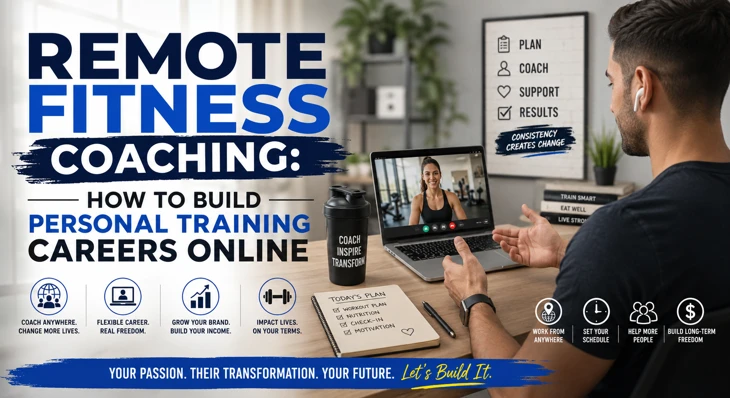
Remote Fitness Coaching: How to Build Personal Training Careers Online
Introduction: A Career That Doesn’t Look Like It Used To
Not long ago, personal training almost always meant being inside a gym. Same equipment, same environment, same kind of routine every day. If you wanted to grow, you either needed more gym hours or more local clients. That version of fitness coaching still exists, but it no longer defines the career. Remote fitness coaching has fundamentally changed the direction of the industry. Trainers are now working with clients across cities, countries, and completely different time zones. Some are building a full-time income from home. Others are traveling while still managing their online clients. And many are slowly moving away from traditional gym setups altogether. What makes this shift interesting is that it didn’t happen because of hype. It happened because clients wanted something simpler—fitness that fits into real life. Not the other way around. That’s where online personal training careers began to become a serious path rather than a side option.What Remote Fitness Coaching Really Looks Like (Not the Social Media Version)
If you only look at social media, online fitness coaching looks polished—perfect transformations, aesthetic workout videos, and smooth success stories. The real process is a bit more grounded. Most remote fitness coaching setups are built around simple but consistent communication. A coach usually spends time:- Designing workout plans based on a client’s actual lifestyle
- Adjusting routines when progress slows down
- Checking in through messages, calls, or voice notes
- Helping clients stay consistent when motivation drops
- Tracking progress in a way that feels realistic, not overwhelming
Why Online Fitness Coaching Careers Are Growing So Quickly
There’s a reason so many trainers are moving toward online personal training careers. It’s not just convenience—it’s a combination of lifestyle and demand. People today don’t want rigid schedules. They want flexibility. They want guidance that fits into their routine, not something that disrupts it completely. At the same time, technology has made this transition easy. Video calls feel normal now. Fitness apps track progress in real time. Even simple WhatsApp chats can replace in-person check-ins. For trainers, this opens up a very different kind of opportunity. Instead of trading time for money in a fixed location, they can build:- Monthly coaching plans
- Group training programs
- Digital fitness guides
- Long-term transformation systems
Skills That Actually Matter in Remote Fitness Coaching
One of the biggest misconceptions is that online coaching is just about being fit or having a certification. That helps, but it’s not the full picture. The real skill set is more practical. You need to understand training well enough to simplify it for different people. A beginner doesn’t need complex terminology. They need clarity. Communication becomes a core skill. Since you’re not physically correcting form, your words need to do that job. Short, clear instructions usually work better than long explanations. You also need the ability to structure programs in a way that feels doable. Many clients don’t fail because they lack effort—they fail because the plan feels too complicated. And then there’s consistency management. This is where most online coaches spend their energy. Keeping clients engaged when life gets busy is often more important than designing the perfect workout. Basic digital comfort helps too. Nothing advanced. Just being okay with video calls, messaging apps, and simple tracking tools.How People Actually Start Remote Fitness Coaching Careers
Most successful coaches didn’t start with a perfect setup. They started small, sometimes even informally. The beginning usually looks like this. First, they get some level of fitness education or certification. Not because it guarantees success, but because it builds confidence when working with clients. Then they pick a direction. Instead of trying to train everyone, they focus on a specific group. For example:- Busy professionals who want short workouts
- Beginners trying to lose weight at home
- People rebuilding fitness after a break