
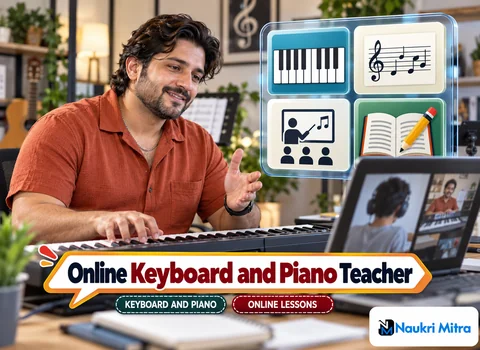
Picture a learner at her first lesson. Her fingers lie flat on the keys like a hand resting on a table, her eyes never leave the keyboard, and she counts out loud only when reminded. A few months later the same learner might curve her fingers without being told, glance at the page for the next bar instead of hunting for middle C, and play a C major scale hands together at a slow, even pace. Nobody can promise that change on a timetable, but steady teaching makes it possible, and that is the work behind these online keyboard and piano teacher jobs. Pianists anywhere in the world may apply; the post is part-time, remote, and pays $15 USD for each hour.
In short, the keyboard and piano teacher job description is to teach live lessons over video, plan each student's next small step and keep practice realistic.
So what does an online keyboard and piano teacher do between logging in and logging off? Most of the hours go into one-to-one sessions, usually thirty to sixty minutes each. A typical lesson might run like this:
Outside lessons you will keep brief progress notes, choose graded practice pieces and reply to parents or adult learners about scheduling through the teaching platform.
A sound online piano lesson plan does not try to cover everything at once. Scales build finger independence and key awareness. Chords, starting with simple triads and their inversions, teach the hand to find shapes rather than single notes, which matters a great deal on keyboard where students often accompany themselves. Sight reading trains the eyes to move ahead of the hands.
Rotate the emphasis. One week might lean on chord changes, the next on reading rhythm accurately. Use traditional melodies, folk tunes, public-domain classical pieces or exercises you write yourself, so nothing in your materials depends on copyrighted songs.
Students learn a lot by watching your hands, so the camera angle matters as much as the sound. A good overhead camera and MIDI setup for online piano lessons is simpler than it sounds.
Clamp a phone or webcam to a boom arm or gooseneck so it points straight down, framing roughly two octaves either side of middle C. A second camera on your face helps with conversation and posture demonstrations.
A MIDI keyboard or digital piano connected by USB lets you send clean audio and note data to your computer. With that connection, piano teaching tools such as a MIDI keyboard paired with Synthesia or Flowkey can show falling notes or highlighted keys, which helps visual learners see exactly what you played. An acoustic piano works too; just place a decent microphone close enough to catch soft passages.
Turn off noise suppression in your video app, or switch on an original-sound option, because these filters can chop off sustained notes. A wired internet connection is usually steadier than Wi-Fi for live lessons.
Keyboard vs piano lessons? The answer depends on your background and the student's instrument. Keyboard students often want chords, rhythm styles and playing along with backing patterns. Piano students are more likely to want classical technique, touch and pedalling. Many teachers offer both, but be honest about where your strength lies and tell students early if their instrument has limits, such as unweighted keys or no sustain pedal.
Some students want structure and a certificate. Others simply want to play for pleasure. Both are welcome.
For exam candidates, you will help them prepare for ABRSM or Trinity grades if they are interested, working through set pieces, technical work, aural skills and sight reading as the board requires. Always check the current requirements on the exam board's own website rather than relying on memory, since boards update their materials. Exam preparation is about readiness, not promises of a particular result.
Hobby learners often do better with a looser plan built around pieces they enjoy, simple arranging and playing by ear. Keep standards up, but let them choose more of the direction.
Piano teacher certification through ABRSM or Trinity grades is welcome, though plenty of good teachers came to this work another way. Proven playing skill combined with real teaching experience is also considered. Core keyboard and piano teacher skills include:
If you have the playing skill but little formal training, start by teaching a friend or family member for free, record the sessions with permission and review them honestly. A short keyboard and piano teacher course on pedagogy can also help, though no specific keyboard and piano teacher certification is compulsory for this role.
Keyboard and piano teacher jobs for freshers do exist, mostly with beginner students. For anyone asking how to start teaching piano online as a beginner teacher, preparation does most of the work. Write three or four lesson outlines for absolute beginners, practise them on camera and time yourself.
Your keyboard and piano teacher resume should give your grades or an equivalent playing level, every class or private pupil you have taught, and a short video link to a sample lesson segment. Typical keyboard and piano teacher interview questions probe practical things: fixing flat fingers through a webcam, mapping out a child's first month, or handling a pupil who turns up unpractised. A brief demo lesson is a common part of selection.
With child pupils, keep the camera running in a room the family shares, route every message through the platform and never swap social media handles.
A keyboard and piano teacher salary here works out at $15 USD for each hour spent at the keys with a student, on a part-time footing. That number is the whole online keyboard and piano teacher hourly rate; what lands in a given week rises and falls with the lessons pupils book. As keyboard and piano teacher work from home, you set up your own space and equipment.
Many teachers also look at freelance keyboard and piano teacher jobs on online lesson marketplaces, music school websites and local teaching directories that offer video lessons. Every marketplace charges its own commission and writes its own rules, which is why the small print deserves a slow read before you create a profile.
Step back from any contact who wants money before you teach, insists you buy their equipment, asks for your bank login or proposes an odd way of paying you. A real teaching role explains the pay rate, the lesson format and who the students are before you start. If the details stay vague after you ask, walk away.
Whether online piano teaching is a good career depends on what you want from it. Part time keyboard and piano teacher jobs suit students, performers and parents who need teaching to sit alongside everything else they do. Because the keyboard and piano teacher salary per hour is a single stated figure, budgeting around it is straightforward. If you like watching a learner's hands slowly settle into shape, this work is worth a try.