
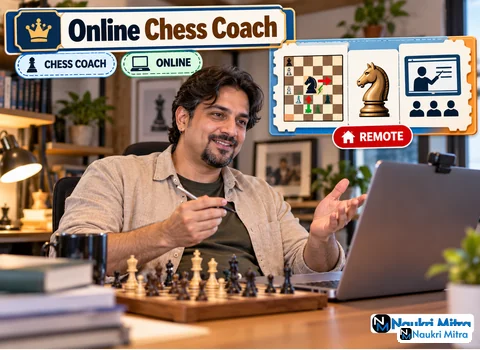
Picture a student who sends in a rapid game and asks where it went wrong. Out of the opening she is fine: both bishops developed, king castled, a rook on the half-open file and a knight one hop from a square no pawn can chase it from. She is better. Then her queen crosses the board to take a loose pawn on the far wing. The pawn is real, but the queen is gone from the kingside for three moves, and that is all her opponent needs. A knight lands next to her king, the queen comes back too late, and the game turns. That pawn grab is where the advantage slips, and finding moments like that, then showing the student the quieter move that kept the pressure, is the core of online chess coach jobs. Coaching is Part-time and remote, open to applicants in any country, at $15 per hour (USD).
You will teach openings, tactics, middlegame plans and endgames to students in one-on-one or group sessions. Lessons run over a video call with a shared board, mostly using Lichess studies and Chess.com. Between lessons you review the games students send you, set puzzle homework, and help players who have a rated tournament coming up. The role is chess coach work from home in the literal sense: you need a laptop, a stable connection and a quiet place to talk. There is no office and no travel.
The chess coach job description, stripped down, is this: find the recurring mistake in a student's play, explain it in clear English, give them work that fixes it, and check next week whether it stuck.
Many club students arrive wanting a repertoire. What they usually need first is the reasons behind the moves. If a player cannot say why the centre matters, why a knight belongs on a central square rather than the rim, or why moving the same piece twice early costs time, a memorised line will fall apart the first time an opponent leaves the book.
So the opening lessons start with principles and a small number of systems that suit the student's style. A Lichess study works well here: one chapter per idea, with the typical plans written into the comments so the student can replay it alone. Depth comes later, once the student is getting playable positions on their own.
At club level, many games turn on a missed tactic, and tactical vision improves with steady repetition. Part of the work is choosing puzzle sets that match what the student is missing. A player who keeps missing back-rank ideas gets a set built around back-rank ideas, not a random mix.
The game above is a middlegame lesson. The student knows the tactics; what she lacks is a plan that tells her the pawn does not matter yet. Middlegame sessions cover pawn structure, which pieces to trade and which to keep, where the weak squares are, and how to tell when to attack and when to improve a piece first.
A useful habit to teach is a short checklist before each move: what does the opponent threaten, which of my pieces is worst, and what is the pawn structure asking for. Students who use it drift less.
Many club players lose drawn endgames and draw won ones. A few core positions, such as basic king and pawn endings, the opposition, and the standard rook endgame defences, often repay study more than another opening line. These lessons are slower and more exact. You set up the position, let the student play it against you, and repeat until the technique is automatic.
Reviews are where you earn the student's trust. A good review does not list every engine inaccuracy. It finds the two or three moments where the game changed, asks the student what they were thinking, and then shows a better way to think, not only a better move. ChessBase is handy for keeping a student's games in one database so patterns show up over months, and the engine is used to check ideas rather than to replace the conversation.
When a student has a tournament coming up, the work becomes practical. You review their recent games for time-trouble habits, tighten the openings they will actually play, run training games at the event's time control, and talk through how to recover after a loss in an early round. Nerves and clock handling matter as much as preparation at this stage.
A strong playing record is expected, typically a FIDE or online rating of around 1800 or higher. FIDE trainer titles are a plus. You also need to explain openings, tactics and endgames clearly in English, and have a laptop with Lichess, Chess.com or ChessBase and stable internet.
If your rating is around 1600, this listing is not a fit yet. It expects around 1800, so you are below the bar for now. That does not rule you out of chess coaching in general. Players at 1600 often teach beginners well, and the usual route to this kind of role is to keep playing rated games, study endgames and annotate your own games until your rating climbs. Coaching younger beginners through a club or school programme in the meantime builds teaching practice and a track record for your chess coach resume.
For anyone looking at chess coach jobs for freshers, the expectation in this listing is playing strength and clear explanation rather than a number of years spent teaching. A short demo lesson where you review a game and explain one idea well will tell an employer more than any chess coach certification line on paper. Typical chess coach interview questions ask you to analyse a position aloud, explain a concept to a weaker player, and describe how you would plan a month of lessons.
Online lessons fall apart quickly when the tech is shaky. Before your first session, make sure you have:
People use the two words loosely, and in daily work they overlap. In common use, a coach tends to work closely with individual players over time, looking at their games, their habits and their tournament results. A trainer often refers to someone who designs and delivers structured training, sometimes for groups or teams, and the word appears in the names of FIDE trainer titles. In this role you will do both: plan a course of lessons and coach the person sitting across the board from you.
Coaching on this listing is Part-time at $15 per hour (USD). Searches for chess coach salary turn up a wide spread, because rates vary with experience, titles, location and the kind of student. Only that hourly figure applies here.
Can online coaching become a sustainable career? For some coaches it does, usually after years of building strength, results and a group of steady students. It is also common to treat it as part-time work alongside study or another job. There is no guarantee of a set number of students or hours, so plan for that. What does carry over is real teaching skill: explaining clearly, planning lessons and reading a student's game quickly, which are the chess coach skills that keep students coming back.