
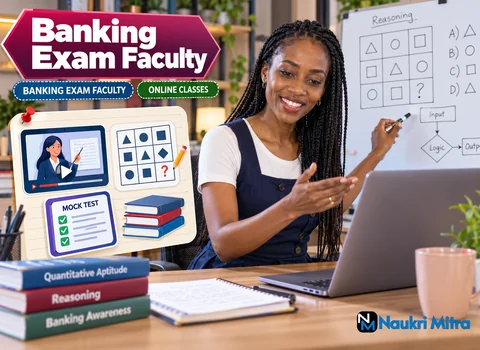
The class opens with a puzzle. Five friends, five floors, one clue that breaks the tie. The chat fills with guesses before you finish reading it out. Next comes a shortcut for successive percentage change, worked on the tablet in four lines. Then a doubt pops up: "Sir, why can't we use the same trick for compound interest?" You stop, you answer, the class moves. That is an ordinary evening in online banking exam faculty jobs. It is Part-time remote work, open worldwide, paying $8 per hour (USD). Your subjects are reasoning and quantitative aptitude, taught live to IBPS PO and SBI PO aspirants.
Your students are preparing for bank officer exams. Many have a day job or a college timetable. They log in at night because that is the only time they have.
Your work covers two subjects: reasoning and quant. You take live classes, share shortcut tricks with PPT notes, solve previous-year questions, run doubt sessions and go through mock test results so each student knows what to fix next. That is the full banking exam faculty job description in one paragraph. The rest of this page breaks it into the blocks of a normal class schedule.
Reasoning is where students lose time, not marks. They know how to solve a seating arrangement. They just take far too long doing it.
So the reasoning block is about speed and method. Typical topics you will handle:
A good reasoning session has a pattern. Show the puzzle. Let them try for a fixed stretch. Then draw the grid on screen and fill it step by step, saying out loud why each clue goes where it goes. Students copy the habit, not just the answer.
Quant is where the shortcut culture lives. Aspirants want tricks. Give them tricks, but always show the long method first, once. A student who knows why a trick works can rescue a question when the numbers change shape.
Expect to cover simplification and approximation, number series, quadratic equations, data interpretation sets, and arithmetic chapters such as profit and loss, time and work, ratio, mixtures and interest. Data interpretation deserves extra care at PO level, because the sets are long and calculation-heavy. Teach students to estimate before they calculate.
Keep your PPT notes clean. One concept per slide. Shortcut in a box. Two practice questions below it. Students download these and revise from them later, so they should make sense without your voice.
Previous-year papers tell students what the examiner likes. Part of your job is to solve them live, at exam speed, and then slow down and explain.
Group the questions by topic, not by year. When a student sees six past puzzles of the same type in a row, the pattern clicks. Point out which questions were traps and which were free marks. Teach skipping as a skill. In a timed paper, leaving a question alone is often the smartest move on the page.
Doubt time usually follows here. Questions arrive in the chat, sometimes dozens at once. Pick the ones that many students share, answer them on the board, and note the rest for a separate doubt session.
Mocks are only useful if someone reads the result properly. You will go through mock test results with students and turn scores into a plan.
Look past the total. Check accuracy per section. Check time spent per question. A student scoring well in quant but attempting too few reasoning questions has a different problem from one who attempts everything and gets half wrong. Say this plainly, one student or one batch at a time, and set the next week's practice around it.
Live teaching runs on a small, reliable setup. Here is what you should have ready before your first class:
Test the whole chain before class. Slides open, tablet pen working, OBS scenes set, audio clear. A dropped stream in the middle of a puzzle costs you the room.
You need to be a graduate with strong quant and reasoning skills. Having cleared or attempted IBPS or SBI exams, or one to two years of teaching experience, is preferred. Clear delivery in Hindi or English matters, since students will judge you in the first few minutes. You should be comfortable with PPT, a pen tablet and OBS.
No specific banking exam faculty certification or course is listed as a requirement here. If you want one, treat it as a way to sharpen your teaching, not as a ticket in. What counts most is that you can solve a PO-level question quickly and explain it in a way a tired student follows at the end of a long day.
Some people move into this work from the exam side. They prepared for bank exams themselves, sat the papers, and know the syllabus from the inside. That background is useful, and it is listed as preferred alongside teaching experience.
If you have never taught, build proof. Record short lessons on one topic each: a syllogism trick, a DI set, a puzzle walkthrough. Teach a few friends or juniors live over a video call and ask them where they got lost. Keep a small bank of solved questions with your own explanations. Put the strongest pieces in your banking exam faculty resume, with a short note on what each one shows.
Banking exam faculty jobs for freshers do exist. Expect the demo to weigh more for you.
For most teaching roles of this kind, the demo lecture is the real interview. Requirements differ from one hiring team to another, but the general shape is similar.
You pick or are given a topic. You teach it for a short session as if a live batch were watching. Reviewers look at a few things: accuracy, speed of solving, how clearly you speak, how you use the board and slides, and whether your audio and video are clean. Some will play the student and throw doubts at you mid-explanation.
Prepare one reasoning topic and one quant topic to demo level. Rehearse with your actual setup. Common banking exam faculty interview questions also touch on how you would handle a weak batch, how you plan a chapter across sessions, and how you respond when a student challenges your method.
Both exam families test reasoning and quant, so the subjects overlap. The flavour does not.
Bank PO papers lean on long puzzles, seating arrangements and heavy data interpretation, with tight sectional timing. SSC papers lean more on standalone questions, and the quant side often goes deeper into geometry, algebra and trigonometry. A banking faculty teaches stamina and selection under time pressure. An SSC faculty spends more time on formula-based topics and concept depth.
Many teachers do both over a career. If you start with banking, you will already have half the toolkit for SSC batches, and the reverse is also true.
At $8 per hour (USD), on Part-time remote hours open to every country, the role suits graduates, working professionals and exam veterans who want to teach in the evenings. Elsewhere, some teachers are paid per class or per course instead. Here, only the hourly rate counts.
On growth: Adda247, Oliveboard and Testbook illustrate the sort of edtech platform found in test prep. A common path runs from live batches to subject lead, content writer for question banks, mock test designer or head of a reasoning or quant team. Some teachers build their own following through recorded lessons. Each step rests on the same base you build here: sharp solving, clear explaining and students who keep coming back to class.