
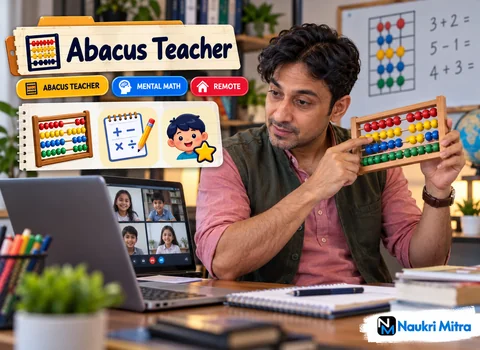
Riya is seven, and on my screen she is dragging beads on a virtual abacus while her younger brother watches over her shoulder. Four plus three, minus two, plus six. She calls out eleven, and I ask her to close her eyes and do it again. Her fingers flick beads that are no longer there, and she says eleven again. That moment, repeated across many batches, is what online abacus teacher jobs are really about. Teaching here is Part-time and remote, open to teachers in any country, with pay of $8 per hour (USD). Your students are small groups of children aged five to fourteen on Zoom, and your tools are a virtual abacus, worksheets and plenty of patience.
An online abacus teacher takes children through a fixed sequence of levels, from recognising bead values to fast mental calculation without any tool at all. Each class has a rhythm. You open with a few minutes of finger work, move into timed sums, then shift to visualisation, and close with homework and a short note for parents when an assessment is done.
The abacus teacher job description is simple to write and harder to do well. You teach levels to small online batches, run speed drills and mental arithmetic practice, share worksheets, track where each child stands, and keep parents informed.
Every class I teach starts the same way. Before any sums, the children move single beads up and down on command: thumb for the lower beads, index finger for the upper bead and for clearing. Young learners at the first level often use the whole hand, and the warm-up is where that habit gets corrected.
On a virtual abacus the movement is a click or a drag rather than a flick, so I ask children who own a physical abacus to keep it beside the laptop and mirror the screen. For five and six year olds, the warm-up may be the longest part of the lesson.
Programmes differ in naming, but the order is broadly similar. Children learn the value of each rod, then simple addition and subtraction, then the small friends and big friends combinations (the pairs that make five and ten), then multi-digit sums, and later multiplication and division. A teacher has to know where each child sits in that sequence, because two children in the same batch can be a whole level apart.
Once fingers are warm, the class moves into timed rounds. I put a column of numbers on the shared screen, start a timer, and the children work on their abaci. Then we check answers aloud. Speed matters, but accuracy comes first.
Good drills are short and varied. A round of five sums, a quick review, then another round with slightly bigger numbers. I keep a simple sheet of each child's time and score so I can see a trend over weeks rather than judging one bad day.
This is the part parents notice. After enough practice, children start to picture the abacus in their heads. I begin with very short sums read aloud while their eyes are closed, and many still move their fingers in the air. That is normal, and I never stop them early. The physical habit is the bridge to the mental image.
Flash cards and dictated sums work well here. Some children take to visualisation quickly while others need much longer, and a teacher has to be clear with families about that instead of promising a fixed timeline.
Each class ends with a worksheet matched to the child's level. I send it as a file or share it through whatever the academy uses, and I check it before the next session. After assessments, I write a short update for parents: what level the child has reached, what is going well, and one thing to practise at home.
You do not need a studio, but the basics have to be reliable. Here is what the role expects you to have at home:
A quiet corner with good light makes a bigger difference than an expensive camera.
Abacus training certification from UCMAS, SIP Abacus or a similar programme is preferred for this role; a degree is not mandatory. Those names are simply examples of the kind of structured training that teaches the full method level by level. A good abacus teacher course, ending in abacus teacher certification, usually covers bead technique, level progression, mental arithmetic methods and classroom handling for young children.
Beyond the certificate, the abacus teacher skills that count most are patience with children aged five to fourteen, clear spoken English or Hindi, and comfort with Zoom and screen sharing. When you prepare your abacus teacher resume, list the levels you are trained to teach and any experience with children, even informal tutoring.
Abacus teacher jobs for freshers do exist, but the sensible route is training first and teaching second. If you have never used an abacus, start with a recognised course and work through the levels yourself until you can do mental sums without hesitation. Practise teaching a relative or a neighbour's child on video before applying anywhere.
So the path to becoming an abacus teacher from home runs in this order: learn the method, get certified, build a simple setup, then apply for part time abacus teacher jobs with a short demo class ready. Academies commonly ask for a demo, and typical abacus teacher interview questions cover how you would explain small friends to a six year old and what you would do with a child who keeps falling behind.
Abacus academies are a common source of this kind of work. Some run online batches alongside centre classes and look for trained teachers who can take regular slots. Some teachers also take freelance abacus teacher jobs, running a few batches for families who find them through word of mouth.
Before you join any academy, do your own checks: ask about batch size, curriculum, how assessments work, and how and when payment is made. Ask to speak with a teacher already working there, and treat any request for money before you are hired as a warning sign.
Parents often ask which one their child should learn, and teachers ask which one to train in. Abacus builds calculation speed through a physical tool and then a mental image of it. It suits younger children well because it is hands-on and visual. Vedic maths uses a set of mental shortcuts and patterns, and it often appeals to older children who are already comfortable with numbers.
Neither is better for every child. If you are starting out, pick the one you can teach with confidence, and be straightforward with families about what each method does and does not cover compared with school maths.
Teaching under this listing earns $8 per hour (USD), on Part-time hours. Abacus teacher salary arrangements differ between academies: some pay by the hour, some by the batch, some on other terms. For this post, the hourly rate above is what counts. Earnings depend on how many classes you take, and no particular number of batches is promised.
Abacus teacher work from home is a good match for people who enjoy children, can keep a regular evening or weekend schedule, and are patient with slow progress. It can be tiring when classes stack up after school hours, and a dropped internet connection means a missed class.