
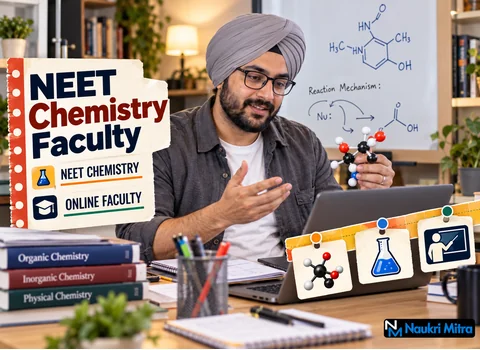
The candidate turns to the digital board and starts drawing the nitration of benzene. The panel watches with cameras off. She writes the electrophile, pushes the first curly arrow from the ring toward it, and then pauses to ask the imagined class where the positive charge now sits. Somewhere in that pause the panel has already made up its mind. This listing is for online NEET chemistry faculty jobs of that kind: you teach organic, inorganic and physical chemistry to NEET aspirants in live online batches, and you prove you can do it in a demo before anything else. It is a Part-time, remote role for candidates in any country, paid at $8 per hour (USD).
The lecture is the visible part, and preparation is most of the work. A plain NEET chemistry faculty job description covers five things. You deliver live lectures across all three branches of the syllabus. You prepare PPT slides for each class. You draw reaction mechanisms in ChemDraw so students see clean structures rather than shaky freehand sketches. You solve previous-year NEET questions with the batch, chapter by chapter. And you run doubt sessions and chapter tests so that each batch knows where it stands.
A typical class moves from concept to solved examples to previous-year questions, then opens for doubts. Students want accuracy and clear notes, and have little patience for long derivations that never return to an exam question.
A frequent weakness in organic chemistry teaching is the list. A faculty member puts a long run of named reactions on a slide, reads them out, and calls it a chapter. Teach the mechanism first: nucleophile, electrophile, leaving group, the stability of the intermediate. Once a student can tell why a carbocation forms where it does, many of the named reactions in the NCERT text stop being separate facts.
This is where ChemDraw earns its place. Prepare the key mechanisms in advance, with arrows and charges drawn correctly, and put them on your slides. Then redraw the key steps live on the digital board so students copy the motion, not only the picture. A panel is quicker to notice an arrow that starts from the wrong place than a slip in a reaction name.
Inorganic chemistry is where NEET students feel the memory load most. Periodic trends, coordination compounds, the p-block and d-block, and the chemical behaviour of common compounds all lean heavily on NCERT text. Your job is to show which facts sit together and why, not to add more.
Good inorganic faculty group exceptions instead of listing them one at a time. They connect a trend to electronic configuration so students can rebuild it under pressure. They also read out the exact NCERT line a question was built from, because the exam stays close to the textbook.
Physical chemistry frightens many medical aspirants because it looks like mathematics. The faculty who do well here keep the algebra light and the units visible. Write the formula, define each symbol, put units next to every value, then substitute. Mole concept, solutions, equilibrium, electrochemistry and chemical kinetics all become manageable when the method stays the same every time.
Solve problems in front of the class at normal speed, including the moments where you check a unit or catch your own error. A calm correction teaches more than a perfect typed solution.
Clearing the demo class is the real gate for this kind of work, so here is what a panel usually looks at. Subject accuracy comes first. A wrong mechanism or a mistaken trend ends the demo early, however good the delivery is. Second is structure: did you say what the class would cover, teach it, and then test it with a question or two? Third is board work: readable handwriting and diagrams students can follow.
After that, the panel listens for pace and for questions to the class. A candidate who talks for the full slot without once checking understanding gives the panel no sign of how they handle a class. Pause and answer a doubt you invent yourself. Finally, the panel checks your setup: audio, lighting, screen sharing and whether the slides switch cleanly. Treat the demo as a real class, not a recital. Common NEET chemistry faculty interview questions after the demo include how you would handle a weak batch, how you build a chapter test, and how you explain a concept you just taught in a simpler way.
Online batches depend on equipment as much as on teaching. Before you apply, make sure you can meet these requirements:
Some classes are live only; others are recorded for students who miss a session. Expect both.
The degree asked for is an M.Sc in Chemistry. One to two years of NEET or medical entrance teaching is preferred. You also need a firm grip on all three branches (organic, inorganic and physical) at NCERT and NEET level, plus working skill with PPT, ChemDraw and a digital board.
People often ask how to become NEET chemistry faculty when they have the degree but little classroom time. Because one to two years of teaching is preferred, NEET chemistry faculty jobs for freshers remain open to an M.Sc graduate, and the demo then carries more weight. A short course on online teaching tools can help, though no particular NEET chemistry faculty certification is listed for this role. On your NEET chemistry faculty resume, list the chapters you have taught, the batch types (school, coaching, online), and any test series or question banks you have prepared.
Part-time faculty hired through this listing get $8 per hour (USD). Hours follow the batch schedule, which suits teachers who want part time NEET chemistry faculty jobs alongside college teaching, a research degree or school work. Because it is fully remote, it also works as NEET chemistry faculty work from home for candidates outside India who teach the Indian syllabus.
Edtech coaching platforms commonly recruit for this kind of role. Some run large live batches, some sell recorded courses, and some hire freelance faculty for crash courses. Rates and contract terms vary across the market, so compare carefully. Here, the hourly figure above is the only one that counts. Find out who runs a platform and read its agreement before you sign, and refuse any request for a registration fee.
The syllabus overlaps a great deal, but the teaching does not. NEET chemistry stays close to NCERT, and questions often test recall of specific textbook lines alongside concepts. JEE chemistry, particularly at the advanced level, leans on deeper problem solving, multi-step organic conversions and harder physical chemistry numericals.
A NEET faculty needs speed, accuracy and careful coverage of every NCERT line. A JEE faculty spends more time on tricky problems and less on recall. NEET batches are mostly biology students, so physical chemistry needs a gentler approach. Faculty who teach both are valued, but prepare your demo for the exam the batch is sitting.
Career growth for online NEET faculty usually follows the work you put out. Faculty who keep good feedback over several batches can move to larger batches, senior faculty roles, or ownership of a full branch of the syllabus. Some move into writing test series and revision notes, or build a following through recorded lectures. The skills you build here carry over to school teaching, JEE batches and content writing for chemistry courses.