
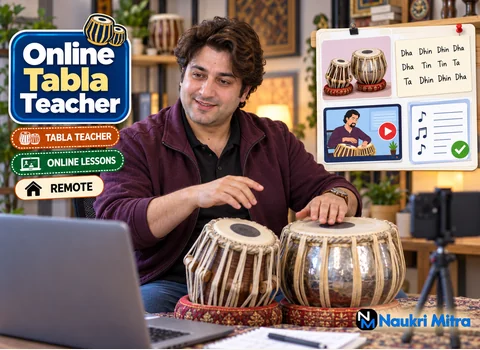
Before the first student logs on, the teacher tilts the dayan towards the light and taps the gajra with a small brass hammer, a little at a time all the way round, until every point on the rim rings at the pitch of the tanpura app. Only then does the camera come on. That quiet ten minutes says a lot about online tabla teacher jobs: the instrument comes first, the screen second. Wherever you live, you may apply for this part-time post, taught entirely from home, where each hour of class earns eight US dollars ($8 USD). Classes run live: you show both hands clearly on camera, correct strokes and laya, and plan lessons for each learner's level.
So what does an online tabla teacher do after the tuning hammer goes down? You run live video classes, often in the evenings or weekends of your students' time zones. A session usually opens with a tuning check on the student's side, moves to warm-up strokes, then theka in the current taal, then new material such as a kaida or rela, and ends with written practice notes.
Between classes you plan level-wise lessons, record slow demonstration clips and keep short notes on each learner. The core of the tabla teacher job description is hearing what is wrong through a compressed audio feed and fixing it with clear words and demonstration.
Phrases such as TiRaKiTa then become the building blocks for kaidas, where a theme is played and varied by the rules of the form.
Teaching tabla bols, kaidas and taals online means teaching students to count as well as play. Teentaal and keharwa usually come first. You explain where sam falls, where the khali section sits and how the theka outlines the cycle, and students recite the bols while clapping the cycle before they play it.
Network delay means you cannot play together in real time, so do not try. The student plays to a lehra loop on their own device while you listen, and you trade phrases instead of playing in unison. A short weekly practice recording often reveals tempo drift that a live call hides.
A front-on webcam shows faces well and tabla poorly. Mount the camera slightly raised and in front, tilted down, so the dayan and bayan both sit in frame with fingers visible against the skins. A second phone camera to the side of the dayan shows finger lift on Tin and Na far better. Ask students to copy the setup, since you cannot correct a bayan wrist that sits out of shot. Even front lighting matters more than an expensive camera.
Call software is built for speech and treats sustained low tones as noise, which is why the bayan's glide often vanishes. Turn on "original sound" or music mode, switch off noise suppression where possible, and use wired headphones, which stop the student's drums feeding back into your mic.
Place a USB mic about an arm's length in front, aimed between the drums and slightly towards the bayan. Aiming straight at the dayan makes the treble harsh and the bass thin. For audio setup to reduce tabla echo on Zoom or similar tools, soft surfaces help most: a rug, curtains, a full bookshelf. Bare walls make every Na ring twice.
Children do best with short segments, recitation games and small weekly wins, such as clean Na and Tin before any combined bol. Keep cameras on, a parent nearby, and keep every message inside the class platform, never on a personal number. Small hands can struggle with a full-size dayan, so you may suggest a smaller set to parents without pushing any seller.
Adults often want the reason before the exercise. They respond well to explanations of taal structure and kaida logic. Their limits are time and stiff wrists, so plan short daily routines and expect slower hands but quicker theory.
On qualifications to teach tabla, a Visharad or Gandharva-level exam is preferred, though long taleem with a guru plus teaching experience is equally welcome. These titles come from recognised music examination boards in India; check details with the board itself. Any tabla teacher course or tabla teacher certification is worth listing, but taleem and accompaniment experience count as much.
The tabla teacher skills that matter begin with strong command of bols, kaidas, relas and common taals, plus clear Hindi or English; you also need your own tabla set, a good mic, a well-placed camera and stable internet. Tabla teacher jobs for freshers with solid training are possible here, though even without teaching experience your own riyaz has to be strong.
Every class hour is paid at $8 USD. Online tabla teacher hourly fees set by private teachers vary widely; for this post, though, the tabla teacher salary per hour stays fixed. Hours depend on student bookings, so no weekly total is promised. Part time tabla teacher jobs like this suit performers and accompanists who want steady teaching alongside concerts, and tabla teacher work from home removes travel between students.
Many teachers also take freelance tabla teacher jobs. Platforms to find tabla students online include tutoring marketplaces, music-lesson websites, cultural associations and your own demonstration videos. Demand for online tabla teachers abroad often comes from diaspora families and adult learners of Indian music, so evening and weekend slots in their time zones tend to be popular.
To start online tabla classes from home, set up a quiet corner, test your sound on a recorded call, write a simple beginner syllabus and take one or two trial students. Keep your tabla teacher resume short, with lineage, exams, experience and a playing clip. Treat any request for a joining fee, or pay far above normal rates, as a warning sign.
The mridangam is a single double-headed barrel drum of the Carnatic tradition, with its own sollukattu and talam system. Tabla is a pair of Hindustani drums with its own bols and taals. Camera and audio ideas overlap, but this role is tabla only.
Expect tabla teacher interview questions about your lineage, how you explain Tin to a beginner, how you fix dragging laya, and how a child's first month differs from an adult's. You will play a theka and a short kaida on camera so sound and framing can be checked. Tune before you start, and keep a written outline of your first three lessons ready, since a question about opening with a complete beginner is likely.