
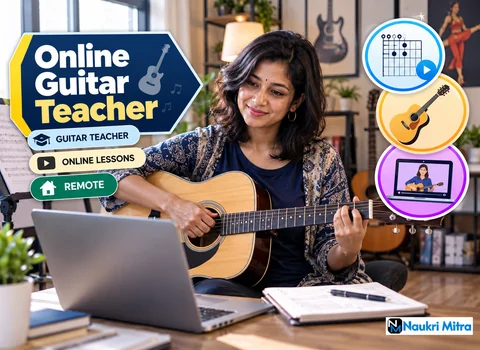
The afternoon might start like this: guitar on your knee, headphones half on, and a student holding a phone up to their headstock while a tuner app argues with them about the G string. Once that's sorted, the next student, a total beginner, tries a first barre chord and gets four strings out of six to ring. Later an intermediate player runs a major scale up the neck while you listen for where the timing slips. That's a normal shift in online guitar teacher jobs, and this one is Part-time, remote, open worldwide, and pays $15 per hour (USD).
Strip the job down and it's simple. You teach chords, strumming patterns, scales and songs in live one-to-one video lessons. You demonstrate through an audio interface or a good mic, with the camera close on your fretting hand. You share tabs in Guitar Pro so the student has something to read after the call ends. You set practice routines between lessons, and if a student wants a graded exam, you help them get ready for it.
The guitar teacher job description is mostly listening. Students can't always tell you what's wrong. They'll say a chord "sounds bad", and it's your ear that works out it's a muted B string from a lazy ring finger. Patience matters more than flashy technique.
Most beginners arrive wanting to play a song they love, and open chords are the fastest route there. A sensible first block of lessons covers E minor, A minor, C, G and D, then the changes between them.
The barre chord is the first proper wall. Over video, you can't reach over and move a thumb, so you describe it: roll the index finger slightly onto its bony edge, keep the thumb low behind the neck, and press closer to the fret wire. Then you have them play string by string while you listen. Tell them it takes weeks, so nobody decides they're hopeless.
Strumming is where lessons online get tricky, because latency on video calls means you can't really play together in time. The workaround is to demo, then stop and listen. Count out loud, have the student mute the strings and strum the rhythm with no chords at all, then add the chords back.
Start with plain down strums on the beat, then down-up eighth notes, then the common pop pattern with a missed down strum in the middle. Keep the hand moving like a pendulum. A metronome or drum loop the student runs on their side is better than you trying to keep time across the internet.
Scales need a point. The minor pentatonic box in the fifth position turns into a blues solo inside one lesson. The major scale explains why C, F and G sound right together in so many songs.
A typical online guitar lesson plan for an intermediate student might be: warm-up with a scale in strict time, a short theory idea (intervals, or how a chord is built from a scale), then put it into a riff or a solo. Guitar Pro is handy here, since the student can slow a passage down and loop it after you've hung up. Keep theory short.
Songs are what keep most students practising. A student who leaves with a song they can half-play will practise. A student who leaves with an exercise sheet often won't. Ask what they listen to, then find something at their level, even if it means a simplified arrangement.
Write it up as a tab in Guitar Pro, mark the tricky bar, and set a small target for next week, like getting the verse up to speed.
Some students want a structure and a certificate. Exam boards such as Trinity and Rockschool are examples of graded systems for guitar. Your job there is working through the board's requirements with the student and running mock assessments. Check the exam board's current syllabus and rules on its official site before planning, since they get updated.
As for your own guitar teacher certification, grades from these boards help, but they aren't the only way in. Several years of playing and teaching experience also counts here. A guitar teacher course on teaching method can help you organise lessons, though this listing doesn't ask for one.
You don't need a studio, but the student has to hear the guitar, not the room. A setup that works:
Turn off the noise suppression in your video app, or your sustained notes will get chopped off.
Both work online, with a few differences. Acoustic lessons rely on the mic, so room noise and placement matter, and strumming dynamics come through well once the mic is set right. Electric lessons can go straight into the interface, which gives a clean, clear signal, but you'll want an amp sim or modelling plugin so the student hears a real tone rather than a thin direct sound.
Check a new student's gear in the first lesson: tuning, string height, a crackling cable. Plenty of "I can't play this" turns out to be "my guitar is badly set up."
Every teacher starts with nobody booked. That's normal, and newer teachers looking at guitar teacher jobs for freshers face the same blank diary as long-time players. Tell friends, local music groups and past bandmates you're teaching online. A short demo clip of your setup helps. Lesson marketplaces such as Lessonface and TakeLessons are examples of where teachers list profiles; if you try one, go through its booking rules and terms on your own first.
Keep a short guitar teacher resume ready: what you play, what styles you teach, any grades, and whether you prep exam students. Expect a few guitar teacher interview questions about how you'd handle a frustrated beginner or a student who never practises. Without teaching experience, grades from Trinity, Rockschool or a similar board are the other route this listing names, and playing ability and clear explaining still have to be there.
Lesson time is paid at $15 per hour (USD), and the work is Part-time. The broader guitar teacher salary picture swings with platform, private clients and location, so read this rate as belonging to this listing, not as a market benchmark.
Can freelance guitar teacher jobs replace a full-time job? For some people, eventually, but there's no promise of that. It depends on how many students stay, how many hours you can fill, and whether bookings hold up through holidays and exam seasons. Many teachers run it alongside gigs or another job, and that's a sensible way to treat part time guitar teacher jobs like this one: extra work you can build on, not a sure replacement for a salary.
You'll want solid knowledge of chords, strumming, scales and basic theory, plus clear English for explaining things to people who've never held a pick. Trinity, Rockschool or similar guitar grades help, or several years of playing and teaching experience. Gear-wise, that's a guitar, an audio interface or good mic, a webcam, Guitar Pro and stable internet.
The guitar teacher skills that matter most don't show up on paper: a good ear, patience, and a habit of breaking hard things into small, playable steps. If that's you, guitar teacher work from home can fit around the rest of your musical life.