
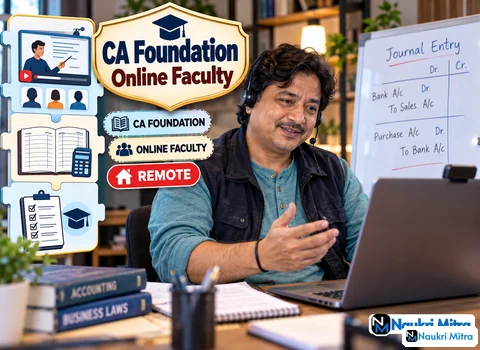
A common assumption is that anyone who cleared CA Foundation can teach it. Then a student in a live class asks why a suspense account exists at all, and a perfectly correct answer leaves half the room more confused than before. Knowing the subject and teaching it to an eighteen-year-old are separate skills. That gap is exactly what ca foundation online faculty part time jobs ask you to close. You would teach Part-time, online, from wherever you live, for $8 per hour (USD). You will take live lectures in accounting, business laws and business mathematics, prepare notes and practice questions, run doubt sessions, set chapter tests and mocks, and follow each student's progress up to the exam.
Think of it as three jobs sharing one calendar. There is the lecture itself, delivered live to a batch over a video platform. There is preparation: notes, worked examples and question sets that students use when you are not on screen. And there is follow-up, which covers doubt sessions, tests and a record of who is keeping up. A practising CA who teaches a few evenings a week will find the follow-up takes more time than expected, and it is also where students decide whether they trust you.
The job description stays the same across all three papers: explain the concept, show it on a worked problem, give students something to try, then check what they got wrong. What changes from subject to subject is the kind of mistake you are trying to catch.
Most Foundation students arrive with school-level bookkeeping and a few habits that need undoing. The useful sequence is slow and cumulative. Start with why every transaction has two sides, then journal entries, then posting to the ledger, then the trial balance, and only then adjustments and final accounts. If a student skips a stage, the error resurfaces three chapters later as a balance sheet that will not tally.
On a pen tablet, write entries live rather than flashing a finished slide. Students learn more from watching you pause over whether rent paid in advance is an asset than from a tidy solution. Keep a running example business across chapters so that depreciation, bills of exchange and partnership adjustments feel like the next event in a story they already know, not a fresh topic.
Law is where many students simply memorise and hope. Your task is to turn provisions into situations. Teach the rule on offer and acceptance through a short scenario, ask the class to decide whether a contract exists, and only then read out the principle. Students remember the case of a seller who withdrew too late far better than a numbered clause.
Keep your teaching tied to the current study material issued by the Institute, because provisions are amended and the syllabus is revised from time to time. Do not rely on notes from your own attempt years ago. Check the latest ICAI material before each batch and tell students to do the same.
Quantitative aptitude splits a class quickly. Commerce students without maths in school often freeze at ratios, logarithms or permutations, while others finish before you have written the question. Teach the method first, then the shortcut, and say clearly which is which. In statistics, plot small datasets by hand on screen so measures of central tendency and dispersion mean something visual before the formulas appear. Short timed drills at the end of a lecture show you who is guessing.
Doubt-clearing is where an online faculty earns trust. Ask students to send questions in advance through chat or a shared form, group similar doubts, and solve the underlying idea once rather than ten near-identical sums. Your notes should be brief and structured, with one worked example per concept and a graded set of practice questions that moves from direct application to mixed problems. Students can tell immediately whether notes were written for them or copied from a textbook.
Chapter tests are diagnostic. Mark them quickly and return them with a short comment per student, not just a score. Track results in a simple spreadsheet so patterns show up: one student loses marks only on adjustments, another only on time. Mock papers later in the course are about stamina and presentation, so review answer layout and working notes as well as final figures. In the last weeks, students need fewer new ideas and more revision of weak areas, so plan sessions around the gaps your tracker shows. For schedules and paper structure, point students to the official ICAI announcements rather than repeating them from memory.
Before assigning batches, platforms often want to see a demo lecture. Treat it as a short, complete class on one topic. Before you record or go live, run through this list:
The stated qualification is CA, CMA or M.Com. Prior teaching or tutoring experience in CA Foundation subjects is preferred. You also need a clear command of accounting, business law and quantitative aptitude, and confident delivery in English or Hindi. There is no separate certification for this role; your degree or professional qualification, plus a strong demo, is what gets assessed. For a CA student still working through the course, the plain answer is that this listing asks for a completed CA, CMA or M.Com, so a student without one of those does not meet the stated requirement. A student who is also an M.Com graduate would qualify on that basis.
Part time ca foundation online faculty jobs can come through online coaching platforms and edtech academies that run live batches, or through smaller institutes that teach online. Freelance ca foundation online faculty jobs also exist, where you are engaged per batch or per subject. Teaching experience is preferred, so a newly qualified CA or M.Com graduate can still apply. Without that experience, gather proof of a different kind: private tutoring for a handful of students, two or three recorded sample lectures, and a resume focused on subjects you can teach and any tutoring you have done. Expect interview questions on how you would explain a specific concept and how you would handle a student who is falling behind.
Foundation is the entry level of the CA course, so the students are usually younger and many are meeting accounting and law properly for the first time. The work leans towards basics, patience and building study habits. Intermediate teaching assumes that base and goes deeper into advanced accounting, taxation, costing and corporate law, with students who are often juggling articleship. Teaching Foundation well is a good way to find out whether you enjoy teaching before taking on the heavier Intermediate subjects.
This post pays its faculty $8 per hour (USD). Elsewhere you may see per-batch fees or revenue shares, which differ from place to place; neither applies to this post. Because this is ca foundation online faculty work from home, it suits professionals who can commit to fixed evening or weekend slots. Keep those slots protected during busy filing periods at your firm, because a batch that loses its faculty mid-chapter is hard to win back.