
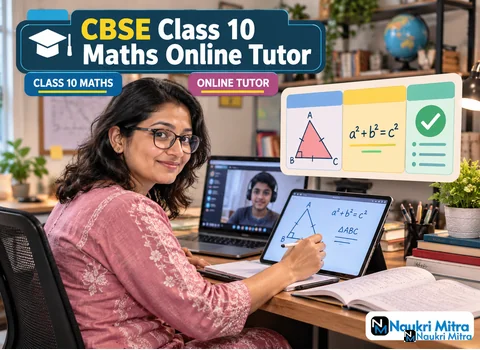
'My daughter can do the formulas in her notebook, but when a heights and distances question comes up in a test she just stops writing. She has started saying she is bad at trigonometry, and the board exam is not far away.' Messages like this one are where most cbse class 10 maths online tutor part time jobs begin: a family that has watched a child lose confidence and wants someone calm and methodical to sit with them over a video call.
A good tutor does not open with a worksheet of thirty questions. They ask the student to talk through one problem aloud, watch where the pen hesitates, and usually find the block is smaller than the child believes: a shaky idea of what sine measures, or starting the calculation before drawing the diagram. By the end of the hour the student has solved two questions they would have skipped, and the parent has a short note on what comes next.
Now the facts. Tutors anywhere in the world may apply, the work is Part-time and fully remote, and it pays $8 per hour (USD). You teach Class 10 NCERT maths in live one-on-one or small group sessions, work through sample papers and previous-year board questions, use GeoGebra for geometry and graphs, set homework and share progress notes with parents.
Think of the role as a term of steady work rather than one-off classes. A family books regular slots, and you carry the student to the point where a full paper feels manageable. Most hours go into live teaching; the rest is light preparation, checking homework and writing a few lines for the parent. One student needs algebra rebuilt, another wants to stop dropping easy steps, so the plan differs for each child.
We ask every tutor to treat the first session as a diagnosis. Before teaching anything new, find out where the floor gives way. A short mixed set works well, with one question each from real numbers, polynomials, linear equations, triangles and trigonometry. Watch how they start, not only whether they finish.
Ask the student which chapter they dread, and ask the parent what the school teacher has said. Then write down two or three specific gaps in plain words and agree the order you will tackle them. That written plan settles a worried family.
The NCERT textbook is the base for CBSE Class 10 maths, and a strong command of its syllabus is essential here. Teach each chapter in passes: the idea, the worked examples, then the exercises in rising difficulty.
Coordinate geometry, circles and the graph of a pair of linear equations come alive in GeoGebra, where a student can drag a point and watch the distance change. For trigonometry, draw the right triangle on the online whiteboard every time until the student does it unprompted. In statistics and probability, many errors are reading errors rather than maths errors.
Once a chapter feels solid, move to sample papers and previous-year board questions on that topic. These show how exam questions are phrased, which is often the real difficulty. Start with single untimed questions, then short timed sets, and only later a full paper.
After each paper, sort the mistakes together: concept gaps, calculation slips and time trouble each need a different fix. Showing a student that most errors are careless slips can change how they feel about the subject. For current sample papers, use the official CBSE academic website rather than forwarded PDFs.
The student has to see your working as you write it; typing equations is too slow. This is the kit we expect:
Practise with the pen before your first paid session until your handwriting looks tidy on screen.
Parents rarely sit in, so your note afterwards is how they see the work. Keep it concrete: what was covered, what went well, what needs practice and the homework set. 'Solved four heights and distances questions alone, still mixes up angle of elevation and depression' tells a parent far more than 'good class today'.
Once a month, compare the student with the gaps listed in the first session. Families who see that list shrinking tend to keep booking.
You should be a graduate in maths or science, ideally with a B.Ed or one year of tutoring. A strong command of the NCERT Class 10 syllabus is essential, because students and parents notice quickly when a tutor has to check the book. You also need comfort with GeoGebra, a digital pen and an online whiteboard, clear English or Hindi, and a webcam laptop on a reliable connection.
Freshers can apply too. If you are a recent graduate without a B.Ed or a tutoring year, a well-prepared demo lesson is the best way to show what you can do. No specific course or certification is named for this listing; short courses on online teaching can help, but how you explain a problem to a real student matters most.
The tutoring rate is $8 per hour (USD). Being Part-time, your hours depend on how many students you take on and the slots you can offer; there is no promise of a fixed number of hours.
You will also come across tutoring platforms such as Vedantu, Cuemath and Superprof; they are named only to show what such platforms look like, each with its own terms. Market rates differ with platform, experience and format, and none of them changes the hourly figure for this listing. Before signing up anywhere, read the terms yourself and check how and when tutors are paid.
The first step is a demo. Prepare a short demo lesson on a topic parents often worry about, such as trigonometry or quadratic equations, and rehearse it on your pen tablet. Keep a one-page resume listing your degree, any tutoring, the chapters you teach most confidently and your available slots.
Expect a short interview or demo before you are matched. Common cbse class 10 maths online tutor interview questions ask you to explain a concept to a nervous student, correct a sample of student working, or describe handling a child who has stopped trying. In the early weeks, be on time to the minute and send your first progress note the same evening.
Class 10 maths covers a broad base: algebra, geometry, trigonometry, mensuration, statistics and probability. The mathematics is not advanced, but students often face board-level pressure for the first time, so much of your work is confidence and method.
Class 12 maths goes deeper, with calculus, matrices, vectors and three-dimensional geometry, and many students are also preparing for entrance exams. It calls for more depth and suits experienced tutors. Many tutors start with Class 10, build a record with families and move up later.
After a few months, look back through your notes for the chapters students find hardest, and build a bank of worked examples, saved whiteboards and GeoGebra files for each. Ask families for honest feedback and refine your demo lesson. Over time you can add small group sessions, offer Class 9, or prepare to teach Class 12. Steady attendance, clear notes and calm explanations are what bring families back the following year.