
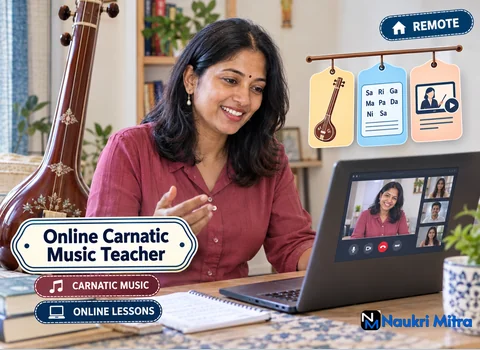
The tanpura drone from the shruti app holds steady on the sa. The student begins sarali varisai, sa ri ga ma pa, and by the second round the ga has slipped a shade below where it should sit. She does not notice. The teacher does, and stops her gently on that note so she can hear the gap for herself. That small moment of listening is most of what these online Carnatic music teacher jobs ask of you. The work is Part-time, taught from home to students anywhere, at $8 per hour (USD). You teach Carnatic vocal or instrument to beginners in live video classes, keep pitch with a shruti box app, correct swara and gamaka errors by ear, send recordings for practice, and guide steady students from basic exercises towards kritis.
A typical Carnatic music teacher job description here comes down to a few repeated tasks. You open each class by setting the student's shruti, warm the voice with a few exercises, teach or review the current lesson line by line, and close with clear practice notes. Between classes you record short demonstrations and keep a simple record of where each student stands. Carnatic music teacher work from home means your room, your headphones and your connection become part of the classroom, so a quiet corner and a reliable setup matter as much as your voice.
Most beginners start with sarali varisai in mayamalavagowla, and the online version of this lesson needs patience. Sing each line slowly in the first speed, then let the student sing it back alone while you listen with the drone running. Ask for the second and third speeds only once the first is even and in tune. Janta varisai, with its doubled notes, shows whether the student can land each repeated swara cleanly rather than sliding into it. On a video call it helps to keep your own volume a little lower than the student's while they sing, so you hear their pitch and not your own.
The alankarams bring tala into the picture. Teach the hand count clearly on camera, with the beats and finger counts visible in the frame, and ask the student to keep tala while singing so you can see both at once. Many students rush the later alankarams in faster speeds. A slower, steady first speed in each tala does more good than a quick run that loses the count halfway.
Teaching sarali varisai and varnams online follows the same habit: short phrases, sung by you, repeated by the student, checked by ear. A first varnam is often the point where a student meets real gamakas for the first time, so break the pallavi and anupallavi into small pieces and return to them over several classes. Write the sahitya and swaras in a shared note so the student can follow along without guessing at the words.
When a student sings varnams with stable pitch and tala, you can plan the move to simple kritis. Choose pieces whose raga the student has already met in exercises or geetams. Teach the pallavi until it settles, then the anupallavi and charanam, and keep revisiting earlier lessons so the base does not weaken. Not every student moves at the same pace, and part of the job is deciding, kindly and clearly, when someone is ready.
Ear correction is the central skill in this work. A flat ga or a sharp ni is easy to miss on a laptop speaker and easy to catch on good headphones. When you hear a drift, stop on that swara, sing it against the drone, and have the student match you before moving on. Gamakas need even more care, because a compressed internet audio stream can flatten the shape of an oscillation. Ask the student to sing the phrase slowly, and if the call blurs it, ask for a short recording sent after class so you can listen at full quality.
Clear pronunciation of the lyrics, in Telugu, Sanskrit, Tamil or Kannada, is part of correct singing. Say each word slowly, then sing it, so the student learns the sound before the melody.
Students improve between classes, not only during them. After each session, share a short audio recording of the lesson in your own voice, at the speed you want them to practise. Keep files named by lesson so a student can find the right one. Some teachers also ask students to send one recording a week, which gives you a clean sample to check without call compression.
The tools for online Carnatic classes are simple: a shruti box app or electronic tanpura, a decent microphone, headphones and a stable connection. Audio delay is a common problem, and you cannot sing together in real time over most video calls, so plan lessons as call and response. These fixes help:
You need several years of training in Carnatic vocal or an instrument, with a diploma, degree or graded certificate preferred. Teaching experience with beginners helps, along with clear pronunciation and the audio setup described above. If you are thinking about how to become a Carnatic music teacher, a structured Carnatic music teacher course or a graded Carnatic music teacher certification from a recognised institution or examining body is one common route, alongside years with your own guru.
You will be paid $8 per hour (USD) for this listing. Market rates for private tuition and other arrangements vary widely, so treat any Carnatic music teacher salary figure you see elsewhere as separate from this role. Apply with a short audio sample of your singing or playing, and a brief Carnatic music teacher resume noting your training and any teaching.
Carnatic music teacher jobs for freshers do exist, though the training requirement still applies. If you have solid training but little formal teaching, mention any time spent helping juniors at your class, since beginner teaching experience helps.
Some teachers combine part time Carnatic music teacher jobs like this one with freelance Carnatic music teacher jobs, teaching private students of their own. Students can come through online tutoring marketplaces, music learning websites, community and cultural groups, and word of mouth from families you already teach. To start classes, fix a clear weekly schedule, decide your lesson sequence, test your audio, and offer a short trial lesson so a family can hear how you teach. Keep your first few students' progress notes careful, because steady progress often brings referrals.
Carnatic and Hindustani music share deep roots but are taught differently, and both traditions adapt well to video. Carnatic teaching for beginners usually follows a fixed sequence of varisais, alankarams, geetams and varnams before kritis. Hindustani teaching often begins with alankars and paltas, sargam and early bandishes within a raga, with its own approach to ornament and improvisation. Neither is easier or better; each asks for teachers trained in that system. Demand for online Carnatic lessons comes from beginners of all ages, including families living far from a local teacher who want their children to learn in a familiar tradition. Students and parents tend to choose teachers carefully, so a patient manner and clean audio count for a lot.