
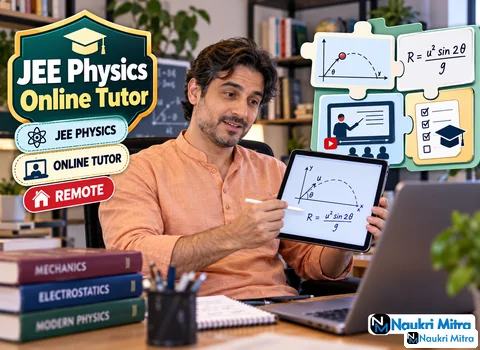
It is 6:25 pm. School finished hours ago, the student has eaten something, and a mock test paper is open on the desk beside the laptop. You have a blank whiteboard on screen and a pen in hand, ready to draw a block on an incline before anyone says hello. That is the start of a typical evening in one of these jee physics online tutor part time jobs. Students can be anywhere and so can you; the slots are part-time, with $8 USD earned per hour of tutoring. You work one-to-one or with a small group, solving problems live and turning test mistakes into practice.
The work is physics problems, worked out loud, with a student trying to get faster and more accurate. It has three parts.
That is the whole jee physics online tutor job description in a nutshell.
Here is how a ninety-minute evening slot might go with one student.
Start with a warm-up from the last session. Ask the student to sketch the forces on a block pulled up a rough slope by a string. Do not correct anything yet. Look for the classic slips: friction drawn the wrong way, normal force drawn vertical, tension missing.
Move to a fresh problem, perhaps a pulley system with two masses or a rotating rod. Let the student lead. You write their steps on the whiteboard and pause where the reasoning wobbles. A good question beats a full solution.
If the idea is still blurry, open a PhET simulation. For a charge moving in a magnetic field, the student can drag the speed slider and watch the radius grow. Seeing it change makes the formula stick.
Pull up the student's latest mock paper. Go question by question through the physics section and label each wrong answer: concept gap, careless algebra, misread question, or ran out of time.
Choose four or five problems aimed at the most common error type and share them before the slot ends. Spend a few minutes writing brief session notes so the next tutor or the parent, where the platform allows it, can see what was covered.
In mechanics, expect kinematics, laws of motion, work and energy, rotation and gravitation. In electromagnetism, expect electrostatics, current electricity, magnetic effects and induction. Modern physics covers topics such as the photoelectric effect, atomic models and nuclear physics. You should be able to solve a hard multi-concept problem cleanly while someone watches and asks why.
The strongest jee physics online tutor skills are not only about knowing the answer. They include choosing a simpler method, spotting where a student's approach went wrong without redoing the whole thing, and explaining in clear English or Hindi without rushing.
Start with a laptop that has a webcam and an internet line you can rely on. A pen tablet or stylus is very helpful for drawing diagrams, though some tutors manage with a mouse at first. The two core teaching tools are a digital whiteboard, where you draw circuits, ray diagrams and force sketches in real time, and PhET simulations, which are free browser-based physics models. Test your setup before the first session so the opening minutes go on physics, not audio problems.
The listing asks for a B.Tech or an M.Sc in Physics along with strong JEE-level problem-solving skills. Having tutored JEE students, or holding a good JEE rank yourself, strengthens an application without being compulsory. That makes this one of the jee physics online tutor jobs for freshers that is actually open to people at the start of their teaching career, provided the physics is solid.
Can IIT students earn as tutors in a role like this? Yes, if they meet the degree requirement or the hiring platform accepts current students; check that point when you apply. What counts in a demo is how clearly you solve and explain, not where you studied.
If you have no teaching background and are looking at jee physics online tutor jobs no experience needed, start by solving a set of recent JEE-level problems on a whiteboard and recording yourself explaining them. Platform skills can come from a short jee physics online tutor course or any general online teaching programme; no jee physics online tutor certification appears among the requirements.
On this listing a part-time tutor receives $8 USD for every hour taught. If you have been checking jee physics online tutor salary per hour figures elsewhere, use this one for this role. Your weekly load rises and falls with the number of students matched to you, so income will not be the same each week. Most demand falls in the late afternoon and evening on school days, plus weekend mornings, because students are in school or coaching during the day. You set the slots you can reliably keep. Because this is jee physics online tutor work from home, open worldwide, any time zone works if you can cover your students' free hours.
Freelance jee physics online tutor jobs and other part time jee physics online tutor jobs usually pay per session hour, with no fixed monthly amount. Read the payment terms before your first class.
JEE and NEET share a lot of physics content, but the teaching feel is different. JEE practice tends to lean on longer, multi-step numerical problems where one idea feeds into another. NEET physics prep tends to reward quick, careful answers to many shorter questions.
This role is about physics only. If calculus and coordinate geometry are your real strength, a maths teaching role will suit you better.
Tutors usually find JEE students through online tutoring marketplaces, edtech platforms that run live one-to-one programmes, small coaching institutes that have moved online, and word of mouth from parents. A short profile with a demo video helps you get matched.
Some offers are not what they claim. Red flags to look out for:
A genuine platform will normally ask for a demo class, explain its payment cycle in writing and keep sessions on its own system.
A jee physics online tutor resume works best when it is short. List your degree, any JEE result you are comfortable sharing, the topics you teach best, the tools you use, and any tutoring you have done, even informally.
Common jee physics online tutor interview questions include solving a problem live on a whiteboard, explaining a concept to a student who is stuck, and talking through how you would review a poor mock test. Practise one problem from each topic area and draw as you talk.
Many JEE students are under eighteen. Keep your camera on and the background neutral, use only the platform's chat and classroom, and do not share personal contact details or arrange private sessions outside it. If a student or parent raises a concern, report it through the platform.