
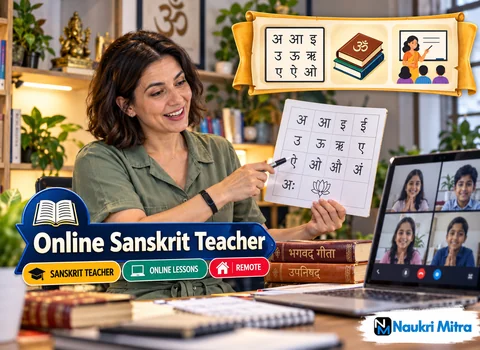
Take the word पङ्कज (paṅkaja) apart and you get पङ्क, "mud", plus ज, "born", a shortened form from the root जन्. Mud-born: the lotus, named for the pond floor it rises out of. A good Sanskrit class hands students that small jolt of discovery again and again, and this role suits someone who enjoys producing it. These are online sanskrit teacher jobs, part-time and taught from home, open to applicants in any country, with each teaching hour worth eight US dollars ($8 USD). You teach live over video, explain grammar with Devanagari slides, help school students with textbook chapters and correct written work.
The plain sanskrit teacher job description runs like this. You teach grammar, shabd roop, dhatu roop, sandhi and translation in live classes. You walk students through chapters from their school textbooks, set practice exercises, mark what they send back and help them get ready for exams.
Between classes there is quiet desk work: building slides, typing exercise sheets, checking a page of translated sentences and writing short notes on what a learner should revise.
Many students come for school Sanskrit. They have a textbook, a set of chapters, class tests and a parent who wants to see progress. With them you follow the book closely, explain each passage line by line, drill the forms the chapter uses and practise the kinds of questions their teacher sets. Exam rules and question formats differ by board and school, so work from the learner's own syllabus and past papers rather than assumptions.
The second group is adults and heritage learners. Some grew up hearing verses at home and now want to read them. Others want spoken Sanskrit, short everyday sentences such as "किं करोषि?" (what are you doing?), with grammar arriving slowly. These classes wander happily into etymology.
So school tutoring is structured and deadline-driven, while spoken and adult classes are open-ended and conversational.
Reciting all of Pāṇini is unnecessary; explaining each area below clearly and patiently is not.
Students meet बालक and suddenly face eight vibhaktis across three numbers. Teach the pattern rather than the wall of forms: take one stem class at a time, show how endings repeat across stems such as राम, लता and फल, and let learners spot the family resemblance themselves before you hand them the full chart.
Dhatu roop teaching online works well with colour on a slide: root in one colour, ending in another. Start with लट् (present) for a root like पठ्, then move to the past and future and the imperative. Explain parasmaipada and ātmanepada as two sets of endings first and as a theory later.
Sandhi is where students either give up or fall in love. Show joins being made and undone, for example सूर्य + उदय becoming सूर्योदय, where अ + उ gives ओ by guṇa sandhi, then reverse the process with real sentences. Compound analysis and translation in both directions round things out.
You need to type Devanagari quickly and correctly. A phonetic input tool or the InScript layout both work; what matters is getting conjuncts such as क्ष, ज्ञ and द्ध right and adding the virāma where it belongs. Use a Unicode font that renders ligatures cleanly, because a broken conjunct on a slide confuses a beginner for a week.
Many adult learners outside India read IAST more comfortably at first, so know your diacritics: ā, ī, ū, ṛ, ṃ, ḥ, ś, ṣ, ṇ. Put Devanagari and IAST side by side on early slides, then remove the roman line as reading improves.
The rest of the toolkit is simple: any slide software, a shared document for exercises, a screen-share-capable video app, and a reliable laptop with stable internet.
Video calls flatten sound, so you correct pronunciation more deliberately than you would in a room. Have learners unmute properly and, where their app allows, turn off the filter that suppresses background noise. Exaggerate mouth position for retroflex ट versus dental त, and show the tongue moving. Separate aspirated from unaspirated pairs with a hand in front of the mouth. For visarga and anusvāra, play a short recording, have the student repeat it, then replay both.
This work is linguistic and practical. When students bring stotras or verses from religious texts, treat them with respect, focus on accurate reading, metre and meaning, and leave devotional interpretation to the learner and their own tradition.
An MA in Sanskrit, or a Shastri or Acharya qualification, is preferred. Classroom or tutoring time counts in your favour without being demanded, so recent graduates have a real chance here among sanskrit teacher jobs for freshers. You also need firm command of grammar, shabd roop and dhatu roop, fast Devanagari typing for slides and the ability to explain clearly in Hindi or English.
The core sanskrit teacher skills are accuracy, patience and the knack of turning a dense rule into one memorable example.
Payment covers the hours you actually spend teaching, $8 USD for each one. No other sanskrit teacher salary per hour applies to this post; other platforms, levels and class arrangements pay differently. The job is part-time. Your hours depend on how many students book and which time zones they live in, so the weekly load can rise and fall, especially around school exam periods.
Demand for online Sanskrit lessons comes from several directions: school students who need extra help, families abroad who want children to read the script, university students in linguistics or Indology, and adults learning for interest.
Students and parents usually find teachers through tutoring marketplaces, language-learning sites that list independent tutors, cultural associations and word of mouth. Many teachers mix a role like this with freelance sanskrit teacher jobs elsewhere. To begin, prepare two or three sample lessons (one school chapter, one beginner spoken class), make a clean profile and offer a short trial class.
For online work, subject depth comes first. A sanskrit teacher course in teaching methods or a sanskrit teacher certification from a recognised institution can help a profile, but neither replaces sound grammar and a good demo.
School-age learners are children, so a few habits are non-negotiable. Cameras stay on for the lesson, a parent knows what is happening, and messages travel only by the platform or routes the family has agreed, never through private contact.
When you look at any sanskrit teacher work from home offer, be careful. Red flags: a demand for money up front, a recruiter who refuses every channel except personal chat, generous pay offered with barely any screening, or bank details requested before anyone has interviewed you. A genuine role will usually ask for a demo class and give clear payment terms. Never send money.
A single page is enough for a sanskrit teacher resume: degrees with institutions, any school or tutoring experience, the levels you teach, your languages of instruction and a line about your Devanagari and IAST typing. If you have taught nothing formally yet, list peer tutoring or study circles honestly, because even beginner-friendly roles want evidence that you can explain.
Sanskrit teacher interview questions are often practical: introduce the instrumental case to a ten-year-old, say, or fix a sandhi slip without deflating the student. Rehearse a ten-minute demo with one slide set and one short exercise. Part time sanskrit teacher jobs like this one are often decided in that demo.