
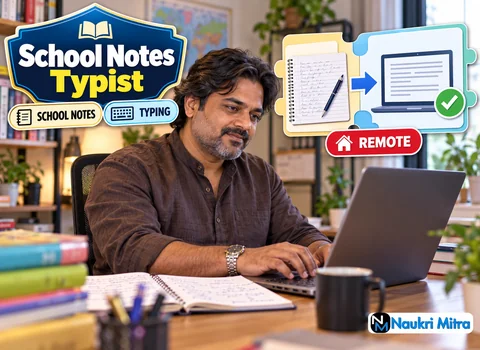
Many people assume online school notes typist jobs are all about typing fast. In practice, most of the work is reading a teacher's rushed handwriting, working out what a smudged symbol means, and making a page that a student can actually study from. Speed helps, but patience and a careful eye matter more.
The role is part-time and done from home, people anywhere in the world can apply, and the typing is paid hourly at 8 USD. Students and homemakers looking for their first paid typing work will find the common problems below, each with a practical fix.
A school notes typist takes handwritten material and turns it into a clean digital file. That material can be class notes, worksheets, chapter summaries or question banks. Teachers and coaching centres write these by hand and need typed copies to print or share.
The basic school notes typist job description looks like this:
New typists often underestimate this part. Teachers write quickly. Letters run together, a 1 looks like a 7, and a u can look like a v.
Solution: Zoom in on the image before you guess. Read the whole sentence first, because the meaning often tells you the word. If a page is about photosynthesis, that scribble is probably chlorophyll. Keep a short list of words or symbols you could not read, and send it to the client with your file instead of guessing quietly. Clients prefer a question to a wrong answer in printed notes.
Maths, physics and chemistry notes are full of fractions, square roots, powers, Greek letters and chemical formulas. Typing x2 when the teacher meant x squared changes the meaning completely.
Solution: Learn the equation editor in Word (Insert, then Equation) and the one in Google Docs (Insert, then Equation). Start with the common ones: fractions, powers, subscripts, roots and the plus-minus sign. In chemistry formulas such as H2O, use the subscript button so the 2 sits lower. An old textbook page makes good practice material.
Notes often have comparison tables, like differences between plant and animal cells, or tables of values in a physics practical. If you build tables with spaces and tabs, they break as soon as someone opens the file on another computer.
Solution: Always use the proper Insert Table tool. Count the rows and columns on the handwritten page before you start. Make the top row bold so it reads as a header, and keep column widths even. If a table spills onto a second page, set the header row to repeat so the reader does not lose track.
Many school notes are in English, but plenty of teachers in India write in Hindi, and some mix both on one page. Hindi and English typing requirements for notes typists depend on the client, so read each task carefully.
Solution: For English, normal touch typing is enough. For Hindi, you will need a Unicode Hindi keyboard such as Inscript, or a phonetic tool like Google Input Tools where you type in English letters and it converts. Older fonts like Kruti Dev are still asked for by some coaching centres, so ask which one the client wants before you start. Typing Hindi slowly but correctly is better than typing it fast with broken matras.
A file can have every word right and still look careless. Uneven spacing, five different fonts and random bold text make notes hard to study.
Solution: Use the built-in Heading 1 and Heading 2 styles instead of making text big by hand. Pick one clear font and stick with it. Keep margins the same on every page and add page numbers.
Most clients want the final file as a PDF so it looks the same on every phone and printer.
Solution: In Word, use Save As and choose PDF. In Google Docs, use File, then Download, then PDF. Open the PDF yourself before sending it. Check that equations, Hindi text and tables came out correctly, because fonts sometimes shift during export.
Coaching centres often need notes before a batch starts or before exam week, so several tasks can land at once.
Solution: Before you accept a task, look at the number of pages and how many equations or tables they have. A page of plain English text is much quicker than a page of algebra. Only accept what you can finish properly. If you are going to be late, tell the client early. A short honest message keeps a client far better than a late file with no warning.
On this part-time role, every typed hour brings in 8 USD. People often ask whether a school notes typist salary is paid per hour or per page. In this market you will see both. Some clients pay a fixed rate for each page, while others, like this role, pay by the hour.
Your school notes typist salary per hour stays the same here, but your value to clients grows as you get quicker and cleaner. The hours vary, so treat this as part-time income alongside your studies or home work rather than a full-time wage.
You do not need anything fancy. Here is what to have ready:
The main school notes typist skills are typing at around 30 to 40 words per minute with high accuracy, reading handwriting, using an equation editor and proofreading. You can test your speed for free on any online typing test. No paid school notes typist course or school notes typist certification is required for this role. Practice on real pages teaches more than any course.
The usual advice on "how to become school notes typist" is to start small. Teachers, private tutors and coaching centres are common sources of this work. Tell local tutors you can type their notes. Look on job portals and freelance sites for freelance school notes typist jobs and part time school notes typist jobs.
Make a simple school notes typist resume. List your typing speed, the tools you know, and whether you can type Hindi. Attach two sample pages you typed yourself: one with equations and one with a table. For school notes typist jobs for freshers, those samples often matter more than anything written on the resume.
Some school notes typist interview questions you may hear: How fast do you type? Can you use an equation editor? What do you do when you cannot read a word? Have a short honest answer ready for each.
Are online notes typing jobs genuine? Many are, though scams do exist. Be careful if anyone asks you to pay money to receive work, buy their software, or deposit a security amount. Real clients pay you, not the other way round.
These jobs sound alike but feel different day to day. A data entry operator usually fills forms, spreadsheets or databases with short pieces of information like names, numbers and addresses. The work is repetitive and the layout is already set.
A notes typist builds a full document. You decide where headings go, build tables, type equations and make the page look good for students. The work involves more reading and formatting, with the student reader always in mind. If you like neat pages and you are patient with handwriting, notes typing may suit you better than data entry.