
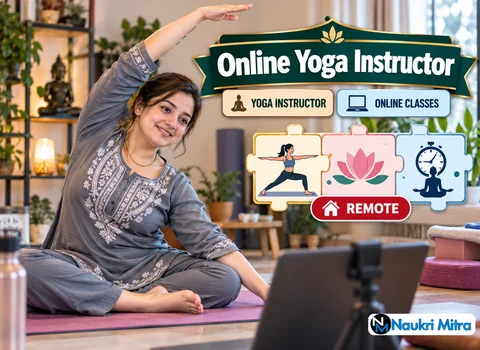
Over a screen, a safe cue matters more than a deep pose. That single rule shapes everything about these online yoga instructor jobs. You will teach live beginner and intermediate classes on Zoom to adults spread across time zones, and you will not be in the room to catch a wobbling knee or a shoulder taking too much weight. Your voice, your camera framing and your choice of modifications have to do that work instead. Certified teachers anywhere may apply; the post is part-time, taught from your own room, and each class hour brings in $15 USD.
A typical session begins before anyone joins. When people arrive, you ask a short check-in question and remind everyone to stay within a comfortable range. You demonstrate each asana from a full-body camera view, talk students in and out of shapes, and scan the video tiles for anyone who looks strained. Afterwards you answer questions, and later you plan the next week of sequences.
That is the plain yoga instructor job description for this role: teaching, not selling programmes or building a social following.
Safety online starts with knowing who is on the mat. New students should fill in a short health screening form before their first class, covering recent injuries, surgery, pregnancy, blood pressure concerns and anything else a teacher ought to know. Where something is flagged, ask the learner to check with their doctor before practising. You do not diagnose, and you never tell anyone that a pose will fix a back problem or a stiff neck.
In class, offer at least one modification for every demanding pose, and say it before students commit to the full version. Props make this easier at home. A firm cushion can stand in for a bolster, a belt or scarf for a strap, two thick books for a block, and a sturdy chair for standing balances. Invite cameras on, but never insist.
Liability belongs in the same conversation. Students should accept a simple acknowledgement or waiver during booking, you should keep brief notes of any reported injury, and you should check whether teacher insurance is expected where you live. Rules differ by country, so look them up rather than assuming.
In a studio you might place a hand on a hip. Online you have words and your own demonstration, so the words need to be exact. Name the body part, then the direction, then the breath: "Right foot steps forward between the hands, exhale." Keep cues short and in order. Four instructions in one sentence will lose anyone listening through a laptop speaker.
Decide whether you will mirror students, then say so and stick with it. Many teachers face the camera and use "your right" throughout, turning side-on for poses where the line of the spine matters. When you notice someone struggling, cue the whole group instead of calling out a name, then follow up quietly in chat if needed. Your cues may be given in Hindi or in English, but either way they must be easy to follow.
Most bookings are gentle, beginner-friendly practice. You do not need to teach every style, but you should be comfortable leading at least two of these.
A beginner sequence might open with seated breath awareness, move through cat-cow, child's pose and a low lunge, add mountain pose, a supported warrior and tree pose near a wall, then close with a simple twist, bridge and a long rest.
Breath-linked movement at a moderate pace for students with some practice behind them. Transitions need extra cueing online, since nobody can copy the person on the next mat.
Suited to learners who find getting down to the floor hard, or who simply want a quieter hour. These lean heavily on props and on very clear setup instructions.
Short guided pranayama and rest, taught carefully, always with the option to breathe normally for anyone who feels lightheaded.
Yoga instructor work from home only works if students can see and hear you clearly. You need a quiet room, a mat with open floor around it, a laptop or phone on a steady stand, a lapel or wireless mic so your voice still carries when you are lying down, and stable internet. Zoom is the main platform, so learn its spotlight, mute and waiting room controls.
Set the camera low, roughly at hip height, and far enough back to show you from fingertips to toes in both standing and lying poses. A horizontal frame suits most rooms. Put your main light in front of you, not behind, because a bright window at your back turns you into a silhouette. Record a minute of downward dog and a lying twist, then watch it back to test the frame.
RYT 200 certification from a Yoga Alliance registered school is expected, or an equivalent recognised yoga course. Yoga Alliance is a voluntary registry, not a government licence. If you are not yet certified, a 200-hour yoga instructor course is the usual starting point. Check that the curriculum covers anatomy, alignment and supervised teaching practice, and that the yoga instructor certification it issues is accepted where you want to teach.
Beyond the certificate, the yoga instructor skills that count here are sound knowledge of asanas and alignment, the habit of offering safe modifications, calm verbal cueing, and enough comfort with technology to fix a frozen screen without losing the room.
Teaching is paid at fifteen US dollars an hour, part-time. The timetable depends on bookings and on which time-zone slots you can cover, so it shifts week by week. If you are comparing yoga instructor salary per hour across offers, look at whether planning time is paid, how far ahead the timetable is shared, and how late cancellations are handled. General yoga instructor salary figures vary widely by country and experience.
An online instructor leads general group classes for adults and offers sensible options for common limitations. A yoga therapist completes separate, longer training and works one to one with people who have specific health conditions, often alongside medical professionals. If a student needs individual therapeutic work, refer them to a qualified therapist or their doctor rather than turning your group class into treatment.
Newly certified teachers are welcome to apply, so freshers searching for yoga instructor jobs for freshers can consider this post. Roles open to beginners usually mean no paid teaching history, not no training, so you still need the certificate and a solid demo. If you are starting from nothing, teach free practice classes to friends or family over Zoom and listen back to recordings for unclear cues.
Part time yoga instructor jobs such as this often sit alongside other freelance yoga instructor jobs in a teacher's week. Fitness apps, local studios that now run online timetables and workplace wellness schemes all take on remote teachers. To grow your own group, start with one fixed weekly slot and word of mouth.
Remote teaching attracts its share of dubious offers. Decline politely when a so-called hirer charges you before you can teach, insists you buy their own "certificate upgrade", or wants bank details before any contract exists. An offer with no named contact, nothing in writing and a rush to commit deserves a firm no. No fixed hours are promised here either, so read any terms closely.
A yoga instructor resume needs a single page: certificate and school, styles you teach, languages, any classes you have led. Prepare a fifteen-minute demo with a warm-up, two standing poses with modifications and a short rest. Yoga instructor interview questions usually test judgement: a student mentions knee pain halfway through, you must cue a pose without demonstrating it, or someone keeps the camera off all class.