
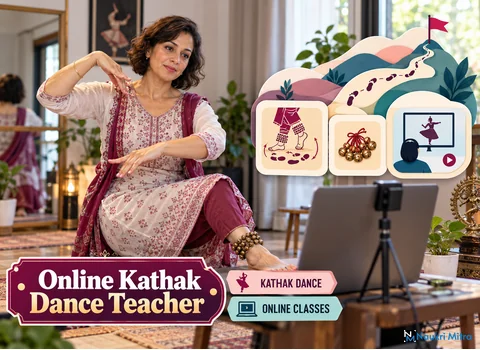
Ta thei thei tat, aa thei thei tat. The student is out of frame for a second, but the microphone still carries every stamp, and on count three the sound arrives a fraction too soon, a dull thud before the clean slap of the ball of the foot. That is a heel landing early, and a good teacher hears it before seeing it. Catching that, and fixing it in a friendly way, is the daily work in these online Kathak dance teacher jobs. The post is Part-time and home-based, open to dancers anywhere in the world, with $8 per hour (USD) as the rate.
A simple Kathak dance teacher job description for this role: you run live lessons over video, demonstrate each movement so the whole body is visible, watch the student repeat it, and give corrections they can act on straight away. You recite bols aloud, keep the taal by clapping or with a lehra track, and explain where sam falls so the student knows where a phrase must land. At the end of each lesson you leave a short practice routine for the week.
Students range from children starting at zero to adults returning to the form, in one-to-one or small group classes. As in many part time Kathak dance teacher jobs, class slots can be planned around your own riyaz.
Tatkar is where most online corrections happen, and much of it is done by ear. Ask the student to count aloud while stamping: 1, 2, 3, 4, then double speed, then back. If the voice and the feet drift apart, you will hear it. Uneven weight shows up as one foot sounding louder than the other. A heel that drops too early makes a heavy, muddy beat instead of a crisp one.
Start slow, at thah laya, and only move to dugun once every beat is even. A few side-on rounds let you check that the knees stay soft. Once students are ready, keep their ghungroo on, because the bells make timing errors easier to hear.
Spins are the part parents worry about and students love. Teach the spot first: the eyes fix on one point, the head turns last and arrives first. A spot just behind the camera brings the gaze back to the lens on each turn.
Build up from single turns on a count, with a full stop and a balanced pose afterwards, before adding more. Watch the heel of the pivot foot and the arms; arms that fly out wide are usually the reason a student loses balance. If anyone feels unwell, stop and go back to tatkar.
Hastaks look simple until you see them on a small screen. Ask students to stand far enough back that fingertips stay in frame at full extension. Correct the line from shoulder to wrist, the soft wrist circle, and the eyes following the hand. When mirroring, say which side you mean ("your right hand, my left on screen").
Posture is the base under everything: chest open, shoulders down, a slight bend in the knees, weight centred.
Bols are the spoken syllables of the dance, and reciting them is as much part of the lesson as dancing them. Have students say a tihai aloud with the counts before they dance it, so they understand why the third repetition lands on sam. Clap teentaal with them: dha dhin dhin dha, with the khali shown by a wave of the hand. You will explain in Hindi or English, and many students like a quick written note of the bols after class.
Audio lag can make it hard to dance together in real time, so it often works better to recite, let the student repeat, and give feedback, instead of trying to dance in unison.
Once tatkar and basic hand work are steady, introduce short pieces: a simple thaat, a toda, a tihai, or a small tukda. Break each one into sections of a few counts, teach the bols first, then the feet, then the hands and turns. Ask for the full piece at the start of the next class.
Weekly practice routines should be realistic. A short daily tatkar set at a slow tempo, one composition repeated with counts spoken aloud, and a few spins with a clean finish will move a student forward more than a long list they never open.
Before your first class, check this setup at home:
Students should copy this arrangement at home, too. You cannot correct feet you cannot see.
Applicants should have a Visharad, diploma or degree in Kathak, with prior teaching experience preferred. You should have a clear command of tatkar, chakkar, bols and basic compositions, and be able to explain them in Hindi or English. The practical requirements are adequate floor space, a full-body camera setup, good audio and stable internet.
If you are working out how to become a Kathak dance teacher online, formal training gives you the base, and a recognised Kathak dance teacher course or Kathak dance teacher certification shows students what level you have reached. Your Kathak dance teacher resume should list your guru or institution, your qualification, performances and the levels you teach. Prepare to demonstrate tatkar and recite a tihai on camera, since interviews often include a short demo alongside Kathak dance teacher interview questions about correcting footwork over video.
Teaching on this listing brings $8 per hour (USD), in Part-time hours worked from home. A Kathak dance teacher salary in the wider market depends heavily on experience, platform, location and whether you teach groups or individuals, and none of those outside numbers alters this one.
Many teachers combine a Part-time role like this with their own students, which makes freelance Kathak dance teacher jobs and listed roles easy to combine as long as the schedules do not clash.
If you also want your own students, lesson marketplaces, cultural groups abroad and short dance videos on social media are common starting points. Each platform sets its own payment terms, so look through them before you join.
Starting Kathak dance teacher work from home is mostly about preparation. Set a fixed teaching corner, test your camera angle and sound with a friend, write out a beginner plan for the first few weeks (posture, tatkar, simple hastaks, one tihai), and decide whether you will teach individuals, groups or both.
Kathak and Bollywood dance are both taught online, and they serve different goals. Kathak classes follow a classical system of tatkar, taal, bols and set compositions that are built up over years. Bollywood dance classes usually teach film choreography that blends many styles and moves quickly from one song to the next. Neither is better; a good teacher explains the difference plainly so families can pick what suits them.
Interest in learning Kathak online comes from many places, including Indian families living abroad who want their children connected to the art form, and adult learners anywhere who are drawn to its footwork and storytelling. Time zones mean evening and weekend slots in other regions are often the busiest.