
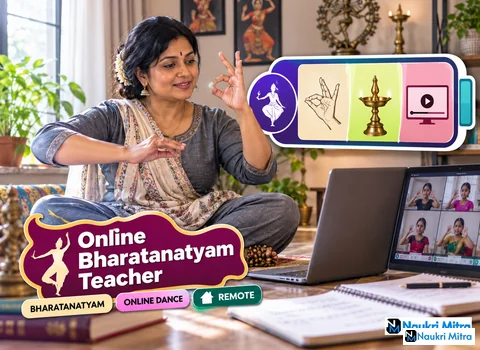
Many dancers still believe Bharatanatyam cannot be taught through a screen, that the form needs a guru in the same room, beating the thattu kazhi and pressing a student's knees out into araimandi. Part of that is true. Most of it is not. These online bharatanatyam teacher jobs ask you to teach adavus, mudras, footwork and simple items in live video classes, demonstrate from a full-body camera view, correct posture through the screen, set practice routines and track each student's progress across levels. Classes run from your home, Part-time, and dancers living in any country may apply; pay is $8 per hour (USD).
A screen carries counts, rhythm, the shape of a hasta near the lens and the order of a sequence very well. It carries poorly the weight a student puts through the heels, small turns of the hip seen straight on, and the hands-on adjustment a teacher gives in a studio. A good online teacher knows which is which and plans around it. The sections below follow the order of a class.
Every class still opens with namaskaram. I ask students to step back until the whole body, crown to feet, sits inside the frame, because the bow to Bhoomi Devi is the first posture check of the day. If the feet are cut off, the device moves before anything else happens.
Warm-up follows: ankle rotations, slow sit-and-rise into araimandi with a straight back, eye exercises for drishti and gentle hip stretches. Ask about the floor in the first class. Polished tiles or a sliding rug are a risk for a child dancing at home.
Adavus are taught as in a studio: by count, slowly first, then in faster speeds. Online, audio lag can leave students a beat behind your voice, so after demonstrating a line I go quiet and let the student say the sollukattu aloud while dancing. Then I hear their count, not an echo of mine. Tatta, natta and the early visharu adavus work well this way.
Turn side-on when a movement travels forward or the knee line matters; facing the lens, a student cannot judge how far your knees open. Settle mirroring early, too. Say once whether you will dance as their mirror image or show your true right and left, and keep to it.
Hastas are where video can beat a crowded classroom. Hold pataka, tripataka or alapadma still near the lens and the student sees every finger. Ask them to do the same, one hand at a time, so you can check the thumb and catch fingers that have started to bend. Asamyuta and samyuta hastas can be taught with their viniyoga, explained in English or a regional language. Then the student steps back and uses the mudra inside a movement, because a hand that looks right up close often loses shape at full arm's length.
Posture asks the most of an online teacher. You cannot press a knee outward or lift a sagging spine by hand, so you correct with words, angles and recordings. Watch the held araimandi from the front, then from the side. Typical faults are knees falling inward, heels lifting, the seat pushed back instead of lowered, and the chest collapsing as the student tires.
Give one correction at a time and name the body part plainly: heels together, knees over the little toes, sit lower. Short clips filmed at home after class help a great deal. You watch them at normal speed and slowed down, reply with notes, and keep a written record of progress.
Once adavus are steady, students move to a pushpanjali or alarippu, then perhaps a short jathiswaram or a shabdam with its first abhinaya. Teach items in small sections and share the music track beforehand. Between classes, assign a routine such as adavus in all speeds plus one section of the item, and check it at the start of the next lesson. Notes on what each student has learned and where they struggle make level changes fair and easy to explain to parents.
A student can only learn what the camera and microphone carry, so the setup needs care:
You should have completed your arangetram or hold a diploma or degree in Bharatanatyam. Prior teaching experience is preferred. If you have helped your guru with junior batches, put it on your resume plainly: levels assisted, items taught, years trained. Freshers with an arangetram or formal qualification may still apply, bearing in mind that experience is preferred.
The core Bharatanatyam teacher skills are clear knowledge of adavus, mudras and basic items, and the ability to explain them in English or a regional language. The usual path to teaching is long training under a guru leading to arangetram, or a structured course leading to a diploma or degree; ask any institution directly what its certification covers. Interview questions tend to be practical: demonstrate adavus on camera, explain a hasta, and show how you would correct araimandi from a clip.
Teaching under this listing earns $8 per hour (USD). Bharatanatyam teacher salary elsewhere has no single answer. Teachers who run their own classes set their own fees, depending on their training, the format (one-to-one or group), the level and where students live. Freelance Bharatanatyam teacher jobs work on terms the teacher and family agree, so put class length, missed-class rules and payment method in writing first.
Students usually come from word of mouth through your guru's school, cultural associations and temple communities abroad, online tutoring and hobby-class marketplaces, and your own social media page with short teaching clips. Read any platform's terms first, including its rules on payments and cancellations.
To work as a Bharatanatyam teacher from home, prepare the room, plan a syllabus for the first few months and run a trial class with a relative to test camera and sound. Set a timetable that suits your families' time zones, and start with one-to-one students or a small group so you can watch each dancer closely. A home class still deserves the discipline of a studio.
People ask which is easier to teach over video. Neither form is easier or lesser; each makes its own demands. Bharatanatyam's araimandi and geometric lines need side-on views and steady framing. Kathak's chakkars and fast tatkar ask a great deal of audio and floor space, since footwork must be heard to be corrected. Both carry abhinaya traditions that suit close-up work. Teach the form you trained in, and teach it completely.
Families of Indian and South Asian origin living abroad are a natural audience for live online lessons, especially where no qualified teacher lives nearby and parents want their children to learn the form, its music and its stories. Some adults also return to a dance they began as children. These families value a teacher who explains the meaning of items and the place of the dance in festivals and temple traditions, not only the steps. Evening and weekend slots in the student's country are common requests, and patience with parents helps students stay with you over time.