
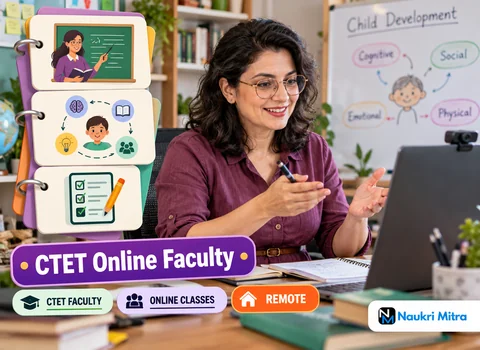
Seven o'clock: ten minutes of recap, where I put three questions from last night's topic on screen and ask the class to type answers in the chat before I say a word. Seven-ten: the concept segment, forty minutes on one idea from child development, say Vygotsky's zone of proximal development, explained with a classroom example and then turned around so learners see how a question might test it. Seven-fifty: a practice set of previous-year style questions, solved together, with me asking why each wrong option is wrong. Eight-twenty: the doubt round, open mic and open chat, until the queue is empty or we book a follow-up. That is a typical evening in these ctet online faculty part time jobs.
Nothing here needs a commute: teachers in any country can take these evening batches part-time, at an hourly rate of $8, paid in US dollars. Your learners are graduates and trainee teachers preparing for CTET Paper 1 and Paper 2. You teach child development and pedagogy, language pedagogy and subject pedagogy in live classes, work through old papers, run mock tests and clear doubts in follow-up sessions. What follows is how I would brief you on day one.
Each of the four blocks has a job. The recap tells you who forgot what, and it gives late joiners a soft landing. The concept segment is where you earn trust: one idea, taught properly, with no rush to cover five. The practice set converts that idea into exam thinking. The doubt round catches what the first three missed. Classes go wrong when one block swallows another, usually the concept segment eating the practice set.
So the ctet online faculty job description here is less about lecturing and more about running that sequence reliably, week after week, with notes ready before you go live.
What does a CTET online faculty teach? The backbone is child development and pedagogy: theories of learning, inclusive education, assessment for learning, the role of the teacher and how children think at different ages. Around that sit language pedagogy (how a first or second language is taught, read and assessed) and subject pedagogy for maths, environmental studies, science or social studies, depending on which paper and stream your batch is preparing for.
Batches are usually split by subject, so you will be matched to the areas you know best. What you must cover is the current official syllabus and exam pattern as published by the conducting body. Read it yourself each cycle, because details can change.
Solving previous-year papers is not about memorising answers. Pedagogy questions often hinge on the most child-centred option among several reasonable ones, and aspirants need to hear you reason out loud. After each mock test you hold a discussion: which questions most of the batch missed, which distractors caught them, and what reading habit would have helped. Keep a running sheet of these patterns.
You will not promise anyone a score or a pass. Offer clear concepts, steady practice and honest feedback instead.
Most of your learners are not full-time students. Many are private school teachers, B.Ed or D.El.Ed trainees, parents returning to a career, or graduates working other jobs. They often join tired, sometimes from a phone. A few habits make a real difference with this group:
Respect is the whole method here. These are colleagues-in-training, many older than you, and adults who feel judged stop asking.
The doubt round needs structure or it drifts. Take chat doubts in order, group similar ones, and answer the shared confusion once. If a question needs more than a few minutes, note it and promise a follow-up session or a recorded short explanation, then actually deliver it. Keep all contact on the platform's own channels; personal numbers and private chats are not part of this role.
Tools for CTET online teaching are mostly the common live class apps: Zoom, Google Meet or a platform's built-in classroom, plus a digital whiteboard, a pen tablet if you like writing by hand, and a quiz or polling tool for quick checks. You need a laptop, a webcam and stable internet, as the requirements say, along with a headset that keeps your voice clear. Test your setup before each batch starts.
The qualifications to teach CTET Paper 1 and Paper 2 online, for this post, are a graduate degree with B.Ed or D.El.Ed, a qualified CTET result, and one to two years of teaching or coaching experience preferred. Strong command of child development and pedagogy and clear delivery in Hindi or English are expected.
Asking how to become CTET online faculty with a B.Ed? The practical path is short: clear the exam, teach in any setting you can (a school, a coaching centre, a community class), and record a few sample lessons. CTET online faculty jobs for freshers do exist, because selection leans on a demo lesson, but a fresher should still show some classroom contact. Openings listed as ctet online faculty jobs no experience usually still expect the CTET pass. There is no separate ctet online faculty certification or ctet online faculty course you must buy; the teaching degree and the exam result are what count, and a short online-teaching workshop is optional.
Here the ctet online faculty salary works out as $8 for each hour you teach, in USD, on a part-time footing. Batch timetables shift from one exam cycle to the next and your hours shift with them, so weekly earnings move around. Look up ctet online faculty salary per hour and the numbers vary widely between listings; judge any figure by what it covers, whether preparation time and mock-test checking are paid, and how reliably payments arrive.
CTET faculty and state TET faculty share a large pedagogy core. The differences lie in content: state TETs are set by state authorities and often bring in state-specific language papers, local context and their own format. Check each exam's official notification rather than assuming the two match.
Hiring comes mainly from test-prep edtech platforms with live batches, coaching institutes that have moved classes online, and independent educators who run their own channels. Freelance ctet online faculty jobs are common at the smaller end. Before sharing documents, check who is actually hiring. Treat these as red flags: a fee to "activate" your account, a push to start teaching before anything is in writing, a recruiter with no name, and pay far above what similar posts mention. A real hirer asks for a demo, not a deposit.
Apply with a short demo video, ten to fifteen minutes, teaching one CDP concept to an imagined batch. On your ctet online faculty resume, put the degree first, then the CTET result, the classes you have handled and the subjects you can cover. Typical ctet online faculty interview questions include explaining Piaget and Vygotsky in plain terms, solving a pedagogy question aloud, and handling a learner who disagrees with your answer. The ctet online faculty skills that stand out in these rounds are calm explanation, careful reasoning about options and good time control, much more than polished slides.
Part time ctet online faculty jobs often lead to more batches, content writing for question banks, mentoring newer faculty or heading a subject team. Some later move into teacher training or curriculum work. Steady, honest teaching with ctet online faculty work from home builds a reputation that travels between platforms.