
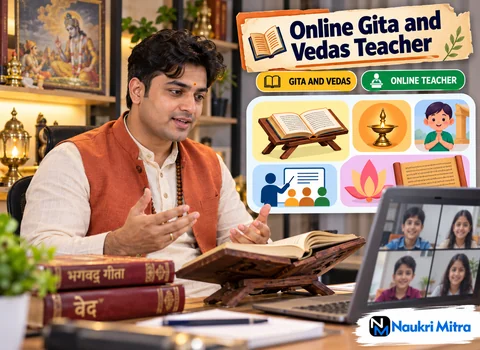
Many people assume that chanting is a matter of memorising sounds and repeating them until they stick. It is not. In the tradition, the syllable, its pitch and its sense are learnt together, and a student who has only the sounds has only part of the text. That is the standard behind these online Gita and Vedas teacher jobs: you will teach Bhagavad Gita shlokas and Vedic chanting in live Zoom classes, with correct swara and pronunciation, and you will make sure every student understands what they are reciting. The post is Part-time and remote, with no restriction on where you live, at $8 per hour (USD).
This is a teaching post, not a lecture series. Your students may be adults returning to texts they heard as children, families abroad who want their children to chant properly, or newcomers drawn to the Gita as literature and philosophy. Classes are small and interactive. You chant, the student repeats, you listen closely, and you correct.
In plain terms, the Gita and Vedas teacher job description covers five things: teaching shlokas and Vedic passages live, keeping swara and pronunciation correct, explaining meanings, sending audio recordings for daily practice, and planning progress chapter by chapter. The sections below take each element in turn, because that is how the work is actually done.
Uccharana is where every class begins. A long vowel held short, an aspirated consonant spoken flat, a visarga dropped at the end of a line: each of these changes the word, and sometimes the meaning. Online, you cannot watch the mouth as closely as you would in a pathashala, so you listen harder and ask students to slow down.
A useful habit is to isolate the difficult syllable, chant it alone a few times, then put it back into the word and the line. Students who learnt from transliterated sheets often carry English habits into Sanskrit sounds. Your task is to correct those patiently and consistently, without making the learner feel foolish for a habit they never knew they had.
For Vedic chanting, swara is part of the text itself. The accents (udatta, anudatta and svarita) are not decoration, and a misplaced accent can change the sense of a word. You should be able to hear a misplaced accent at once and show the student, by voice and by simple hand gestures where your tradition uses them, how it ought to sound.
Chandas matters for both the Vedas and the Gita. Students who sense the metre find it easier to breathe at the right places, keep an even pace, and remember long sections. Explaining why a line divides where it does is often more helpful than asking for one more repetition.
The Bhagavad Gita is taught here as a text to be understood as well as recited. After a shloka is chanted correctly, you explain its sense in English or Hindi: the key words, how the verse connects to the ones around it, and the theme of the chapter it belongs to, whether that is duty, knowledge, devotion or the nature of the self.
Keep explanations clear and non-sectarian. Students come from different backgrounds and schools of thought. Where commentators differ, you may say so plainly and let the student explore further. You are there to teach the text faithfully, not to promise outcomes or press a single view.
Chanting improves through daily repetition between classes, and that is where recordings come in. After each session you share an audio file of the portion covered, chanted slowly and clearly at the correct pitch. Some teachers record two versions: one slow, with pauses for the student to repeat, and one at normal pace.
Ask students to send short recordings of their own practice when they can. Listening to these lets you catch errors that slipped past in the live class, and it gives the student a record of their improvement over the weeks.
Learners do better with a visible plan. For the Gita, that usually means moving through the eighteen chapters at a pace that suits the student, with revision built in before starting new material. For Vedic chanting, it means choosing passages suited to the learner's level and only moving on when the swara is secure.
Keep simple notes for each student: what was taught, which syllables still need work, and what comes next. Share a short update with adult learners, or with parents for younger students, so everyone knows where things stand.
Because pitch carries meaning, sound quality matters more in these classes than in most online tutoring. A reasonable setup includes:
Test your setup with a friend before your first student. Chant a passage with clear accents and ask whether they can hear the rise and fall distinctly.
Training from a Veda Pathashala, a Sanskrit degree or traditional gurukul study is preferred. What is required is correct pronunciation, working knowledge of swara and chandas, and the ability to explain Gita shlokas in English or Hindi. You also need a laptop with a good microphone, Zoom and stable internet.
People often ask how to become a Gita and Vedas teacher without a formal background. If you studied under a recognised teacher and your chanting is accurate, that counts for a great deal. A Gita and Vedas teacher course or certification from a respected institution can support your application, but the real test is how you chant and how you correct. Expect the Gita and Vedas teacher interview questions to include a short live recitation and a sample explanation of a verse. Name your teachers, your place of study and the texts you know well on your Gita and Vedas teacher resume.
Teaching hours are paid at $8 per hour (USD), and that is the Gita and Vedas teacher salary per hour for this post. Private and institutional arrangements outside it differ, so weigh every other offer separately.
Because the role is Part-time, it can sit alongside temple duties, study, or other teaching. It is genuine Gita and Vedas teacher work from home: you need your own quiet space and equipment, and class timings are agreed around students in different time zones.
A Sanskrit teacher usually focuses on the language: grammar, vocabulary, reading and composition. A Gita and Vedas teacher works with specific texts and their oral tradition. Grammar comes into it when it helps explain a word, but the main concern is accurate recitation, swara, and the meaning of the verses being learnt.
The two overlap, and many good chanting teachers also know Sanskrit grammar well. In this role, though, the student's chanting comes first, and grammar serves it.
Interest in learning these texts online comes from many directions: families living abroad, adult learners, yoga and philosophy students, and people who simply want to chant correctly at home. How many students a teacher finds varies, and patience and reliability count.
Teachers who later look for freelance Gita and Vedas teacher jobs elsewhere generally use general tutoring platforms, community and cultural organisations, and word of mouth from satisfied students. Any platform's rules on payment and scheduling deserve a careful read of your own before you sign up. To start classes, prepare a short introductory session, a clear plan for the first chapter or passage, and a set of recordings. For Gita and Vedas teacher jobs for freshers, a few well-run trial classes and candid feedback from early students will show you what to adjust.