📚 Table of Contents
- Digital Art Isn’t “New” Anymore—It’s Normal Work Now
- NFTs Without the Noise: What They Actually Are
- How a Remote Creative Career Actually Starts
- Start with the basics (and don’t rush it)
- Your style will matter more than your skill level (at some point)
- A portfolio is not a gallery—it’s a filter
- NFTs as an Income Layer, Not a Magic Button
- Selling directly to collectors
- Royalties that continue over time
- Collections tend to work better than single drops
- Tools You Actually Need (Not Everything You See Online)
- Core creative tools
- NFT platforms
- Wallet basics
- Getting Attention Without Feeling “Salesy”
- The Part Nobody Talks About Enough: Slow Phases
- Where This Is All Heading
- If You’re Starting Today, Keep It Simple
- FAQs
- 1. Is it realistic to start digital art with no experience?
- 2. Do I need expensive software or equipment?
- 3. Is NFT art still relevant today?
- 4. How long does it take to earn from this?
- 5. Do I need to fully understand crypto first?
- Conclusion
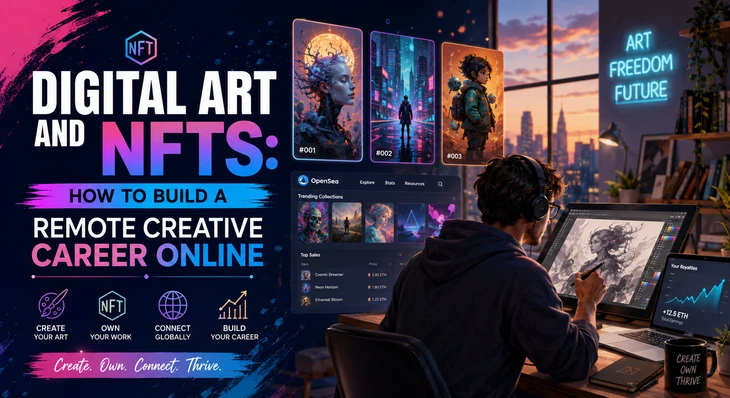
Digital Art and NFTs: How to Build a Remote Creative Career Online
There’s a quiet shift happening in the creative world, and you can feel it everywhere if you pay attention. People are no longer waiting for permission to become artists. They’re not waiting for galleries, agencies, or “the right opportunity.” They’re just starting—with whatever tools they have—and figuring things out along the way. Digital art and NFTs have become part of that shift. Not as hype, not as a shortcut, but as a new way of working, earning, and sharing creativity with the world. Some artists are building remote careers from their bedrooms. Others are collaborating with global clients they’ve never met in person. And many are doing both at the same time. If you’re trying to understand how this space actually works in real life—not the exaggerated version, but the practical side—this guide will walk you through it in a grounded, simple way.Digital Art Isn’t “New” Anymore—It’s Normal Work Now
A few years ago, digital art felt like something experimental. Today, it’s just… work. Real work. It shows up in places you might not even notice at first. Game environments. Movie concept sketches. Social media campaigns. Brand identities. Even product mockups you scroll past online. Most artists don’t sit in fancy studios. They sit at home, working with tools like Photoshop, Procreate, Blender, or sometimes even lighter browser-based apps. The tool doesn’t matter as much as the habit of creating consistently. And here’s what really changed things: location stopped mattering. A designer in a small town can now work with a startup in Berlin or a gaming team in Canada. That kind of access didn’t exist at scale before. Now it does. And that’s why digital art quietly became one of the strongest foundations for a remote creative career. I’ve seen artists start with basic sketches and slowly turn them into freelance income, just by posting regularly and improving over time. Nothing dramatic. Just steady work.NFTs Without the Noise: What They Actually Are
NFTs sound complicated until you strip away the buzzwords. At the simplest level, an NFT is just a way to prove ownership of a digital item. Think of it like a digital certificate attached to an artwork. It doesn’t stop people from viewing or sharing the image—it just records who owns the original version. For digital artists, that changes something important. For years, the biggest frustration was this idea: “If I post my work online, anyone can copy it.” NFTs don’t remove copying, but they do introduce ownership in a way the internet didn’t have before. So instead of just posting art, artists can now:- Sell original pieces directly to collectors
- Release limited digital collections
- Earn royalties when work is resold
- Build a long-term identity around their creations
How a Remote Creative Career Actually Starts
Let’s be honest—most people don’t wake up with a clear roadmap for this. A remote creative career in digital art usually starts messy. A few sketches here, some experiments there, maybe a portfolio that feels slightly incomplete. That’s normal. What matters more is direction.Start with the basics (and don’t rush it)
There’s always pressure to jump into advanced stuff—NFTs, clients, branding—but the foundation still matters. Not in a rigid way. Just enough to give you control over your work. Focus on things like:- Drawing regularly, even if it’s simple
- Understanding light and shadow without overthinking it
- Practicing composition until it feels natural
- Getting comfortable with one main tool first
Your style will matter more than your skill level (at some point)
This might sound surprising, but people don’t always remember the “best” art—they remember the most recognizable. That’s why style becomes important. Not forced style. Not copied style. Something that slowly forms from repetition. It could be:- Soft, emotional character illustrations
- Dark, surreal NFT-style visuals
- Clean futuristic 3D environments
- Rough sketch-based storytelling art
- Experimental AI-assisted compositions
A portfolio is not a gallery—it’s a filter
Many beginners try to upload everything they’ve ever made. That usually weakens their presentation. A strong portfolio feels selective. Almost intentional. You don’t need 50 pieces. You need a small set that actually represents your direction. Something like:- 8 to 12 solid artworks
- Clean layout without distractions
- Simple context where needed
- Easy contact or commission option
NFTs as an Income Layer, Not a Magic Button
There’s a misconception that NFTs automatically create income. They don’t. What they actually do is add another layer to how artists earn.Selling directly to collectors
Instead of going through agencies or platforms that take large cuts, artists can mint work and sell it directly. It feels more personal, but also more competitive.Royalties that continue over time
This is where NFTs feel different. If someone buys your artwork and later resells it, you can still earn a percentage. You’re not just paid once—you’re tied to the lifecycle of your work. Not every piece will resell, of course. But when it does, it becomes passive income you didn’t have to renegotiate.Collections tend to work better than single drops
One artwork can get attention. A collection builds momentum. A 10–20 piece themed release—maybe around emotions, characters, or a visual concept—creates a stronger identity. Collectors often respond to consistency. If they understand your theme, they’re more likely to engage with the full set instead of just one piece.Tools You Actually Need (Not Everything You See Online)
It’s easy to overthink tools. You don’t need a massive setup to start.Core creative tools
- Photoshop for editing and illustration
- Procreate for drawing and sketching
- Blender for 3D work if you go in that direction
- Figma for layout or design structure
NFT platforms
- OpenSea for minting and listings
- Foundation for curated drops
- Rare for community-driven sales
Wallet basics
- MetaMask for managing crypto assets
- Coinbase Wallet for transactions
Getting Attention Without Feeling “Salesy”
Most artists struggle here—not with creating, but with visibility. The truth is, you don’t need to be everywhere. You just need to be consistent in a few places. Posting regularly on platforms like Instagram or X (Twitter) slowly builds recognition. Not instantly. Over time. And something most people overlook—process content often performs better than finished art. A sketch. A breakdown. A half-finished idea. These feel more human and relatable, which is why people engage with them more. Communities also matter more than people expect. Discord groups, NFT circles, and creative forums are where many real connections form.The Part Nobody Talks About Enough: Slow Phases
There will be phases where nothing seems to move. No sales. No attention. No feedback. This is where most people stop. But in creative work, slow phases are normal—not exceptions. Skills are still forming, even if results aren’t visible yet. The artists who continue anyway are usually the ones who eventually break through.Where This Is All Heading
The direction is pretty clear if you look at the bigger picture. Remote creative work is becoming standard. Digital ownership is becoming normal. And creative careers are no longer tied to physical spaces. We’re already seeing:- Remote design teams are becoming common
- Virtual galleries replacing physical exhibitions
- AI tools blending into everyday creative workflows
- NFT-based digital collectibles are expanding into new industries
If You’re Starting Today, Keep It Simple
Overthinking is usually what slows people down. You don’t need a perfect plan. Start small:- Create something every day, even if it’s rough
- Share your work without waiting for perfection
- Explore NFT platforms just to understand them
- Watch how other artists grow, not just what they post