
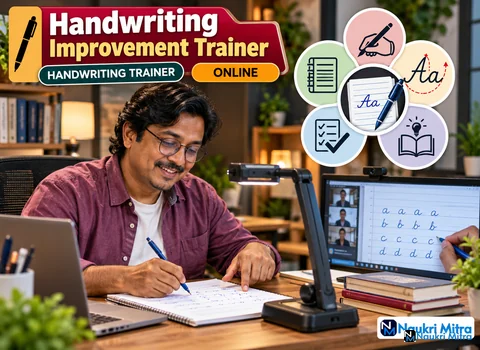
When you read a page of someone's writing, do you notice the gaps between letters before you notice the words? Do you spot a slant that drifts from upright to leaning halfway down the line, or a pen held so tightly the knuckles go white? If you do, you already have the eye this work depends on. These handwriting improvement trainer online part time jobs are for people who can see those small things and explain them kindly, one stroke at a time, to a learner on the other side of a screen. Lessons happen online from wherever you live, the schedule is part-time, and each hour of teaching pays $8 USD.
Most sessions follow a simple rhythm. You start by looking at a fresh sample from the learner, written that day, so you can compare it with last week's page. Then you choose one fault to work on, perhaps an open a or a crowded word gap.
You demonstrate the stroke slowly under your camera, talk through where the pen starts and which way it travels, and then watch the learner try it. You correct gently, praise what improved, and finish by setting a short practice worksheet.
In short, the handwriting improvement trainer online job description covers four things: assessing each learner's writing, teaching letter formation, spacing, slant and pen grip in live sessions, assigning practice, and tracking improvement week by week.
Small hands tire quickly. Short bursts of tracing, big letter shapes, and a lot of encouragement work better than long drills. Pencil grip is often the first thing to fix.
This group often comes because schoolwork is hard to read or writing is slow in exams. They respond well to seeing their own before-and-after samples side by side.
Adults tend to want a tidier everyday hand for forms, notes or cards, or they simply dislike how their writing looks.
Where students are minors, keep your camera on, keep conversation on the lesson, and keep all contact inside the platform or through the parent. That small discipline protects everyone.
Good handwriting improvement exercises are short, specific and repeated. A few that trainers rely on:
Children usually need more play and variety. Adults often prefer a steady routine they can repeat at home in ten quiet minutes.
Yes, though the setup matters more than people expect. The learner has to see your pen tip and the paper clearly, without glare or shadow.
A document camera is the tidiest option. It sits over your desk and shows the page straight down. If you do not have one, a phone on an overhead stand works well. Add it as a second camera in the video call so your face stays on the laptop.
A few habits that help with camera angle:
For worksheets, keep a folder of printable PDFs and share them through the class platform or the parent's email before the session. Ask students to hold their page up to the camera or send a clear photo afterwards so you can mark it properly.
There is no degree requirement. A certificate in handwriting training or graphology and a neat, consistent hand are preferred. What matters most is that your demonstration letters look the same each time, because learners copy what they see.
Patience with both children and adults is needed, along with clear spoken English or Hindi. On the equipment side you need a laptop, a document camera or phone stand, and a connection steady enough that a demonstration never freezes mid-stroke.
The core handwriting improvement trainer online skills are a steady hand, a sharp eye for small faults, calm explanation, and good record-keeping so you can show a learner how far they have come.
Live teaching on this listing earns $8 for every hour, in USD, as part-time work. Weighing the handwriting improvement trainer online salary per hour against other offers? Find out whether the rate covers only live teaching time or also includes reviewing homework and preparing worksheets.
Hours are arranged around learners, so evenings and weekends are common, especially for school-age students. Nothing about the number of sessions is fixed in advance. Since this is handwriting improvement trainer online work from home, a quiet desk and good light are all the workspace you need.
Calligraphy is decorative lettering. It uses special nibs or brush pens, slows writing right down, and aims for beauty on display pieces. Handwriting improvement is practical. The goal is everyday writing that is legible, comfortable and reasonably quick with an ordinary pen.
There are handwriting improvement trainer online jobs for freshers, and some families care more about a patient manner than a long CV. A practical route in looks like this:
Openings for handwriting improvement trainer online jobs no experience do exist, but you will need to show your own writing and a short demo lesson in place of a track record.
Even with so much typing, children still write by hand at school, and many exams remain handwritten. Parents notice when a child's writing is slow or hard to read and look for help. Demand differs by region and season, so it is sensible to build a small base of steady learners rather than count on a full calendar.
To start handwriting classes online from home, many trainers list themselves on tutoring marketplaces, hobby class platforms and local parent groups. Others take freelance handwriting improvement trainer online jobs through teaching agencies, and some later grow into running their own small batches. Part time handwriting improvement trainer online jobs are also posted on general job boards.
Most offers are honest, but some are not. These signs should make you pause:
A genuine offer explains the work, the pay and how payment is made, and lets you ask questions before committing.
Make your handwriting improvement trainer online resume brief and visual. Include a clear photo of your model alphabet, a sentence written at normal speed, any certificates, and the age groups you are comfortable teaching.
In the interview, be ready for handwriting improvement trainer online interview questions about fixing a poor pen grip, holding a young child's attention and showing parents what has improved. You may be asked to write live on camera, so test your angle and lighting before the call.