
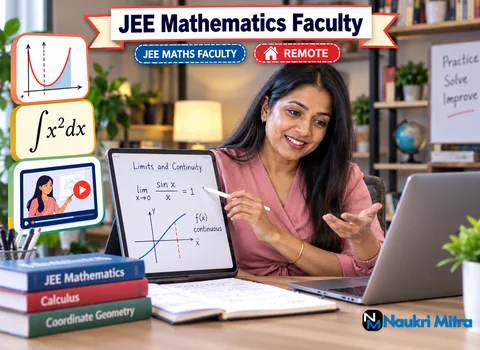
Many people assume JEE maths teaching is a bag of shortcut tricks: memorise a formula for the area under a parabola, flash it on screen, move on. Students who learn that way tend to stall the moment a question is framed slightly differently. Good faculty teach the reasoning first and the shortcut last, and only once the class can justify it. These online jee mathematics faculty jobs are built on that principle. You can take one on part-time from any country, entirely online, for $8 USD an hour. You will teach calculus, algebra and coordinate geometry in live lectures, build and discuss daily practice problems, work through previous-year questions and run doubt sessions after each chapter.
The plainest jee mathematics faculty job description is this: you own a chapter until the class can handle it under exam pressure. In practice that splits into three kinds of work.
Each lecture builds one idea properly. In limits, for instance, you might start with why a function can approach a value it never takes, then move to standard forms, and only later show the expansion-based approach that saves time. Students should leave knowing when a method applies and when it fails.
Daily practice problems are where the lecture gets tested. You write or curate a short set after each class, graded from routine to stretching, and then discuss it in the next session. Previous-year questions are solved in the open, including the dead ends a student would likely hit, so the class sees how an experienced solver recovers.
Once a chapter closes, a doubt session collects whatever is still unclear. Some doubts are about a single step; others reveal that a whole idea, such as the sign of a derivative on an interval, never landed. Part of the job is spotting the second kind and fixing it before the next chapter builds on it.
JEE Main and JEE Advanced draw on largely the same mathematics, but the questions reward different habits. For Main, the premium is on quick, accurate work over a broad range of standard problems, so drills and clean, repeatable methods matter. Advanced-level problems often combine two or three chapters in one question and punish rote approaches, so classes need more time on proof-like reasoning, careful case analysis and problems that have no obvious starting point.
A capable teacher can switch between these modes within a single batch. You might close a coordinate geometry lecture with a quick set of Main-style questions, then hand the stronger students one multi-concept Advanced problem to think about overnight. Exam patterns and weightages can change, so check the current official information yourself rather than relying on old notes.
All teaching happens on screen, so the setup matters. You will need:
Neat board work is one of the core jee mathematics faculty skills. Number your steps, leave space between lines, and keep diagrams to scale where it helps.
Applicants should hold a B.Tech from a top engineering institute or an M.Sc in Mathematics. Prior JEE coaching experience is preferred, not mandatory. What we test closely is command of calculus, algebra and coordinate geometry at both Main and Advanced level. An IIT background helps you understand what the exam asks of a student, but an M.Sc graduate who can solve and explain hard problems clearly is just as strong a candidate.
Put simply, the jee mathematics faculty salary per hour here is $8, with payment made in USD. This is a part-time remote role. Weekly hours depend on batch schedules and are not fixed in advance, so treat the hourly rate as the reliable figure rather than any expected monthly total. If you are comparing part time jee mathematics faculty jobs, ask any employer exactly which activities count as paid time: live lectures only, or also DPP preparation and doubt sessions. Ask for the reply in writing, not just on a call.
Because the work is jee mathematics faculty work from home, you supply your own equipment and connection. Many faculty take this on alongside a degree, a research post or another teaching commitment.
Freshers can apply. Jee mathematics faculty jobs for freshers usually turn on whether your subject strength and explanation hold up in a demo, not on how long you have taught. Here is one workable plan for how to become jee mathematics faculty with no teaching record:
You can apply without any particular jee mathematics faculty course or jee mathematics faculty certification. A short course on online teaching tools can help, but your demo carries far more weight than a certificate. Openings for jee mathematics faculty jobs no experience still come with a demanding subject test, because that is how depth is judged.
Selection usually runs in a few stages. The details may change, so read the instructions you receive at each step.
Expect problems at Advanced difficulty across calculus, algebra and coordinate geometry. We look at method as well as the final answer, so show your working.
You will teach a short topic live, using your own pen and software. Reviewers watch for clarity, pacing, board layout and whether you check understanding instead of talking straight through.
Common jee mathematics faculty interview questions include how you would explain a concept to a struggling student, how you design a DPP, and how you would handle a batch with mixed ability. Keep your jee mathematics faculty resume short: degrees, subjects taught, any coaching or tuition work and the tools you use.
Large edtech platforms, coaching institutes and smaller online academies all hire maths faculty, and freelance jee mathematics faculty jobs also appear through smaller tutor networks. Before you commit to any offer, do your own checks. Warning signs to watch for:
A genuine employer will explain the pay rate, hours, payment method and selection steps plainly. If those answers do not come, walk away.
Many JEE aspirants are minors. Keep your camera on and your background neutral, stay on the platform's official channels, and do not contact students privately outside them. Doubts are answered in sessions or approved forums, never in personal chats.
Faculty who teach well over several batches often move toward larger batches, recorded courses, test-series design or a lead role setting the maths curriculum for a team. Some build a following and go independent. None of that is promised; it depends on your teaching record and on what the employer offers. The steady part is that strong problem setters and clear explainers remain in demand, and the work you put into DPPs and solution libraries stays useful to you.
Can you teach a hard integral without hiding behind a trick? Then, once your equipment is ready, apply with your degree details and a note on the topics you teach best.