
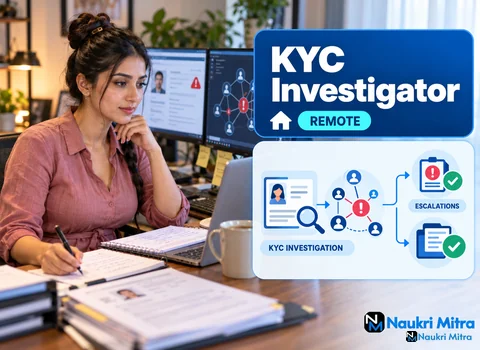
The file arrived with a single line from the onboarding analyst: "Ownership unclear past the second layer." That line is where remote KYC investigator jobs begin. This is a full-time, fully remote role open worldwide, with pay of $4,000 USD a month, for people who take the cases a standard KYC review could not close. You trace who really owns a customer and write the memo that decides whether the business keeps the relationship.
Routine onboarding matches a passport to a selfie and screens names. A case is escalated when that routine breaks. A director's date of birth differs between two registries, an adverse media hit cannot be ruled in or out, or a shareholder list stops at a company nobody can see inside.
Ownership is the usual trigger. Many firms treat anyone holding more than 25% of a company, directly or indirectly, as a beneficial owner who must be identified. When a holding company sits in a country with a thin public register, reaching that line takes real research. Read any KYC investigator job description closely and it asks for the same thing: take the questions the first line could not answer, find the evidence and say plainly what it means.
Lantern Freight Ltd (fictional), a logistics customer, applied for a business account naming one shareholder, Orrin Holdings, and no individual owners. The analyst could not see past Orrin, so the file came up. The investigator rebuilt the chain from registry filings:
The discrepancy was simple and serious. Pell controlled 60% of Lantern yet appeared nowhere on the application. A news archive search then turned up a Marten Pell listed as a former director of a freight company wound up after a customs dispute. The birth year matched the trust deed. The investigator asked the relationship manager for the deed and a signed ownership declaration; both arrived within a week and confirmed the link.
The memo excerpt read:
Notice that it never calls Pell dishonest. It records what was found and what was missing, so a reviewer can audit it in two minutes.
The KYC investigator skills that matter most are research habits, but the tools shape the day:
At home you need reliable broadband, a second monitor for comparing filings, and a private room; customer files are confidential.
Reviewers read dozens a week, so yours must answer four things fast: who owns and controls the customer, what risk was found, what evidence supports each point, and what you recommend. Keep facts and opinions in separate sentences. Write "the registry lists two directors", not "the company seems to be run by two people", and note the source and the date you checked it.
The common mistake is padding. Newer investigators paste every screening hit into the memo, including 40 false positives for a common name. One line covers those ("40 name matches, all discounted on date of birth and nationality"); spend your words on the hit that mattered.
This listing asks for a bachelor's degree, ideally in finance, business or criminal justice, and at least 3 years in KYC, AML or investigations. Most people who get it are stepping up from an analyst seat.
Be realistic about entry level remote KYC investigator jobs: very few exist. The entry route runs through analyst work, then periodic reviews on higher-risk clients, then volunteering for escalations. Anyone searching for KYC investigator jobs no experience should aim at analyst posts first. On your KYC investigator resume, lead with escalations closed and memos written, with numbers: "25 enhanced due diligence cases a month, two exits recommended and upheld."
The KYC investigator salary per month here is a fixed $4,000 USD, or $48,000 over a full year. Received in an Indian account, it lands somewhere between ₹3.7 and ₹3.9 lakh, with the rate on payday and transfer charges setting the exact number. Keep remittance records for tax.
Two credentials come up repeatedly. CAMS (Certified Anti-Money Laundering Specialist) is awarded by ACAMS and covers laundering typologies, sanctions and compliance programmes. The CFE (Certified Fraud Examiner) comes from the ACFE and leans towards fraud investigation and evidence. Either is valued; neither is mandatory.
If you are still working out how to become KYC investigator material, a short KYC investigator course on beneficial ownership and enhanced due diligence is a sensible start. Then practise mapping a public company's owners on Companies House.
Expect a written exercise, often an anonymised ownership chart to untangle. Typical KYC investigator interview questions include:
KYC investigation asks who the customer is: identity, ownership, control and reputation. An AML investigator starts from transactions, such as an alert on structured cash deposits or funds passing through mule accounts, and decides whether a suspicious activity report is needed. The KYC file often feeds the AML case.
After a few years of complex files, the usual steps are senior investigator, team lead, then compliance manager, where you own policies, quality checks and auditor conversations. Digital banks, payment companies and crypto exchanges are among the firms known to hire for this work. Strong memo writing carries you up, because managers mostly review other people's conclusions.
Some "compliance recruiters" are the fraud. They want money for sign-up, a training kit or a "security deposit", ask for a bank OTP or UPI PIN, refuse to talk anywhere but Telegram or WhatsApp, produce an offer without an interview, or make your first assignment depositing a cheque or routing a "test transfer". You will not be asked to pay anything for this listing, at any stage.
Competition for KYC investigator jobs remote worldwide is stiff, so send a short CV, a line on your strongest ownership trace, and any CAMS or CFE progress. Compared with most KYC investigator work from home jobs, the difference here is the case mix: complex files, not volume. Applying is free.