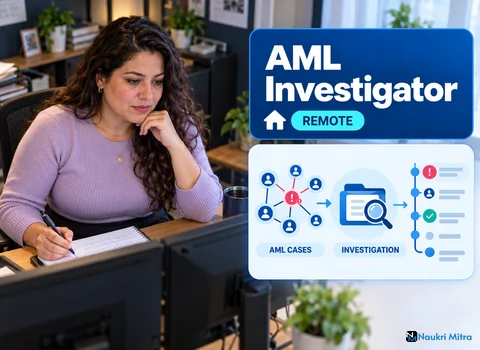
Alert received: where remote AML investigator jobs begin
Every file in remote AML investigator jobs opens the same way, with an alert that somebody has to own. Here is one built for this page. On a Monday morning, an Actimize queue shows a cash-structuring alert on a small business account, a fictional corner bakery that normally banks around $2,500 in cash a week. Over six business days, the account took cash deposits of $9,400, $9,750, $9,200, $9,800, $9,650, and $9,500, spread across five branches, each just below the $10,000 cash threshold at which US banks must file a currency transaction report. The scenario rule fired on day five. The file is now yours, and nothing has been decided yet.
The role is full-time and remote for candidates anywhere, at an AML investigator salary of USD 4,000 per month. This AML investigator job description follows one case from alert to final quality check, since that shows the work better than a list of duties.
Gathering the facts before forming a view
You start with the record, not a conclusion. For the bakery, that means twelve months of transaction history, so you can read the six deposits against the account's normal pattern. Were there seasonal spikes last December? Where does the money go after it lands?
- Account activity: deposits, withdrawals, wires out, and the branches or ATMs used.
- Counterparties: who receives outgoing payments, and whether any of them appear on other open alerts.
- KYC file: the stated business type, expected monthly turnover, beneficial owners, and the date the profile was last refreshed.
- World-Check: screening the business and its owners for sanctions, politically exposed person status, and adverse media.
- LexisNexis: public records, corporate filings, litigation and news that might explain or contradict the activity.
In this sample file, the KYC profile lists expected cash of around $10,000 a month. Six days produced more than $57,000. That gap alone does not prove anything, but it is the question the case now has to answer.
Red flags weighed against innocent explanations
The most useful habit in this work is writing down the innocent explanation next to every concern. Reviewers trust investigators who show both columns.
What raises concern
- Amounts clustered tightly below the reporting threshold, several days in a row.
- Deposits spread across branches the owner has never used before.
- An outgoing wire to an unrelated trading company two days after the last deposit.
What could explain it?
- A catering contract or holiday orders that a LexisNexis news hit or the owner's website might confirm.
- A second shop location opened recently, which would explain new branches.
- A supplier payment for equipment, with an invoice the relationship manager can request.
The task is to find out which story the evidence supports, and to say plainly when the evidence is not enough either way.
Writing the case narrative
The narrative is the product. A regulator, an auditor or a law enforcement officer may read it years later with no access to you, so it has to stand on its own. Good narratives cite a source for each fact and avoid adjectives that do the reviewer's thinking. A short excerpt from the sample case:
"Between 2 March and 9 March, Account ending 4471 (the bakery) received six cash deposits totaling $57,300, each between $9,200 and $9,800, at five branches. The KYC profile, last updated in January, lists expected monthly cash of $10,000. World-Check returned no matches for the entity or its two owners. A LexisNexis search found no record of a second location or a catering contract. On 11 March, the account sent a $52,000 wire to an unrelated trading company with no prior history on the account. No business rationale was identified. Escalation to SAR review is recommended."
Escalation, closure and the SAR decision
Most alerts close, and a well-documented closure is as valuable as a filing. When the facts point the other way, you recommend escalation and a suspicious activity report. In most programs, the investigator recommends, and a senior reviewer or BSA officer makes the final filing decision, so the recommendation has to show its reasoning.
- Close with rationale if records confirm a legitimate source, such as a documented contract.
- Request information through the relationship team, then hold the alert for a set period.
- Escalate for SAR consideration, with the narrative and supporting exhibits attached in Actimize.
Investigators also maintain strict confidentiality. You never tip off the customer that a report is being considered, and you never discuss a case outside the approved systems.
Quality review and the second pair of eyes
In most AML teams, a QA analyst or team lead samples or fully reviews cases. They check that each search is logged with a date, that screenshots match the narrative, that the timeline is correct, and that the conclusion follows from the facts. Expect comments such as "Branch list missing for deposit four" or "State why the wire counterparty was not screened." Clearing those notes quickly builds reviewers' trust.
Two to three years in alerts, plus CAMS
You need a bachelor's degree in finance, criminal justice, or a related field, plus two to three years in AML alert review or financial crime investigations. Working knowledge of BSA/AML rules is expected, along with hands-on time in Actimize, World-Check, and LexisNexis. Strong written English matters, since the narrative is what gets judged.
CAMS or an ICA diploma is a plus, not a gate. If you are weighing an AML investigator course or AML investigator certification, those two are the ones this role names; study them through the awarding bodies' own materials and practice writing sample narratives as you go.
A word on entry-level remote AML investigator jobs: this is not one of them. For anyone searching AML investigator jobs with no experience, the usual route is a first-level alert analyst or KYC analyst seat, often in an office, then moving into investigations after a year or two of clean QA scores. For most people, that is how to become an AML investigator. The work also differs from a fraud investigator's: fraud teams chase losses to the institution or its customers, often in hours, while AML teams trace where money came from and where it went, over weeks.
A secure home setup, not a kitchen table
AML investigator work-from-home jobs follow the same data rules as office roles. Expect to need a private room where nobody can read your screen, a reliable wired or strong broadband connection, and the employer's VPN for every session. Many programs also require a locked-down company device, no personal printing, no screenshots saved locally, and a clear desk when you step away. Expect questions about it during hiring.
Salary, who hires, and the road to BSA officer
This full-time post states an AML investigator salary of USD 4,000 per month. As AML investigator jobs go remote worldwide, hiring is mostly done by banks, fintechs, payment companies, money service businesses, and compliance consultancies that run outsourced review teams.
The path forward is well trodden. Investigators move to senior investigator, then QA or team lead, then into roles such as AML compliance manager. Some go on to become a BSA officer, the person accountable for the whole program.
On paper and in the interview room
On an AML investigator resume, list alert types you have worked on (structuring, rapid movement of funds, high-risk jurisdictions), the systems you used, your typical case volume if you can share it, and your QA record. Bring one anonymized narrative you wrote, stripped of all real data.
Common AML investigator interview questions are hands-on. You may be given a short transaction table and asked to talk through your approach, or asked when you would close rather than escalate. The AML investigator skills that interviewers test hardest are clear writing, patience with detail, and the judgment to say "insufficient information" when that is the honest answer.
Cover note, security answers and background checks
If your background fits, send a short cover note and your resume, and mention how your home setup meets the security points above. No fee applies at any stage. A genuine compliance team pays for its own interviews, training, and equipment, so a request for payment deserves the same suspicion as an unexplained wire. Listings described as remote AML investigator jobs hiring now usually still involve background and reference checks.