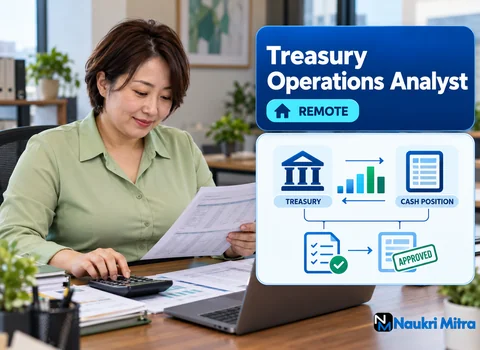
Here is an illustrative position at 7:40 a.m., before a single payment has been released. The USD operating account at a large US bank shows $1,142,900 available, with $1,305,000 of approved supplier wires queued for this afternoon. The EUR account at a eurozone bank holds €412,300 and nothing urgent goes out of it today. The GBP payroll account has £21,750, and today's UK payroll file is £96,480. Overall, the group looks fine, but two accounts are short: USD by $162,100 and GBP by £74,730. Closing the gap between "the company has cash" and "this account has cash before the cut-off" is the core of remote treasury operations analyst jobs.
Here, the fix might be a $175,000 transfer from the USD concentration account, which covers the gap with a small buffer, plus a euro-to-sterling spot trade for at least £74,730 with same-day value. You then confirm both amounts have landed before the payments go out. The opening is full-time, can be worked from any country, and carries
USD 4,000 per month.
Advertisement
Overnight statements: what is waiting when you log in
Most of the morning rests on files the banks send overnight. The prior-day statement arrives either as an MT940, the older SWIFT text format, or as a camt.053, its ISO 20022 XML successor. Either way, it carries the closing booked balance for each account and every line that posted: customer receipts, outgoing wires, card settlements, bank fees, interest, returned items.
The first check is simply whether every expected statement turned up. A missing file from one bank in one country leaves a hole in the position, and the right response is to mark that balance stale and chase the bank. You also learn each bank's habits, such as truncating remittance text so the customer reference gets cut in half.
Building the daily cash position in Kyriba
Kyriba imports those statements and lays the accounts out by entity, bank, and currency. The position starts with opening available balances, then layers on what is known to move today: the approved payables run, payroll, loan interest, tax payments, card processor settlements, and expected customer receipts. The output is a projected end-of-day balance per account, with those heading below target flagged.
Excel still carries plenty of the load around the edges. A typical workbook compares Kyriba's opening balances with the bank portals and ties the forecast to the payables schedule. Advanced Excel here means lookups across untidy bank exports and formulas a reviewer can follow.
Funding transfers and the bank cut-off clock
Once the shortfalls are known, money gets moved to cover them. Usually that is a transfer from a concentration or header account down to an operating account.
Timing matters as much as amount. Every bank and currency has its own cut-off: a domestic USD wire may be accepted until mid-afternoon Eastern time, while same-day sterling or euro payments close during the European afternoon. Access usually means a personal login and a hardware or app token for each bank portal, with approval limits set per user, plus your own Kyriba credentials.
FX deals and intercompany moves
When the shortfall sits in a currency the group holds little of, as with the payroll account above, the answer is an FX deal: sell euros or dollars and buy sterling for same-day or next-day value. The analyst gets quotes, books the trade, matches the bank's confirmation, and checks settlement lands in the right account.
Intercompany funding is another major source of transfers. A subsidiary collecting revenue in one currency may lend surplus cash to a sister entity, or the parent may fund a new entity's first few months of costs. Each move needs matching entries on both sides and a loan or netting reference that accounting can trace later.
Payment approvals, controls and the breaks you chase
Treasury is where fraud attempts tend to land, so controls are a core part of the treasury operations analyst job description. Payments are normally created by one person and released by another, with limits by amount and by bank. A new or changed beneficiary account is verified by calling a known contact on a number already on file, never the number in the email that asked for the change.
You will also own the investigation of breaks, for example:
- a wire marked as sent in Kyriba that the bank never debited
- an incoming receipt with no invoice or customer reference attached
- an outgoing payment held for review by the bank's sanctions screening
- a transfer returned because one digit of the IBAN was wrong
Each break gets a note, an owner and a follow-up time.
Month-end close and short-term liquidity
At month-end, treasury hands accounting a clean set of figures: bank balances reconciled to the general ledger, FX deals and intercompany loans listed with settlement status, interest and fees booked, and a reason for anything still open.
Running beside that is the short-term liquidity forecast, often a rolling view of the next one to thirteen weeks by entity. Comparing last week's forecast with what cleared shows which business units predict their cash well.
Where payments ops ends, and treasury begins
Payments operations roles manage money movement for customers: ACH batches and wires sent on clients' behalf, returns, and customer payment queries. Treasury operations looks after the company's own cash. Your counterparts are the company's banks, the payables and receivables teams, accounting, and the treasurer, and you answer one question each day: does the business have enough in each account, in each currency, on time?
Both sides use SWIFT and bank portals, so treasury operations analyst skills overlap, but the focus here is funding and liquidity rather than customer cases.
Hiring bar for remote treasury operations analyst jobs
Most teams look for a degree in finance, accounting, or economics and two to three years in treasury, cash management, or bank operations. Hands-on Kyriba experience is ideal, though a comparable treasury management system also counts. Reading SWIFT messages, building advanced Excel workbooks, and maintaining accuracy under daily deadlines are all expected.
The CTP (Certified Treasury Professional) credential from AFP earns credit but is not required. Among treasury credentials, it is probably the best-known treasury operations analyst certification, and its exam material spans cash, liquidity, payments, and risk. Preparing for it doubles as a solid treasury operations analyst course.
About entry-level remote treasury operations analyst jobs and treasury operations analyst jobs with no experience: two to three years are required here, so it is not a first finance job. The usual way in is an accounting, payables, or bank operations post where you already reconcile banks and handle payments.
Contract questions and the USD 4,000 figure
Compensation is
USD 4,000 per month, full-time. Treasury operations analyst salary levels differ by country and employer, so for anyone asking about treasury operations analyst salary per month, this is the one firm number on the page. Before accepting, ask how you'll be paid, whether the contract is employment or freelance in your country, and who handles local tax.
Interview stories and resume numbers
A strong treasury operations analyst resume puts numbers on the work: how many bank accounts and currencies you covered, which systems you used, roughly how many payments you released each week, and what happened to reconciliation exceptions after you took over.
Treasury operations analyst interview questions are usually practical. You may be asked to talk through building a morning position, say what you would do when one bank's statement is missing, explain how you verify a changed bank detail, or contrast MT940 with camt.053. Have one story ready about a payment break you traced.
Moving across from accounting? Lead with bank reconciliations, intercompany entries, and month-end close work, which carry straight over. That background is the practical bridge into a treasury operations title.
Time zones and the last step
This post sits among treasury operations analyst jobs remote worldwide, so any time zone works, but confirm that your hours can overlap the main banks' cut-offs before you apply.
There is no cost to apply; bank portal access is included, and no real employer charges for it. Treasury operations analyst work-from-home jobs involve live bank access, so expect identity checks. For treasury operations analyst openings hiring now, send a tailored resume plus a few lines on the treasury systems, banks, and currencies you have worked with.