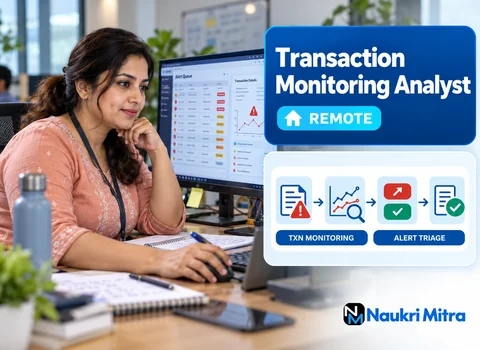
This full-time role reviews the alerts a bank or fintech's monitoring system raises on customer accounts. It pays USD 4,000 per month and, like many remote transaction monitoring analyst jobs, accepts applicants worldwide. Below is what a first month often looks like at teams that train new analysts in-house; the listing itself does not set out a training schedule.
The usual order is the system first, then the patterns, then real cases with someone checking your work, and finally a queue of your own. If a transaction monitoring analyst job description has made you think you need years of AML experience, note that this listing asks for a degree and says graduates are often trained in-house, which puts it among entry-level remote transaction monitoring analyst jobs.
Week one: getting to know the case system
Your first days are usually spent learning the tool before live work. Depending on the team, that tool will be NICE Actimize, Verafin, or Hummingbird. They look different but do the same job. A rule or model fires, an alert lands in a queue, and an analyst opens it to see the customer profile, the transactions that triggered it, and any past alerts on the same account.
You will learn where the KYC record lives. How to pull a longer date range of activity. How to attach a bank statement extract to the case. How to write a note that the next person can read cold. A typical exercise in week one is opening a closed training case, for example, a retail customer with twelve cash deposits of USD 900 to USD 980 across three branches in ten days, and walking through every screen until you can find each piece of evidence without help.
Week two: the typologies behind the alerts
Week two is about why alerts fire. A typology is simply a known pattern that criminals use to move or hide money, and each rule in the system is written to catch one or more of them. You will spend this week on the common ones:
- Structuring: splitting cash into amounts that sit just under a reporting threshold, often across days or locations.
- Rapid movement of funds: money that arrives and leaves within hours or a day or two, with little left behind, which can point to a pass-through or mule account.
- Funnel accounts: many small deposits from different places flowing into one account and then out in larger amounts.
- Activity that does not fit the profile: a student account receiving regular business-sized wires, or a dormant account that suddenly wakes up.
Memorizing the list matters less than judgement. You learn what normal looks like for a payroll account or a freelancer paid from abroad, so you can tell when an alert is just a busy month.
Week three: real alerts, with a checker beside you
Now you work live alerts, but every decision goes to a checker, usually a senior analyst or QA reviewer, before it is final. This is the four-eyes stage. You write your rationale, propose a decision, and the checker either agrees or sends it back with comments.
Expect plenty of send-backs. A common one is a note that says "activity consistent with customer profile" without saying what the profile is. The checker will want something like "customer is a self-employed electrician, deposits match invoices seen over the last six months, no third-party funding." Specific notes are the main skill you build here, and they matter more than speed at this point.
Week four: working your own queue
On many teams, new analysts are clearing alerts on their own by around the fourth week, with QA sampling a share of closed cases rather than checking each one. You will start to be measured against alert-aging targets, which simply means alerts should not sit unworked past an agreed number of days. Your lead will tell you the team's figure. Steady, defensible decisions matter more than speed, and asking early about a case that doesn't make sense is good practice.
Clearing or escalating an alert, in plain terms
Every alert ends in one of two places. This decision is called disposition, and it is the core of what a transaction monitoring analyst does.
Clearing means you have looked at the activity and found a reasonable explanation. Most alerts end this way; they are false positives. You close the case with a short written reason, the evidence you checked, and anything that would change your view if it happened again.
Escalating means you could not explain the activity, or you found more red flags the deeper you looked. You do not decide whether a crime happened. You hand the case up for investigation with a clear summary: what fired, what you reviewed, what still does not add up. A good escalation note lets the investigator start working instead of repeating your steps.
When you are unsure, the common advice is to escalate and explain why.
Monitoring is not investigation
New hires often mix up the two levels. As a monitoring analyst, you sit at the front of the process: high volume, one alert at a time, decide quickly whether it needs a deeper look. Investigators and SAR writers sit behind you. They take escalated cases, review all of a customer's accounts and connected parties, and, if the facts support it, draft the suspicious activity report that goes to the authorities (FinCEN in the US).
So the difference between a transaction monitoring analyst and a SAR writer is mostly depth and output. You produce decisions and notes on many alerts; they produce full narratives on a few. Many people move from monitoring into investigation and SAR writing after a period in the queue, which is one reason clean escalation notes are worth the effort.
Starting without years of AML work
The degree requirement is a bachelor's in finance, accounting or something close to it. Graduates, including those with some banking operations experience, are often trained in-house, so this role suits people starting out without a long AML history. If you have been browsing transaction monitoring analyst jobs with no experience listings, this is close, though the degree still matters. Familiarity with Actimize, Verafin, or Hummingbird helps, as do basic AML typologies, solid Excel, and clear written English, since most of your output is written notes.
The listing values CAMS or ACAMS courses. CAMS, from ACAMS, is what people usually mean by a transaction monitoring analyst certification. Many take it, or a shorter transaction monitoring analyst course, after some queue experience. The useful transaction monitoring analyst skills are the ones you will practice in your first month: reading a statement quickly, spotting what does not fit, and writing it down plainly.
Privacy at home, and the alert-aging target
Transaction monitoring analyst work-from-home jobs put customer financial data on your screen, so the listing asks for a private, secure home office. In practice, that means a room where your screen stays out of sight, no shared family computer, and a stable connection. Employers commonly supply or approve the device and require a VPN and multi-factor login, so ask what this one expects. The listing mentions alert-aging targets; ask at interview whether any other productivity measures apply.
USD 4,000, quoted per month
Expect USD 4,000 per month for full-time hours; the post ranks among remote transaction monitoring analyst jobs worldwide. When you compare transaction monitoring analyst salary per month figures from other listings, check the period each one uses, since some quote a yearly number.
Preparing for remote transaction monitoring analyst jobs
Before you apply, spend a few evenings on the basics. Read up on structuring and rapid movement of funds, practice sorting and filtering a sample statement in Excel, and write two or three mock case notes so you can show you explain decisions clearly.
On your transaction monitoring analyst resume, lead with anything that shows careful review work: reconciliations, loan processing, KYC checks, audit support, or customer due diligence, even from an internship. In transaction monitoring analyst interview questions, you may get a sample flagged account to talk through, or a request to explain one typology simply. Answer with a concrete example.
Applications are free to send. Real employers never bill candidates, so a payment request is your cue to stop.