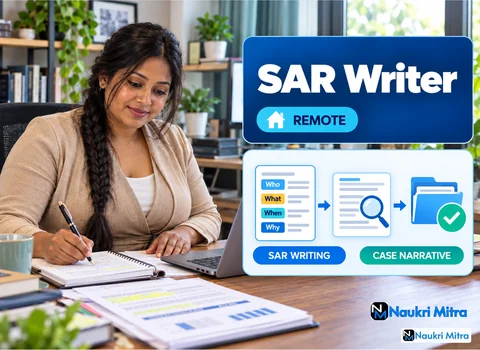
A first draft that turns up far too often reads: "Customer did suspicious transactions in his account and the bank thinks it is fraud." The rewrite reads: "Between March 3 and March 28, the subject, a sole proprietor holding a personal checking account opened in 2024, received 41 incoming transfers from unrelated third parties totaling $186,400, and sent most of each deposit by wire to an overseas beneficiary within a day, a pattern with no visible link to his stated lawn care business." The facts are the same, but only the second version answers who, what, when, where, and why for a FinCEN reader. Producing the second kind of sentence, case after case, is the core of remote SAR writer jobs. This is a full-time, worldwide role paying USD 4,000 per month.
Remote SAR writer jobs: what the desk produces
A SAR writer takes an AML investigation that someone has already worked on and turns it into the narrative section of a suspicious activity report. You are not the person deciding whether the activity is suspicious; the investigator and the case decision have done that. You make sure that decision survives a stranger at FinCEN or law enforcement reading it months later, with no case file and no way to ask questions.
That is the plain version of the SAR writer job description. It also covers checking subject details and amounts, filing through FinCEN BSA E-Filing, and tracking continuing activity reviews. Below is a narrative broken down the way an editor reads it.
The opening summary: the case in one paragraph
The first paragraph should let a reader stop there and still know what happened. Name the type of activity, the subject or subjects, the total amount, the date range, and the reason for filing. QA reviewers tend to return drafts that open with an internal alert number or the escalation history.
A weak opener: "This SAR is being filed as a result of alert 2207-118 generated by the monitoring system." A usable one: "This report concerns unusual cash deposits totaling $94,700 made to the business account of a convenience store owner between June 1 and July 15, inconsistent with the store's reported revenue." The alert number can wait for the closing.
The who: getting subjects right before anything else
Every person or entity in the narrative needs a clear role: subject, account holder, counterparty, beneficial owner, authorized signer. Drafts go wrong when the same person is "the customer" in one paragraph, "Mr. Subject" in the next, and a first name in the third. Pick a convention, tie each party to the form's structured fields, and keep it.
If the narrative says the account opened in 2019 and the form says 2021, QA may catch it, or nobody will. Checking names, dates of birth, addresses, and account numbers against the core record belongs in every draft.
The what and the when: amounts, instruments and dates
Readers need numbers they can reconcile. Give totals, counts and date ranges, and break out instruments: cash, wires, ACH, checks, card activity, crypto purchases. Instead of "large amounts", write something like "fourteen cash deposits between $8,000 and $9,800, totaling $126,350, from April 2 to April 30".
Summarise the case file's transaction table rather than pasting it, then check your totals back against it before the draft goes to review.
The where and the how: channels and locations
Where did the money move, and through what? Name the channels (branch, ATM, mobile app, wires) and the countries wires went to or came from. A plain description ("deposits at three branches in two counties on one afternoon") lets a downstream investigator see the shape. You describe what the records show the bank observed. You do not speculate about methods beyond the evidence, and you never write anything that would read as advice on how activity could have gone unnoticed.
Why it is suspicious, in words a stranger can follow
This is the paragraph most drafts rush. "Activity is inconsistent with the customer profile" is a conclusion without its reasoning. Say what the profile was (a retired teacher with a pension deposit and utility payments) and what changed (incoming wires from four unrelated companies, forwarded the same day). Name the red flags relied on and any explanation the investigator ruled out.
Write observed facts, not accusations. The report should say the activity appears suspicious and why; it should not declare anyone guilty of a crime.
The closing: what the institution did and where the records are
End with actions taken: account closed, restricted, placed under enhanced monitoring, or kept open with a continuing review. Note that supporting documents are retained, and add the internal reference if procedures want it. Keep it inside the building: SAR confidentiality rules mean nothing about the filing is shared with the subject, and writers treat drafts with the same care.
Filing in BSA E-Filing and getting past QA
Once the narrative is done, the writer completes or checks the structured fields in FinCEN BSA E-Filing and either files directly or hands off to a QA reviewer, depending on the bank. As general US FinCEN rules, not a description of this employer's process: an initial SAR is due within 30 calendar days of first detecting facts that may support a filing, and if no suspect has been identified, filing can be delayed by up to 30 more days, so no later than 60 days. FinCEN guidance on continuing activity describes a 90-day review after a filing, with any follow-up SAR due within 120 days of the previous one. Each institution sets its own internal timelines inside those limits.
QA reviewers read for completeness, consistency with the form, and whether the conclusions the facts support. Keep a list of the comments you get back, since the same few issues tend to recur.
From AML analyst to the writing desk, and beyond
Most people arrive here from an AML analyst or alert review seat, and the listing wants two to three years of investigations, alert review, or compliance behind you. The difference from a transaction monitoring analyst is focus. The analyst triages alerts and decides what to escalate; the SAR writer works on cases already escalated and is judged on the finished report.
Growth inside BSA/AML usually runs toward senior writer, QA reviewer, team lead for a SAR unit, or financial intelligence work. Regional banks, banking-as-a-service banks, payment companies, neobanks, and compliance consultancies all hire for this work. No employer is named here.
Credentials and skills a SAR writer resume should show
Beyond the degree and AML years, the listing wants BSA and SAR narrative knowledge, BSA E-Filing and case management experience, and concise written English. CAMS or formal BSA/AML training helps; it is not listed as mandatory. If you are weighing a SAR writer certification, CAMS is the widely recognized one; internal BSA training and FinCEN's published guidance count too. A paid SAR writer course is not something this listing requires.
On the page, list the SAR writer skills that matter: narrative drafting, BSA knowledge, data checking, deadline tracking, and a named case management system if you have used one. Honest note on SAR writer jobs with no experience: true entry-level remote SAR writer jobs are rare, because the job assumes you already understand investigations. If your question is how to become a SAR writer, the usual path is to start as an analyst.
Compensation, the writing test and submission
Stated monthly figure
On this post the SAR writer salary is USD 4,000 per month and the hours are full-time. A SAR writer salary per month quoted elsewhere reflects that employer, not this listing.
The writing sample
Nothing in the listing covers the interview process, but writing exercises are common for this kind of role, so practice on an invented case of your own. Never submit a real SAR or anything drawn from one, since that breaches confidentiality and would end your candidacy. Common SAR writer interview questions ask you to explain the five Ws, walk through filing deadlines, and critique a deliberately weak draft.
Submitting
This is one of the remote SAR writer jobs worldwide, suited to anyone looking for SAR writer work-from-home jobs with full-time hours. If you are searching for remote SAR writer jobs hiring now, send a resume that shows your AML years plainly and attach a short, fictional sample. Applying costs nothing; any request for money during hiring is a scam signal.
Frequently Asked Questions
The main output is the narrative section of suspicious activity reports. A SAR writer takes completed AML investigations and drafts that section, covering who, what, when, where and why. The role also checks subject details and amounts for accuracy, files reports through FinCEN BSA E-Filing, and tracks continuing activity reviews on reports filed earlier.
As far as the listing goes, yes. USD 4,000 per month, on full-time terms, is the only figure given, and no bonus or allowance appears beside it. Raise anything else you need to know, such as how pay is sent, with the hiring team before accepting.
Useful, yes; a gate, no: the listing says CAMS or formal BSA/AML training is useful, nothing more. Candidates without it can still show strength through two to three years of AML work, solid BSA knowledge and a clean, well-organised writing sample.
No. A transaction monitoring analyst reviews alerts and decides which ones go up the chain. A SAR writer works later in the process, on cases already escalated, and is measured on the quality, accuracy and timeliness of the finished report and its filing in BSA E-Filing.
Under general US FinCEN rules, an initial SAR is due within 30 calendar days of initial detection, or up to 60 days if no suspect has been identified. FinCEN guidance describes 90-day continuing activity reviews, with follow-up filings due within 120 days. Employers set internal deadlines within those limits.
Prepare a short narrative based on a fictional case you invent, with a clear opening summary, named roles, totals, date ranges, channels and a reasoned explanation of why the activity looks suspicious. Never use a real SAR or confidential case material, as that breaches confidentiality.
Mid-size and regional banks, banks offering banking-as-a-service to fintech partners, payment companies, neobanks, credit unions and compliance consultancies that file for clients all keep writers on their BSA teams. No employer is named on this post, so research any company that contacts you.
Yes, it is the most common route. Two to three years spent on AML investigations, alert review or compliance is the stated requirement, and the listing notes that writers often move up from AML analyst roles. Strong, concise written English and BSA E-Filing familiarity make the move easier.