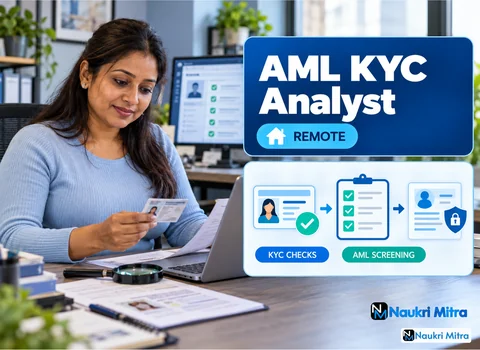
Who actually owns this company? That is the question you will ask more than any other in this role. Consider a sample applicant: a small trading company that imports goods and wants a business account. Its registration papers list one shareholder, and that shareholder is another company, a parent holding company registered in a different country. Your job is to keep asking until you reach the real people behind both names. The post sits among remote AML KYC analyst jobs on Naukri Mitra and is full-time, worldwide, and paid USD 4,000 per month. The AML KYC analyst job description below follows one onboarding file, from arrival to approval.
The file opens: what lands in the queue
A file opens when a customer submits an application. For an individual, that usually means a passport or national ID card, a selfie or video check, and proof of address. For a company like the trading business above, you can expect a certificate of incorporation, the articles or constitution, a register of shareholders and directors, and the ID of whoever signs on the company's behalf.
Your first pass is simply a completeness check. Is every page there? Is the incorporation certificate legible, and does the company number on it match the one typed into the application form? When something is missing, you write to the customer in plain language, saying exactly which page you need and why.
Identity and address: matching the paper to the person
Next comes verification. You compare the name, date of birth, and document number across every item in the file. Small mismatches matter: a middle name on the passport missing from the utility bill, or an address that shows an apartment number on one document but not another.
Proof of address normally has to be recent, often within the last three months under a typical firm policy, and issued by a third party such as a bank, a utility or a tax office. Over time you learn to spot a bill whose fonts or logo look slightly off.
The ownership chart and the people above the threshold
This is where the opening question comes back. The trading company is owned 100 percent by its parent, so you request the parent's own shareholder register. Say it shows two individuals holding 60 and 40 percent, which means they indirectly own 60 and 40 percent of the applicant. Both sit above the 25 percent threshold many jurisdictions use (some set it lower, and firm policy can be stricter), so both are treated as beneficial owners and go through the same identity and address checks as a direct applicant would.
You then draw the chart: a simple diagram showing each layer, each percentage and each country of registration. If a layer is a trust or a nominee arrangement, you note the settlor, trustees and beneficiaries, or the person the nominee acts for. If nobody crosses the threshold, many rule sets ask you to identify whoever exercises control in another way, such as a senior managing official.
Screening names in World-Check or Bridger
Every name you have collected now gets screened: the company, the parent, the directors, the signatory and each beneficial owner. Depending on the firm, you will use Refinitiv World-Check (now part of LSEG) or LexisNexis Bridger. Both return possible matches against sanctions lists, PEP records and adverse media.
Most hits are false positives. A common name will throw up dozens of results, and you discount them by comparing date of birth, nationality and other identifiers, writing a short line on each one explaining why it is not your customer. A true match on a sanctions list typically stops the file and goes to a senior reviewer under the firm's escalation procedure. A match on a PEP record is not a refusal, but it changes the next step.
Risk rating, and when the file moves to enhanced due diligence
With the facts gathered, you assign a risk rating, usually low, medium, or high, using the firm's scoring model. Inputs usually include country, industry, products, ownership complexity, and the screening outcome.
Standard customer due diligence covers most files. Enhanced due diligence applies when something raises the risk: a PEP among the owners, a link to a higher-risk jurisdiction, an ownership chain that is hard to explain, or a business model that handles a lot of cash. EDD means asking for more: where the money funding the account comes from, how the owners built their wealth, and sometimes senior sign-off before approval. In the example, if one of the parent company's owners turned out to be a former government minister, the trading company would move into EDD, and the file would need a manager's approval.
Periodic review: the same file, a year or three later
Approval is not the end. Every customer is reviewed again on a cycle tied to its risk rating, for instance yearly for high risk and less often for low risk, depending on policy. In a refresh, you reopen the file, check whether documents have expired, rescreen every name, and ask whether ownership or business activity has changed. Refresh reviews carry deadlines, and clearing them on time is a real part of the week.
The grounding remote AML KYC analyst jobs assume
The listing asks for graduates in commerce, finance or business, or people with equivalent banking operations experience, who have spent one to two years in KYC or onboarding. You should already know your way around CDD rules, beneficial ownership checks, and screening in World-Check or Bridger. A CAMS, CGSS or ICA certificate helps, though it is not the only route in. Of all the AML KYC analyst skills, patience with detail counts most, because problems often sit on the second page of a register.
KYC at the front, AML behind it
People often use the two terms as if they were the same job. KYC is the front end: establishing who the customer is before and during the relationship. AML is broader and includes monitoring transactions and investigating suspicious activity after the account is open. This seat sits on the KYC side, although the files you build are what AML investigators rely on later.
Passports on your screen: the security rules at home
Because you will handle passports, bank statements, and ownership records, the home setup matters. Plan on a room of your own with a door that closes, a stable internet connection, and a computer that meets the firm's security standards, typically with a VPN, multi-factor login, and no customer data saved locally. These rules are standard for AML KYC analyst work-from-home jobs, and an employer that does not mention them at all is worth questioning.
The analyst seat's monthly pay
Full-time hours here earn USD 4,000 per month. If you are comparing AML KYC analyst salary per month figures across listings, this is the number stated here, and no range is given.
Thin on KYC time? Close the gap first
If you are applying with a commerce degree and limited KYC experience, be honest and show what you do know. Read the public guidance from the Financial Action Task Force on customer due diligence and beneficial ownership. Practice drawing ownership charts from public company registries. Entry-level remote AML KYC analyst jobs exist, but most still expect some grounding in onboarding, which is why this listing asks for one to two years.
Regulators in most countries expect banks, payment companies, and fintechs to know their customers, so the work tends to remain in demand. Career growth typically runs from analyst to senior analyst, then into EDD specialist, quality assurance, team lead, or a move into AML investigations.
An anonymized file story with your CV
Send your CV plus two or three sentences on one onboarding or review file you handled well, leaving out any customer names. Sending it is free. A firm that asks applicants for money fails its own due diligence test, so do not proceed. Openings like this one show up among remote AML/KYC analyst jobs worldwide, posted by digital banks, payment processors, crypto exchanges, wealth platforms, and compliance outsourcing firms. They accept applications while the post is live.
Frequently Asked Questions
Two kinds of work: new onboarding files and periodic refresh reviews. You open a case, check the documents against the application, screen every name in World-Check, write up the ownership structure, set a risk rating and either approve it, send it for EDD, or email the customer asking for a missing document.
It can be, if you are honest about the gap. The listing asks for one to two years in KYC or onboarding, or equivalent banking operations experience. If you have done account opening, branch compliance checks or loan document verification, describe that clearly. AML KYC analyst jobs no experience required are rare, so build relevant exposure first if you can.
CAMS, CGSS and the ICA certificates are all named as helpful, and any one of them shows you understand the regulatory basis for the work. None is a strict requirement here. Pick the one that suits your budget and career direction, and remember that hands-on file experience usually carries more weight in screening calls.
Optional. No single AML KYC analyst course is required. On how to become an AML KYC analyst, many people start with the free guidance published by FATF and their national regulator, then move to a recognized certification. Practicing with public company registries, tracing who owns what, builds the exact skill you will use on beneficial ownership charts.
Mostly scenarios. Typical AML KYC analyst interview questions show you a two-layer ownership structure and asked who the beneficial owners are, given a screening hit and asked how you would discount it, or asked when you would escalate a customer to enhanced due diligence. Talk through your reasoning step by step.
Full-time pay is USD 4,000 per month, which is the AML KYC analyst salary stated. How it is paid, and whether you are engaged as an employee or contractor, depends on your country, so raise it early in the hiring conversation and ask for it to be confirmed in the offer letter.
No. Screening tools such as World-Check and Bridger are licensed by the firm and accessed through its secure systems. What you provide is a reliable computer, a stable connection and a private space. You will be set up with access and logins through the employer's own processes after joining.
On an AML KYC analyst resume, open with the file types you have reviewed, the screening tools you have used and the volume you handled. Mention CDD, EDD, beneficial ownership and periodic review by name. A single line describing a complicated corporate structure you untangled often says more than a paragraph of general strengths.