
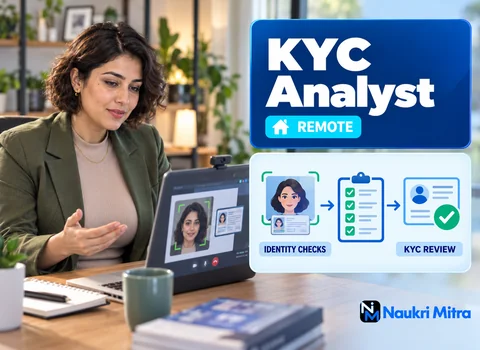
A white glare spot sits across the signature strip of an Indian passport photographed on a kitchen table, and the selfie beside it was taken under a tube light. This listing is one of those remote KYC analyst jobs, verifying identities for a financial platform: full-time, fully remote, at $4,000 a month in US dollars.
KYC stands for Know Your Customer. Before a bank, payments app or crypto exchange opens an account, it must confirm the person is real and not on a list it cannot serve. Most of the first pass is automated. Tools such as Onfido (now part of Entrust) and Jumio read the ID, compare it with a selfie and give a result. Your queue holds the cases the machine was not sure about.
So the real KYC analyst job description is short: you are the human second look. A typical morning starts with 60 to 80 cases, and a common target is clearing anything older than 24 hours by lunch.
Document checks are where your eye matters most. On a passport you compare the two machine-readable lines at the bottom (the MRZ) with the printed name, number and dates. They should match character for character. Fonts should look even, and the glare must not hide an edit.
Then the selfie. A liveness check asks the applicant to blink or turn their head on camera, proving a live person is there. When the face match is borderline, compare ears and eyebrows, because hairstyles change but bone structure does not. Address proof comes next: a utility bill or bank statement, usually dated within three months.
After identity, you screen the name. World-Check, run by LSEG, is a database of sanctioned people and PEPs. A PEP is a politically exposed person, such as a minister, senior judge or their close family. A sanctions hit means the name resembles someone a government has banned firms from dealing with. Neither means automatic rejection.
Freshers are often surprised by how many hits are false positives. A name like Rajesh Kumar can return a dozen matches. You clear them by comparing date of birth, nationality and photo, and you write down why each one is not your applicant.
Every case ends in approve, reject or escalate, or a request for a clearer photo or newer bill. One fictional applicant, step by step:
The case note you would leave reads: "Passport verified, MRZ and visual data match, exp. 2031. Selfie match and liveness passed. Address: electricity bill dated 12/08/2026, name and address match. WC: 1 PEP hit (former state official) discounted as false positive, DOB and photo differ. Approved." An auditor reading it in two years should follow your reasoning unaided.
If you have spent a year in back-office onboarding, BPO verification or bank account opening, you already know half of this. The listing prefers a bachelor's degree and asks for around 12 months of related experience, plus working familiarity with Onfido, Jumio and World-Check and good written English.
The KYC analyst skills that matter are an eye for altered documents and the habit of writing a note before moving on. Quality reviewers sample your cases, and one missed forgery weighs more than twenty fast ones.
The pay here is fixed: $4,000 per month, in US dollars, for full-time work. If you are checking a KYC analyst salary per month from India, expect somewhere around ₹3.8 lakh before tax; the exact amount follows the day's rate and your bank's conversion charges. You handle your own tax on foreign income, so keep payment records tidy from month one.
You will see passports and home addresses all day, so expect rules: an updated laptop with antivirus, stable broadband with a mobile hotspot as backup, and a private room where nobody sees your screen. Screenshots and printing are usually banned, and you log in through a VPN with two-factor authentication. Never forward a customer document to your personal email, even to "check it later".
A certificate helps a thin CV stand out. The ICA Certificate in KYC and CDD, from the International Compliance Association, covers customer due diligence and is close to daily work. CAMS, from ACAMS, is broader and focused on anti-money laundering; it suits you after a year or two. If both feel expensive, start with a shorter KYC analyst course online.
People often search "how to become KYC analyst" or "KYC analyst jobs no experience". Entry level remote KYC analyst jobs do exist, but this one asks for about a year in a related role, usually onboarding or verification at a bank, NBFC or outsourcing firm.
"Reviewed 70 to 90 account opening files a day at 98% quality" beats "Responsible for KYC". Name your tools and any certificate in progress.
KYC happens at the door: is this person who they say they are, and should we let them in? AML (anti-money laundering) work watches what happens after, reviewing alerts on unusual transfers. Many people do two years of KYC, then move into AML, enhanced due diligence, quality assurance or team lead roles, and later compliance officer jobs. Automation keeps taking the clean passports, so the messy files stay with people.
Be wary of any "KYC job" that begins with you paying, whether for registration, study material or a refundable "security deposit". Other fakes ask for the one-time code your bank just texted or your UPI PIN, keep every message inside Telegram or WhatsApp, hand over an offer with no interview, or want you to bank a cheque and send the money on. Genuine verification teams check other people's documents, not your wallet.
There is no charge at any point with this listing, and applying is free. Among remote KYC analyst jobs hiring now, it is open worldwide, much like the KYC analyst jobs remote worldwide that firms such as Binance and Wise have advertised. If KYC analyst work from home jobs with a steady queue suit you, send a clear CV with your tools and case volumes, and expect a screening call and a short practical test.