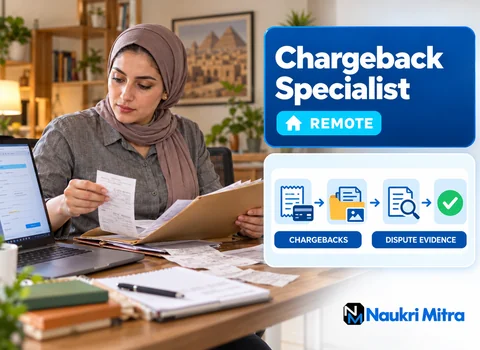
A winning representment packet usually holds the same exhibits: the itemized receipt, carrier proof of delivery with the address matched to the order, login and device logs showing the cardholder's own account at work, and the customer's own messages- the ones where they thanked support for the tracking link before telling their bank the parcel never came. Assembling that file under deadline, cleanly enough that an issuer reviewer can follow it at a glance, is the job. Among remote chargeback specialist jobs, this one sits squarely on the merchant side of the table, and the facts are simple: full-time, fully remote, any country of residence accepted, $4,000 USD per month.
The chargeback specialist job description below is organized like a case file: by claim type first, then systems, clock, and reporting.
Fraud and card-not-present claims: proving the cardholder was there
Much e-commerce dispute volume arrives under fraud codes. The cardholder says they never made the purchase, and in a card-not-present sale there is no signature or chip read to fall back on. Your answer is circumstantial evidence assembled with care. Did the order use an IP address or device the customer had used on earlier, undisputed purchases? Was the account logged in with the correct password? Did the billing address pass AVS, and was the CVV supplied?
Each point is weak alone. Together, with timestamps, they make a case. Know which data points the rule actually credits, and do not pad the file with the rest.
Item not received: building the delivery trail
Here the question is narrower: did the goods or service reach the person who paid? For physical goods, you pull carrier tracking, the delivery scan, the address on the order, and any signature or photo the courier captured. For digital goods and subscriptions, the evidence shifts to download records, login history, and usage after the purchase date.
The trap in this family is the mismatch. If the parcel went to an address that differs from the billing address, you need to show the customer chose it at checkout. If tracking stalls in transit, honesty matters more than volume: sometimes the right call is to accept the chargeback and tell the merchant team their courier has a problem.
Not as described: letting the customer's own words testify
Quality and description disputes are where written skill earns its keep. The cardholder claims the item was defective, counterfeit, or materially different from the listing. Your rebuttal compares the product page as it stood at the time of sale with what was shipped, shows the return policy the customer accepted, and quotes the support thread. If the merchant offered a return and the customer never sent the item back, that fact belongs near the top of the letter, stated plainly.
Reviewers see plenty of angry merchant letters; yours should read as a calm summary of evidence.
Duplicates, credits and other processing errors
Processing errors are the most mechanical claims and the easiest to lose through carelessness. A duplicate-charge dispute is defeated by showing that the two transactions were separate orders, with different order numbers, items or shipping events. A credit-not-processed claim is answered with the refund record and its acquirer reference, or conceded if the refund truly never went out. Incorrect-amount claims rely on authorization and settlement records. This work should be fast and exact.
Building the packet in Visa VROL and Mastercom
Visa disputes are handled through Visa Resolve Online (VROL) and Mastercard disputes through Mastercom, usually reached via the acquirer's portal or a dispute management platform rather than directly. You will upload documents, select the response type, and write a short rebuttal that maps each exhibit to the reason code's requirements. File formats, page limits, and field rules differ between the two systems, so a packet built for one cannot simply be dropped into the other.
The discipline is a lawyer's: one claim, the rule it falls under, the evidence answering that rule, in that order. Exhibits get labeled, screenshots get cropped, and nothing goes in that a reviewer would have to puzzle over.
Dispute platforms and the daily queue
Chargebacks911 is one example of a platform that sits between the merchant and the networks. They pull in disputes, pre-fill evidence from order systems, and track status. They save time but do not think for you; auto-generated responses still need a human to confirm the evidence fits the reason code and the facts of this order. Expect to spend your day working a queue sorted by due date, deciding for each case whether to fight, accept, or escalate.
Network deadlines and reason-code fluency
Every card network sets its own response windows, and they are strict. Miss one and the case is lost regardless of how strong the evidence was. You will learn each network's windows for first chargebacks, pre-arbitration and arbitration, and build your queue around them.
Reason-code knowledge is the other half. Visa groups codes into categories such as fraud, authorization, processing errors, and consumer disputes; Mastercard uses its own numbering and condition rules. Knowing which compelling evidence a code accepts, and which it explicitly does not, decides most cases before you write a word. Training on card network dispute rules usually comes from the networks' published guides, acquirer documentation, and short industry courses, and many specialists add a chargeback specialist certification once they have some live cases under their belt.
Win rates in Excel and the patterns worth reporting
Every closed case becomes a row: reason code, amount, network, evidence type, outcome. In Excel, you track win rates by reason family and product line with pivot tables and lookups. The numbers show where effort pays.
They also reveal repeat dispute patterns the merchant team needs to hear about: one product that keeps drawing not-as-described claims, a billing descriptor customers fail to recognize, a subscription that renews without a clear reminder, a shipping lane where parcels vanish. Flagging these with data attached prevents more chargebacks than any packet wins.
Hiring bar and pay for remote chargeback specialist jobs
Start with the money: the chargeback specialist salary per month here is $4,000 USD for a full-time week. Education requirements start with a high school diploma, with preference given to bachelor's graduates. The role expects one to two years in chargebacks, disputes, or payments support, working knowledge of Visa and Mastercard reason codes, hands-on familiarity with Visa VROL and Mastercom, exposure to tools like Chargebacks911, strong written English for rebuttals, and solid Excel. Those are the core chargeback specialist skills, and they can be learned.
Entry-level remote chargeback specialist jobs are rare, and with no experience, this seat is probably a stretch. The honest route runs through adjacent work: e-commerce support, a payments operations desk, fraud review, or a bank's disputes intake team. Volunteer for refund tickets, study reason codes, and keep a record of cases you handled. A chargeback specialist resume that lists concrete outcomes, such as dispute types handled and tools used, reads far better than a list of adjectives.
Same rulebook, opposite desk: the issuer-side disputes analyst
People often confuse this role with a disputes analyst. The split is about which side of the transaction you sit on. A chargeback specialist works for the merchant or its acquirer and defends the sale, building evidence to reverse a chargeback. A disputes analyst more often sits at the issuing bank, takes the cardholder's complaint, decides whether it qualifies under network rules, and raises the chargeback in the first place. Same rulebook, mirrored job, and analysts who move merchant-side already know what an issuer reviewer looks for.
Senior cases, prevention work and the next title
Dispute work builds a strong foundation in payments because it touches fraud, customer service, product, and finance at once. Nexi and Ecommpay are two payment companies that do this kind of work, as are acquirers, payment service providers, marketplaces, and large online merchants. Specialists typically progress to senior or lead roles handling arbitration and complex cases, then toward chargeback prevention, fraud strategy, risk analysis, or payments operations management. None of that is automatic, but rising win rates and fewer incoming disputes make a strong argument.
When you apply, a short note describing one dispute you won or lost, and why, will say more about your judgement than a list of tools.
Frequently Asked Questions
Exactly $4,000 USD a month on a full-time schedule, with your home base in any country you choose. Do not read that number as an industry rate: other merchants and acquirers set their own chargeback pay according to seniority, location and case load, so weigh any offer by its monthly figure and the duties behind it.
The queue, sorted by due date, sets the agenda. For each case you read the reason code, decide whether to fight or accept, collect receipts, delivery records and customer logs, then submit a representment packet. You also update the Excel tracker and note any repeat patterns for the merchant team.
Probably not, because one to two years in chargebacks, disputes or payments support is part of the hiring bar. Good stepping stones are e-commerce customer support handling refunds, fraud review, payments operations or a bank disputes team. Studying Visa and Mastercard reason codes on your own also helps you stand out.
Several industry bodies and dispute management vendors offer short chargeback specialist courses and certifications covering network rules and representment. They are useful for structured learning, but employers usually weigh hands-on case experience and reason-code knowledge more heavily. Treat a certificate as support for your experience, not a replacement for it, and check the provider's reputation first.
A chargeback specialist usually works for the merchant or acquirer and defends transactions by submitting evidence to reverse a chargeback. A disputes analyst more often works at the card-issuing bank, assessing the cardholder's claim and raising the chargeback. Both follow the same network rules, so experience on either side transfers well to the other.
Be ready to explain how you would answer a specific reason code, such as a card-not-present fraud claim or an item-not-received dispute. Interviewers often ask which evidence you would include, how you prioritise cases against deadlines, and how you would calculate win rates in Excel. Have one real case ready to explain clearly.
Usually, yes: logins to Visa VROL, Mastercom and any dispute platform come through the employer's or acquirer's accounts. Your side of the bargain is a dependable computer, a steady connection, a quiet corner and secure handling of payment and customer data. Strong habits around calendars and deadlines matter more than any particular home setup.
No. Merchant-side dispute work exists at acquirers, payment service providers, dispute management firms, marketplaces and large online retailers. Nexi and Ecommpay are two payment firms where it is done. When applying anywhere, a genuine employer will never ask you to pay a fee to be considered for a role.