
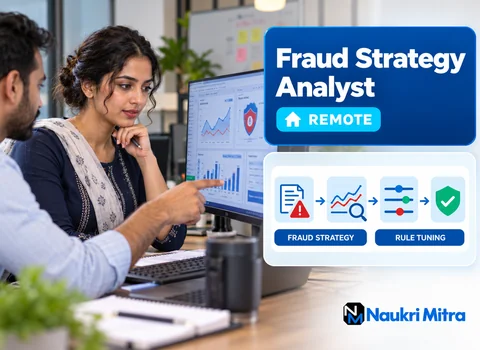
At 02:14 on a Tuesday, the authorisation chart on the fraud dashboard grows a spike: 1,140 payment attempts in eleven minutes, nearly all for $1.00, across 600 card numbers and just four devices. That is card testing, and someone has to turn it into a rule before stand-up. This listing is one of those remote fraud strategy analyst jobs: full-time, fully remote, with a salary of $4,000 USD per month. As one of the fraud strategy analyst jobs remote worldwide, it cares more about your SQL than your postcode.
Strip any fraud strategy analyst job description down and you find one trade-off. Block too little and chargebacks pile up, each costing the disputed amount plus a fee, while the card networks watch your dispute ratio. Block too much and you decline real people, who rarely complain; they simply buy elsewhere.
So you pull transaction and chargeback tables, look for clusters that were not there last month (a new BIN range, one shipping address across forty accounts), write a rule aimed at the cluster, then prove it earns its place. The rules live in Stripe Radar or a similar engine, and the proof in dashboards you build.
Card testers check stolen numbers with tiny purchases. The tell is not the $1 amount alone; it is many different cards from one device inside a short window.
First draft: BLOCK if attempts_from_device in last 10 minutes > 3
Second draft, after a backtest: BLOCK if attempts_from_device in last 10 minutes > 5 AND distinct_cards_from_device in last 10 minutes >= 3 AND amount < $5; otherwise REVIEW if attempts > 5
Replay one week of traffic through each version. The numbers are illustrative, though the shape is typical: 40,000 attempts, 1,800 of them testing.
Draft two lets 50 more testers through and spares about 390 real customers. That one is an easy call; most trade-offs are closer.
Every rule note carries its target, backtest window, expected precision and a review date. A rule without a review date lives for ever, declining a family that shares one tablet.
The fraud strategy analyst skills that matter are unglamorous: SQL window functions counting attempts per device over a rolling ten minutes, joins tying each dispute to its payment, and pandas notebooks for backtests too awkward for the engine.
Stripe's Radar for Fraud Teams supports custom block, review, allow and 3D Secure rules, saved blocklists, and backtests on about six months of past payments. Dashboards might sit in Looker, Tableau or Metabase, with alerts that fire when hit rates or approval rates move.
Like most fraud strategy analyst work from home jobs, this needs dependable broadband, a second monitor and a quiet room for incident calls. Customer data stays inside the team's secure systems, never on a personal drive.
The listing wants a bachelor's degree in statistics, economics, computer science or similar, plus 2 to 3 years in fraud analytics or data analysis. You will need strong SQL and Python, hands-on rule tuning in Radar or a comparable engine and comfort building dashboards. A CFE is a plus, not a gate.
People who do well can tell a product manager, in two sentences, why a rule declining 0.3% of good payments still earns its place. Employers known to hire for this work include payment processors such as Stripe, fraud platforms such as Sardine, neobanks and crypto exchanges. This listing's employer is not named and is none of those.
The fraud strategy analyst salary per month here is fixed at $4,000 USD, about $48,000 a year. Converted at recent rates, that is near ₹3.8 lakh, though the rupee figure moves with the market. Quiet weeks pay the same as incident weeks. Plan some overlap with the team's core hours; attacks ignore time zones.
Analysts asking how to become a fraud strategy analyst already have the hard part. What is missing is domain knowledge and proof.
Truly entry level remote fraud strategy analyst jobs are rare, because a bad rule declines real money on day one. Searches for fraud strategy analyst jobs no experience mostly surface operations roles, which are a sensible first step. This listing asks for 2 to 3 years.
Your fraud strategy analyst resume should lead with measured outcomes from your own work, such as fewer false positives at flat losses. Typical fraud strategy analyst interview questions:
A fraud operations analyst works individual cases, often against a cases-per-hour target. Strategy looks at those cases in aggregate and changes rules so the queue shrinks. Ops usually spots new patterns first, so strategy analysts who sit in on queue reviews write better rules.
Career-wise, the seat grows towards senior analyst, fraud strategy lead and risk manager, or into model monitoring. The Nilson Report put worldwide card fraud losses at about $33.4 billion in 2024, slightly down on 2023 despite higher card spending.
Nothing on this listing costs you a rupee, from application to offer.
Apply through the button on this page; applying is free. Attach a resume with numbers and a note on one rule you tuned. The role is open, but no listing can guarantee selection. Expect a screening call and a SQL or case exercise.